 @stewbits22
more from that month
@stewbits22
more from that month
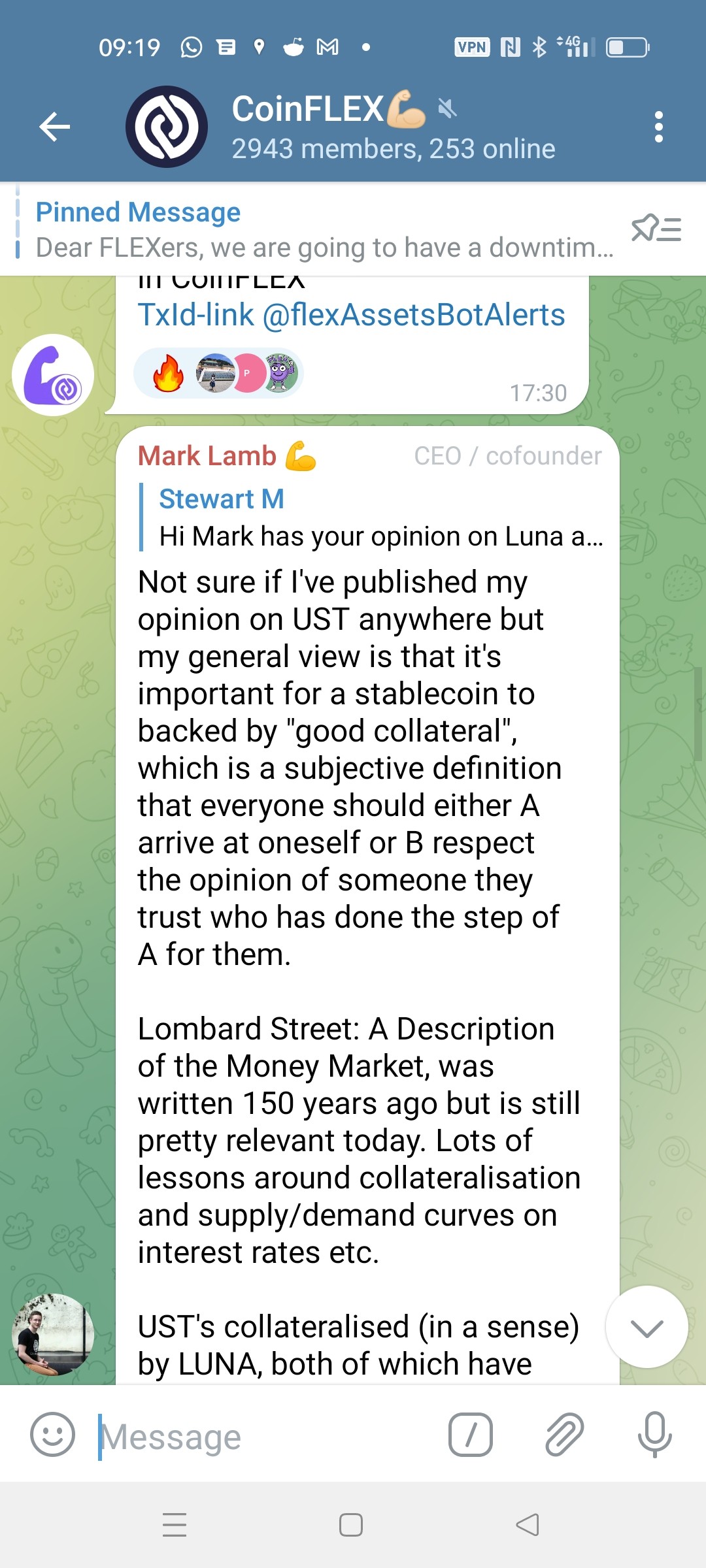
Here is a better description of Luna and UST and it's inherent weakness from a question I asked Mark Lamb: Not sure if I've published my opinion on UST anywhere but my general view is that it's important for a stablecoin to backed by "good collateral", which is a subjective definition that everyone should either A arrive at oneself or B respect the opinion of someone they trust who has done the step of A for them. Lombard Street: A Description of the Money Market, was written 150 years ago but is still pretty relevant today. Lots of lessons around collateralisation and supply/demand curves on interest rates etc. UST's collateralised (in a sense) by LUNA, both of which have been conjured into existence and one of which aims to track a $1 price. LUNA's value really depends on UST demand. If UST is in high demand, LUNA has a upwards momentum (buy pressure) to it, but if UST is in low demand, or is being "redeemed" (redemption occurs in the form of new LUNA being issued and then sold on the market), then LUNA has a sell pressure to it. Much of the UST demand is coming from Anchor: https://app.anchorprotocol.com/ Which is paying a high rate, which is being largely subsidised by the protocol and will run out (has come close to in the past). A few key differences with flexUSD, before we get into what the risks are: UST's collateral, LUNA, doesn't have a fixed $ value. The value goes up and down with the market. Now flexUSD is backed by a basket of repo positions. The crypto in that backing does go up and down in value, but the value of the Crypto + Short Perp positions (we can call this sum, a repo position) doesn't go up and down. TL;DR Lending in CoinFLEX repo is delta neutral. The value of a dollar deployed into CoinFLEX's repo market doesn't change as the prices of cryptoassets go up and down. This is the key difference between UST and flexUSD. flexUSD is backed by "good collateral" and UST is effectively backed by "speculative" collateral (LUNA). UST also has a tail risk which is: What if the main reason people hold UST is to get the yield on Anchor? Certainly the majority of UST are deployed in Anchor. If Anchor's yield reserve runs out and yields go down, do they "redeem" UST and then sell LUNA (because after all, they are dollar yield collectors rather than speculative governance token HODLers)? These are the questions UST holders have to ask themselves. flexUSD holders mainly just have to ask whether CoinFLEX's liquidation engine works correctly and CoinFLEX's insurance fund functions correctly, both of which have had a 4 year track record over some very extreme and aggressive price movements, with huge positions to manage. I think holding flexUSD is mentally easier / more comfortable than holding UST. I also think that experimentation in stablecoins is useful for testing out hypotheses and that from every stablecoin attempt, the market is getting smarter. We're watching economic experiments play out in real time with billions of dollars and that's a great thing for humanity. Humanity is the winner, regardless of what happens. https://t.me/coinflex_EN/110370
No comments yet