 @orxad
edited
more from that month
@orxad
edited
more from that month
What are Altcoins?- what to know about them
**THE DEFINITION** **Altcoins** are basically defined as all other forms of cryptocurrencies that came just after the success of their predecessor- Bitcoin. As the word **'alt'** implies short for **'alternative'**, Most Altcoins usually present/propose themselves as better alternatives to Bitcoin. With each altcoin hoping to address certain flaws and limitations Bitcoin has. Anyway, the fact that the success of Bitcoin as a peer-to-peer digital currency paved the way to the development of the majority of altcoins cannot be rubbed off. **BRIEF HISTORY** Over the years, since the onset of Bitcoin, there have been over **3000** more cryptocurrencies that have come into existence as at this time. While most altcoins were built on frameworks quite similar to that of Bitcoin, they are in most features, different from each other. In **April 2011,** the first noticeable altcoin was created based on the Bitcoin code and with the same proof-of-work algorithm. It was called **Namecoin.** Like Bitcoin, the supply of Namecoin was also limited to **21 million coins** as well. Namecoin can store data within its own blockchain transaction database and it was primarily meant to increase the anonymity of users by allowing them to register and mine using their own .bit domains.
Later in **October 2011,** another altcoin was also introduced- **Litecoin**. Litecoin was created to serve as a 'lite' version of Bitcoin. Just like silver is to Gold. A major advantage Litecoin had was that it allowed for faster transactions than Bitcoin and mining Litecoin required low processing power. Litecoin had a total supply of **84 million** coins, exactly **four times** the total supply of Bitcoin.
**TYPES OF ALTCOINS**
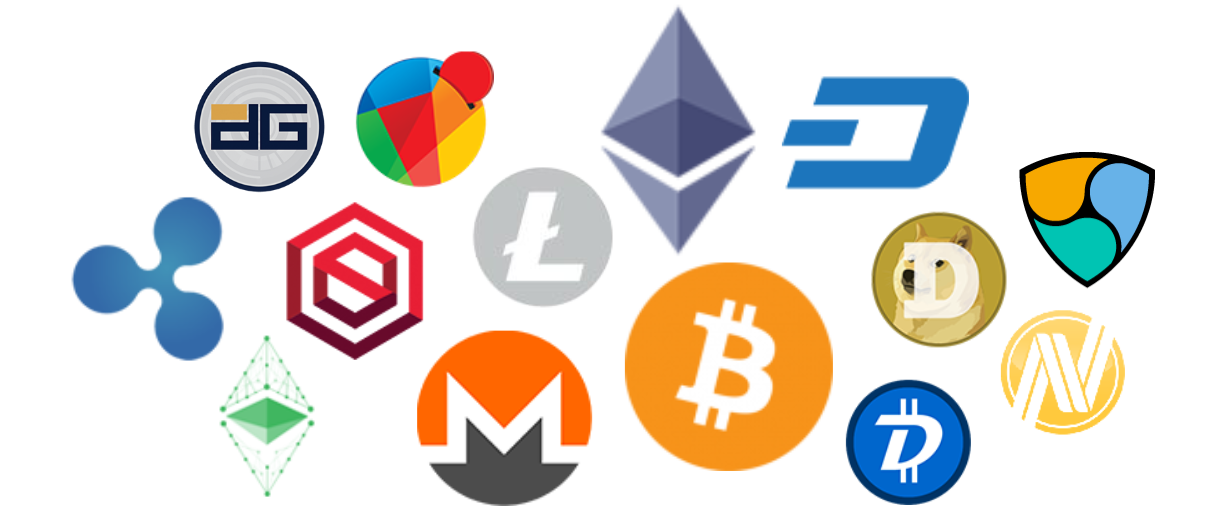
Since the advent of so many Altcoins, a basic classification has been made to help place the various altcoins into groups based on why and how they were initially created; **Mining-Based Altcoins** These are basically altcoins that take after the mining aspect of Bitcoin as a resemblance. **Mining** is the process by which new coins are created by solving challenging cryptographic equations to unlock blocks. Most popular altcoins including **Litecoin and Ethereum** fall under this category. **Stablecoins** Now, these are the particular type of altcoins that aim to fix the issue of the high volatility of Bitcoin and other cryptocurrencies. The idea behind this is to peg the actual value of these coins to pre-existing currencies like **U.SDollar, Euro,** or even real-life assets like **Gold**. Very popular examples of this kind of altcoins include **Tether (USDT) and Facebook's Libra** (yet to be launched). **Security Tokens** Security tokens are types of altcoins that often launch with an **initial coin offering** **(ICO)**. These types of coins are linked to businesses and usually resemble traditional stocks, as they often promise some type of dividend like payout or ownership in a business. An example of this type of altcoin is **Bcap (Blockchain Capital) security token.** https://en.wikipedia.org/wiki/Initial_coin_offering **Utility Tokens** Like security tokens, Utility tokens could also be sold as part of an ICO. A major difference here, however, is that utility tokens provide a claim on services. A good example of this is **Filecoin** which was designed to be exchangeable for decentralized file storage space. **POPULAR ALTCOINS RIGHT NOW;** **Ethereum (ETH)**
Created by **Vitalik Buterin**, Etheruem was introduced in **2013** based on a decentralized protocol allowing for developers to create Decentralized applications (DApps) based on the Ethereum network. Ethereum currently sits beside Bitcoin as the **2nd** most popular cryptocurrency in the world by market cap. **Bitcoin Cash (BCH)**
Known popularly as one of the most successful hard forks of Bitcoin, Bitcoin Cash also still remains an altcoin to be talked about. Since it was initially created in **2017**, it has widely gained various forms of adoption worldwide. It is currently the **4th** top cryptocurrency by market cap. **Ripple (XRP)**

Ripple was created with a goal targeted at providing financial institutions the fastest, most reliable option for sourcing liquidity on demand. It promises faster and scalable transactions than Bitcoin and some other major altcoins. Transactions on the Ripple network basically take seconds to complete. Presently, XRP is the **3rd** top cryptocurrency by market cap. **Tether (USDT)**

Tether is a very popular **Stablecoin** initially backed by the **U.S Dollar**. Most times, at any point in time, 1 Tether should always equal 1 USD. However, **Tether Limited** (The company that created Tether) states that owners of tethers have no contractual right, other legal claims, or guarantee that tethers will be redeemed or exchanged for dollars. **Conclusion** Generally, altcoins are very relevant as each Altcoin is essentially unique, and tends to propose, in its own way, how it can solve one Bitcoin limitation or the other. Over the years, altcoins have proven to be good forms of investments generally as far as the crypto space is concerned. **Thank you for taking the time to read this. You can share your thoughts in the comments section, I'll be waiting!**

2 comments
> It is currently the 4th top cryptocurrency by market cap. You got that right
Thank you very much 😊