 @ms16969
more from that month
@ms16969
more from that month
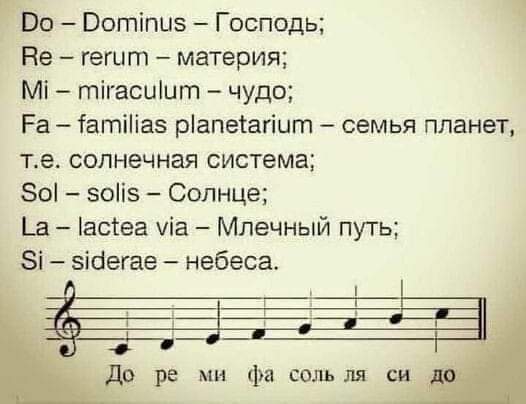
Who invented musical notation and why exactly Do-Re-Mi-Fa-Sol-La-Si, and what the names of the seven notes actually mean. The inventor of the world-famous musical notation is the monk Guido Aretinsky, who lived in 991-1060 AD. Music notation originated near Florence, a small town in Tuscany - Arezzo. A monument to a monk is erected in Florence. Guido was a teacher of music and choral church singing at various churches. Once, trying to come up with an easier way to memorize unfamiliar melodies for chanting, Guido came up with a system of solmization based on the acrostic prayer to John the Baptist. The names of all notes, except for the first, end in a vowel sound, they are convenient to sing. The syllable ut is closed and it is impossible to sing it like the others. Therefore, the name of the first note of the octave, ut, was replaced in the sixteenth century with do (most likely from the Latin word Dominus - Lord). The modern interpretation of the note names looks like this: Do - Dominus - Lord Re - rerum - matter Mi - miraculum - miracle Fa - familias planetarium - a family of planets, i.e. solar system Sol - solis - Sun La - lactea via - Milky Way Si - siderae - heaven Thanks to the authority of Guido, the Latin letter notation established itself as generally accepted in Western Europe and continues to this day. Among other things, Guido also has a great merit in the progress of the written part of musical notation. Subsequently, Guido began to mark sounds with notes (from the Latin word nota - a sign). Notes, shaded squares, were placed on a stave, consisting of four parallel lines. Now there are five of these lines, and the notes are depicted in a circle, not a square, but the principle introduced by Guido has remained unchanged. 🎼 🎶
No comments yet