 @merurial9
more from that month
@merurial9
more from that month
The Myth of the $75,000 Happiness Benchmark In our never-ending pursuit to understand the connection between **wealth** and happiness, there is a widely discussed notion that suggests reaching an annual income of $75,000 is the pinnacle of joy. However, let us delve deeper into the research and misconceptions surrounding this monetary benchmark. https://leofinance.io/@leoglossary/leoglossary-wealth **Source** https://www.cnbc.com/2023/03/28/how-your-salary-affects-happiness.html#:~:text=Psychologists%20have%20long%20agreed%20more,even%20if%20your%20income%20increases. **Disproving the Illusion of $75,000**

Primarily, it is important to clarify that the frequently cited $75,000 benchmark for happiness stems from a study conducted in 2010 by Daniel Kahneman and Angus Deaton. Contrary to belief, this study did not state that **money** has no bearing on happiness. The study itself declares that high income improves quality of life but not emotional well-being. In terms, it suggests that while a higher income may not guarantee happiness in our day-to-day lives it does contribute to a more positive long-term outlook. https://leofinance.io/@leoglossary/leoglossary-money **Source** https://news.gallup.com/businessjournal/150671/happiness-is-love-and-75k.aspx#:~:text=interesting%20findings%20Dr.-,Kahneman%20and%20Dr.,and%20emotional%20well-being%20questions. This phenomenon is linked to what psychologists refer to as the hedonic treadmill. Humans tend to return to a level of happiness regardless of significant life events—whether they are positive or negative. For example, winning the lottery may initially bring joy. Over time that elation diminishes gradually. Similarly, the impact of losing a job can affect one's happiness. With resilience, it is possible to bounce back but difficult for most. **Source** https://www.healthline.com/health/hedonic-treadmill **Beyond Psychological Aspects** The significance of the $75,000 figure goes beyond being a number. It represents the point where financial constraints no longer dominate concerns but can still pose obstacles, to achieving long-term goals like buying a house, paying off debts, retiring comfortably or exploring the world. However, it is important to acknowledge that this study does not offer a solution. It was based on 709,000 households. Assumed they were all similar. Earning $75,000 can have implications for an individual professional with minimal expenses compared to a family of five living in an expensive city. **Time - Often Overlooked Factor**
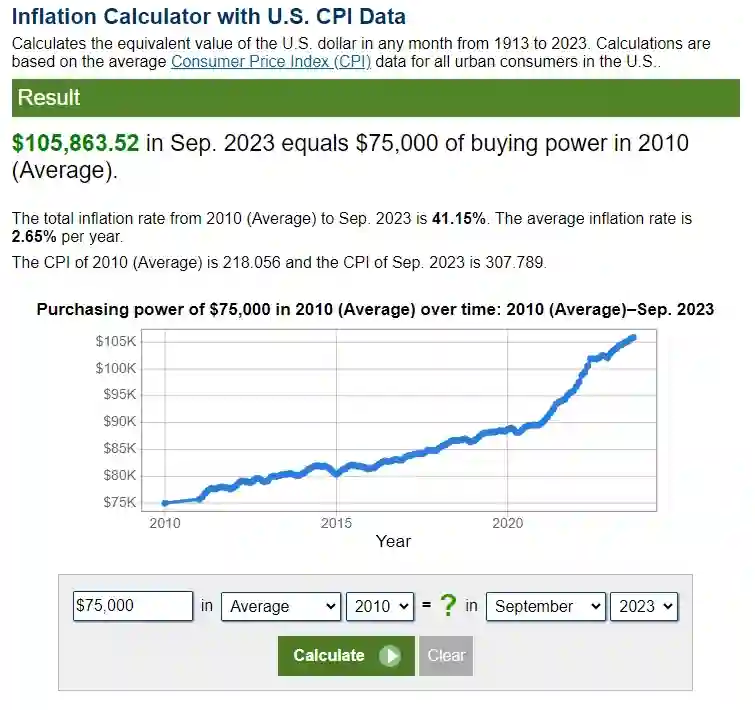
**Source** https://www.calculator.net/inflation-calculator.html?cstartingamount1=75%2C000&cinmonth1=13&cinyear1=2010&coutmonth1=9&coutyear1=2023&calctype=1&x=Calculate#uscpi Let us not forget another aspect - time. The study was published in 2010. Considering inflation rates since then $75,000 in 2010 would equate to around $105,863.52 today. Therefore, the benchmark holds more significance than initially perceived. Additionally, it is worth noting that this study took place during the crisis when layoffs were prevalent and there were stock market crashes and home foreclosures. The harsh circumstances significantly eroded people’s sense of happiness. For those with incomes, the impact was less severe because they had possessions at stake. **The Pursuit of Eternal Contentment** So how much **money** is sufficient to achieve happiness? The simple answer is more. Recent research on this topic reveals a correlation between income and happiness. Negative emotions. There seems to be no limit. However, the connection between **income** and happiness is not linear. An individual who increases their **income** from $25,000 to $50,000 may experience a 50% increase in happiness. In contrast, someone moving from $225,000 to $250,000 would not notice a difference. The crucial factor lies in predictable increments in **income**— rewards that sustain the flow of happiness. https://leofinance.io/@leoglossary/leoglossary-money https://leofinance.io/@leoglossary/leoglossary-income **Source** https://hbr.org/2020/09/does-more-money-really-makes-us-more-happy **Happiness is a Complex Puzzle**

While it is undeniable that income influences happiness, it is one piece of the multifaceted puzzle. The original study found that income accounted for 37% of variations in happiness. The remaining 63% rely on factors such as health, relationships with others, spirituality and achieving a work-life balance. A person who has an **income**, and healthy and fulfilling relationships might find more happiness compared to a wealthy individual who is burdened by stress and loneliness. https://leofinance.io/@leoglossary/leoglossary-income

It is important to recognize that life’s complexities go beyond benchmarks like $75,000 being the key to happiness. **Money** certainly plays a role, in happiness. It is just one piece of the larger puzzle. The pursuit of happiness is a nuanced journey that does not have a one-size-fits-all solution. Now I am curious as to what amount you consider as your personal happiness factor. https://leofinance.io/@leoglossary/leoglossary-money Thank you for reading and hope you have a good rest of the day! Follow me on these other platforms where I also post my content: **Publish0x** || **Hive** || **Read.Cash** || **Noise.App** || **Twitter**|| **Torum** https://www.publish0x.com/@aftershock9?a=Vyb82ANmev https://hive.blog/@mercurial9 https://read.cash/@merurial9 https://noise.app/mercurial9 https://twitter.com/minimalistpixel https://www.torum.com/u/mercurial9
No comments yet