My Programming Journey!
var data = [{
'name':'Destiny',
'date':'2020-07-03',
'username':'lilsoftx'
}];
Good day all, I know some might see what I wrote above a weird or so but it's totally isn't.
I haven't really needed or had any reason to share my programming experience here on read.cash yet but after seeing a an article written by @Dangerous_Fly, on his programming journey and experience I felt the need to write this.
I dived into the world of programming when I was 16years old. Though I had eyes on it long before then but based on my country status, I didn't have such privilege at such an age. So I had to hold on to that dream and Passion until I was old enough and had the right resources to get started.
So just after my high schools days, my dad was able to afford a desktop computer which i started working with, initially I used it for playing video games and watching movies but I soon became bored and felt I wasn't doing anything productive with my life while I wait to get into the university. So I started searching on the net on how to create my own games of which I love playing back then.
After days of searching, I discovered I can't just start building games, I had to first understand the programming world by going back to the bare basics, which is HTML and CSS.
I then decide to go with it since it would lead me to where I wanted to be. I search on YouTube for tutorial on learning HTML and CSS, and the best I saw at the time was tutorials by Quentin watts, he was the one who got me started on my journey because his tutorials was so relative like he was talking to me in person.
I later completed my training on HTML and CSS to an intermediate level and I was able to clone some websites though initially it took a while to clone some websites like e-commerce websites, I had to toil for hours before actually figuring out the issues sometimes and when I finally get it, it's always worth it.
So I moved on to PHP skipping JavaScript, since I wanted to test out how forms are handle because it was so interesting to me after seeing some tutorials by Quentin watts. So I got on that train too and started learning it.
Along the line my desktop crashed beyond repair for reasons I can't explain. At the time I was so fraustrated because I felt I would never be able to catch up again knowing fully well my dad couldn't afford to buy me another pc, I was so sad for days, I decided to start visiting friends who I knew had a PC or brothers had a PC. Sometimes I was allowed access to their PC other times I wasn't. I noticed it still wasn't working out because the learning process was so slow, I learnt only twice a week or three times in two weeks.
It then dawned on me that I would soon lose what I have passion for because of faustration, so I told my mom I would like to work and save money to get my own PC, and she agreed. She spoke to her friend who was a principal and she asked me to come with my WAEC result, jamb result and CV of which I did. I was given some problems to solve and I breeze through them.. she was really impressed and took me to teach basic 6 students which was the highest position available in the school as at then. She said since I was so good in maths she wanted me to teach her student because they where not so strong at it yet and they have their common entrance exams coming soon. So I took the job and started teaching basic 6.
This article is getting really long. I know how tiring it can be to read something that's really long even if it's interesting. So I would stop here for now and continue on my next article - look forward to that;
***Thanks for reading***
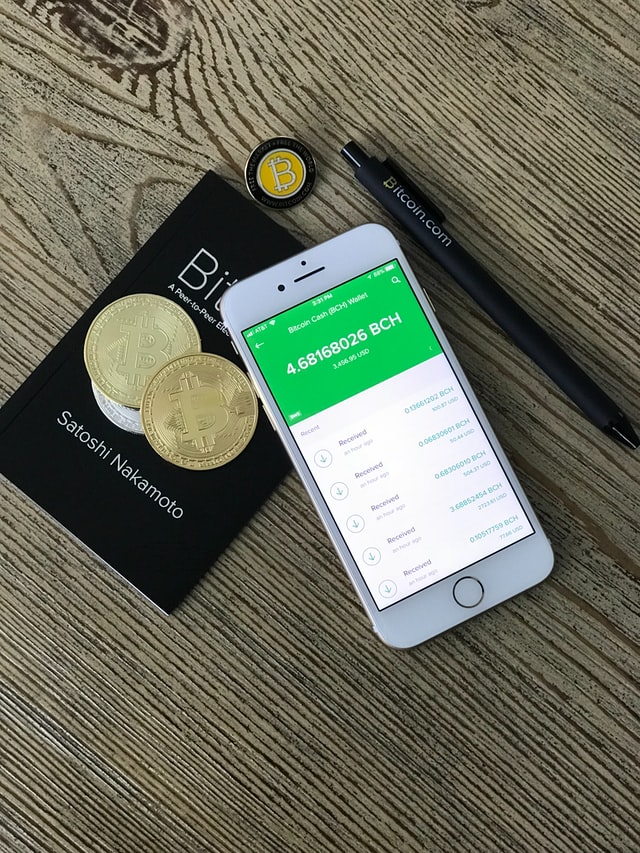
Demystifying Bitcoin Cash
As at the time of writing this article, Bitcoin Cash is said to be the fifth most valuable Cryptocurrency, with a daily trading volume of about $1.4 billion dollars, and also with a market capitalization of $4.4 billion.
The price of Bitcoin Cash is not so volatile as compared to it's older brother (Bitcoin). It is significant to note to that BCH has risen quite well in it's price, as at March 13th, Bitcoin was trading at $152, but now it's about $225.
Bitcoin Cash recently did breach the resistance level of $235 and as it did so, crypto investors and traders channelled their focus to Bitcoin Cash thereby making it even exceed the strong resistance level of $250. Though Bitcoin Cash dropped in value some weeks back but it's an opportunity for investors like myself who was recently inspired by @MarcDeMesel to invest into Bitcoin Cash now before it increases again.
If you are not financially buoyant just like myself then I employ you to invest more time on read.cash now and make some BCH for yourself which you can invest. Even if you won't take it from an ordinary person like me take it from the major sponsor of this platform who has invested a lot into this Cryptocurrency because he believes in it success. The right investment pays.
So still on Bitcoin Cash, it was first designed around 2017, from a fork of Bitcoin. More transactions can be carried out on Bitcoin Cash block per time compared to Bitcoin because it's has a much larger block size of 32mb while that of Bitcoin is still same 1mb and refusing improvement.
Bitcoin Cash has it's very own ledger system or block chain. The major difference between Bitcoin Cash and Bitcoin is that transfers on Bitcoin Cash are more cheaper than that of Bitcoin which is around $0.1 - $0.2 that is per transaction, thereby making investors and traders to be more attracted to it. Since they could be carrying out multiple transactions, it makes sense to go for that which offers less fee and more speed.
Bitcoin Cash is also know as Bcash. So next time when you hear the name Bcash don't get confused thinking it's something else. It's our very own Bitcoin Cash.
Thanks for reading and hopefully I was able to demystifying some confusions you might have had about Bitcoin Cash and also motivated you to invest It.
***Bitcoin Cash is the future invest now***
How to prepare the Nigerian Egusi Soup
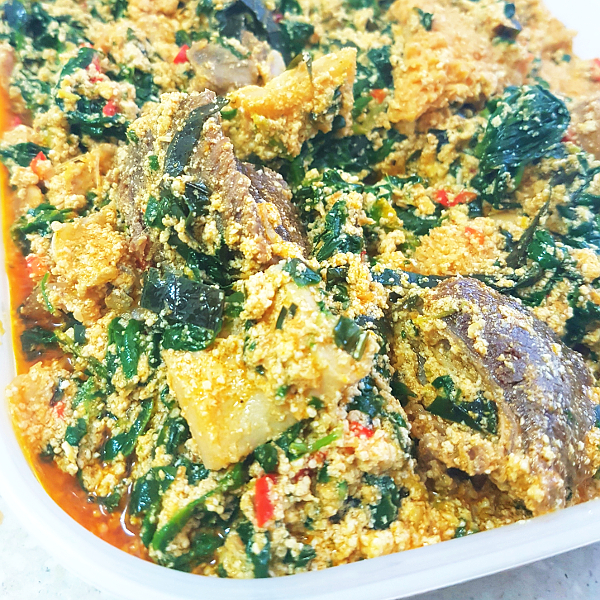
Egusi soup is one of the most recognised soup in all of Nigeria and even to other African countries. The taste of this soup would make you keep coming back for more. I remembered a day I the Egusi soup 3 times, in the morning afternoon and evening. That was to tell you how delighted I was with this delicacy. Though it really weighed me down because I ate it to much but hopefully you get my point. It's a really wonderful delicacy and it can also be prepared in different ways. Some of these ways include:
Caking Method
Fried Egusi
Akpuruakpu Egusi
Those are the three(3) major ways of preparing the Nigerian Egusi soup. This soup can actually also go with Eba, fufu, pounded yam, semovita, amala and I have even seen someone eat it with starch but I can't vouch for that because I haven't eaten it with starch before.
So for today we would be taking a look at the caking method of making the Nigerian Egusi, in another article we would also discuss the others on the list so look out for those. Now let's get out ingredients for cooking this soup ready.
**INGREDIENTS**
red palm oil
Beef
Fish (dry and/or stock fish)
Vegetable
Egusi (Melon) seed
Ground crayfish
Dry pepper
Salt
Onion
Seasoning Cube
Good! Now all our ingredients are ready. it's time for part, lets get cooking. First things first we have to handle the melon seed, dry fish and/or stock fish, dry pepper and vegetable.
For the melon seed you blend it with a dry mill, then also grind the ground cray fish and the dry pepper too. The vegetable should be sliced into smaller pieces, then you need to sock the dry fish in warm water for about 20 minutes and the stock fish for about 30 minutes till its breakable by hand.
**So we are all set, lets get cooking:**
Boil the stock fish, dry fish and the beef to be used for the soup add salt, seasoning cube and onion, boil at medium heat so the beef doesn't get too soft. when done remove the beef, and dry fish from the stock(the residue water used in boiling the meat and fish) and place in a different pate.
Now add the ground cray fish and pepper into the stock still in the pot. Add the Egusi also and stir, you can also add water at this stage to give it a bit of smoothness to your liking. Once it is to your liking cover the pot to keep boiling until it cakes, ensure you watch it closely so it doesn't get burnt also you can add water if necessary.
Add water at interval for about 25 minutes then you would notice the clear Egusi oil floating to the surface.
Add red palm oil and bitter leave, pepper, seasoning cube, salt to add taste to your liking. Cook for about 10 minutes then you should notice when the Egusi and oil forms a blend of light yellow color. Then you are good to proceed.
Add the cooked meat and fish and any other soft vegetable you might have, and stir the soup. Leave to boil for about 3 minutes at most. Then turn off the cooker and your food is ready. After cooking leave for about 5 minutes before serving it. It can be serve with virtually any swallow like Eba, fufu, amala, semovita, pounded yam and others.
**Enjoy!!!**
The Nigerian Banga Soup Dish
Hello friends,
So today I would be taking us down the road of how to prepare what we know as Banga in Africa.
Quick disclaimer this is my favourite local ditch so don't get upset if I over rate things but I am sure after reading this you would be able to prepare your own Banga soup quit nicely.
I have been having this delicacy since I was a little kid, my mum was a pro at this soup that she was able to convince my dad to start eating it. Initial my dad was not a fan of this soup because he said he didn't like the fact that the soup was so watery but my mom being a pro that she was at this particular dish(you should understand how moms cooking are as a Nigerian), she prepared the banga soup and dished dried it in a local pot known as ewere so as to make it really thick. She then served this delicacy to my dad, he had no choice but to eat the meal after see how delicious it looked, lo and behold from that day onward my dad started eating the soup and even enjoyed it more than others in the house.
So enough of the stories I know you guy want to learn how to prepare this awesome delicacy. well to get started on this meal, you need to have some thing ready. I would try and explain the some what not so common ingredient for those who are not familiar with local Nigerian spices.
**INGREDIENT:**
Palm fruit (canned or fresh)
Banga spice (These can be bought or you can make yours by grinding Ataiko and Irugeje in a drill mill)
Beletete (bitter leaf or scent leaf can also be used)
Oburnubebe stick (optional)
Fish (Mostly fresh catfish is used but any other fresh fish can be used)
Beef (This is what we call assorted in Nigeria, It includes shaki, liver, floater, kidney, cow leg and so on)
Shrimps (mostly fresh)
Smoked fish
Periwinkle (optional)
Maggi (seasoning cubes)
Salt
Onion
Water
while these might seem a bit much, you would come to know that it is all worth it when you are done.
**How to Cook the Banga Soup**
Firstly we need to season the beef (assorted beef) and dried fish by boiling. So get them in a pot add some water no too much but enough to boil it to tender add salt, water, onion and maggi (seasoning) cubes.
So if you are making use of the fresh palm fruit then you would have to pound it with mortar and pistol to seperate the fruit shell from the nut. What is needed hear is the shell and not the nut, so we wash this in a way that seperate the shell from the nut. After this process is complete we pour the residue of liquid washed from the palm fruit into a pan(pot), boil for about 20 t 3o minutues.while it boils you are advice not to cover it with so it does boil over and also to reduce the chances of this happening you could also but a wooden spoon it.
You would notice now at this point that the palm fruit extract bubbles up and oil starts floating above it and it starts to thicken. Now you can add your periwinkle and beef and cook for another 1o minutes.
Now add the Banga soup spice and Oburunbebe stick and leave to boil for another 10 minutes. This Banga spice gives the soup a very rich aroma like you can almost taste it in the air.
Add salt and seasoning cube to your taste. Stir in between to avoid soup sticking to the bottom of the pan.
So once we are satisfied with the result we can move on to adding the fresh cat fish, beletete or bitter leaf. Leave this to boil for another 10 minutes. This shouldn't be stirred at this stage so as not to scatter the fish but if need be you would have to be really careful or you could twirl the pan a bit.
Your Banga soup is ready! It can be served with any swallow of your choice like Eba, pounded yam, starch, fufu and so on.

Read.Cash got me restless last night!
Good morning friends,
I had to write this so early this morning because it really got me fraustrated last night I didn't even sleep well just thinking about it.
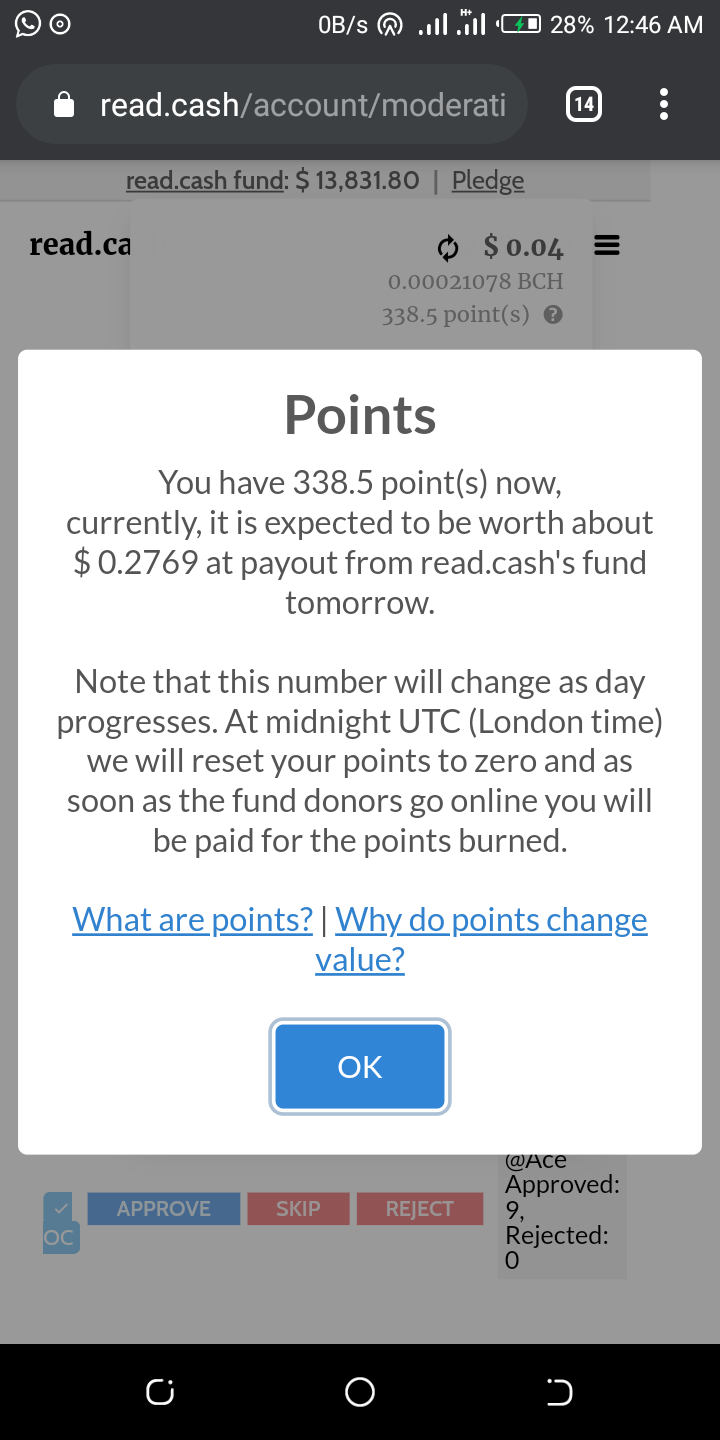
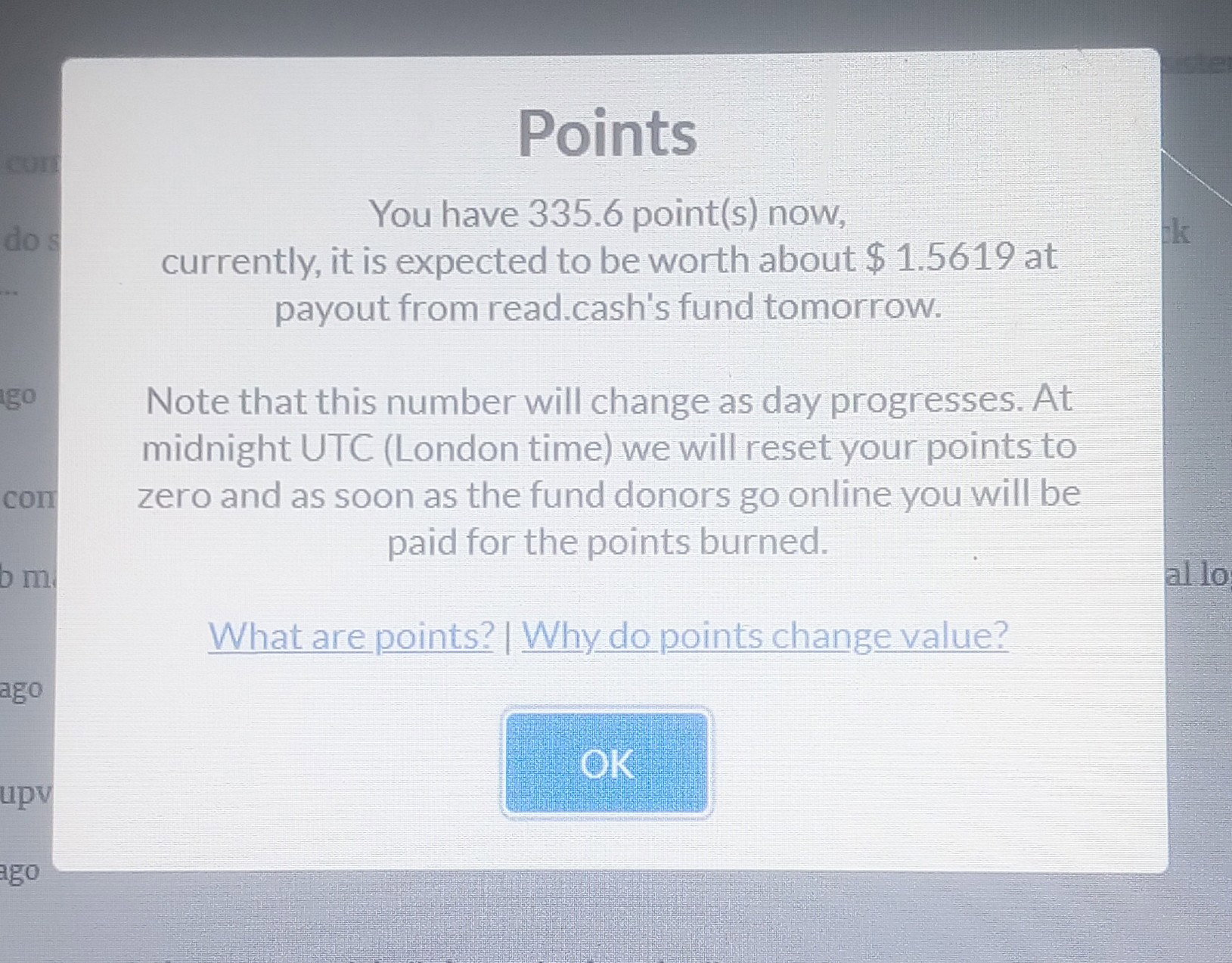
So yesterday I met with a friend I invited to read.cash and along the line we started sharing our experience on read.cash so far... I then discovered something really alarming. My friend was earning way more than I did... The difference was so much that I had to feel really bad. Let me share with you what I discovered:
The first picture there is mine while the second picture is from my friends account. I had 338.5 points and I earned $0.2769 while my friends had roughly the same points at about 335.6 but earned $1.5619 for it.
This really mad me sad yesterday, this is actually a Friend I referred to the platform but for some reason my earning just dropped drastically... I don't know if i did anything wrong on this platform. I have been on this website for about 2weeks now and ever since then I have been putting in my all to make the community grow. I have made sure I didn't break any of the rule set by the read.cash team. I have referred a lot of my friends to this platform:
As you can see I have referred 45 of my friends so far... You can see I am putting in my best... I try to improve on my self daily and make my articles valuable to my readers and supporters but for some reason my earnings just keeps reducing... It seems like the more effort I put in, the less I got. Please I would like to appeal to the @Read.Cash team to help me out by telling me what I did wrong that is affecting my earnings negatively so I know how to improve and so I don't make those mistakes any more.
Please if anyone else in this community knows why my earnings are this way also help I would really appreciate it. It really got me sleepless last night just thinking about it. Please help me!
Affiliate on read.cash
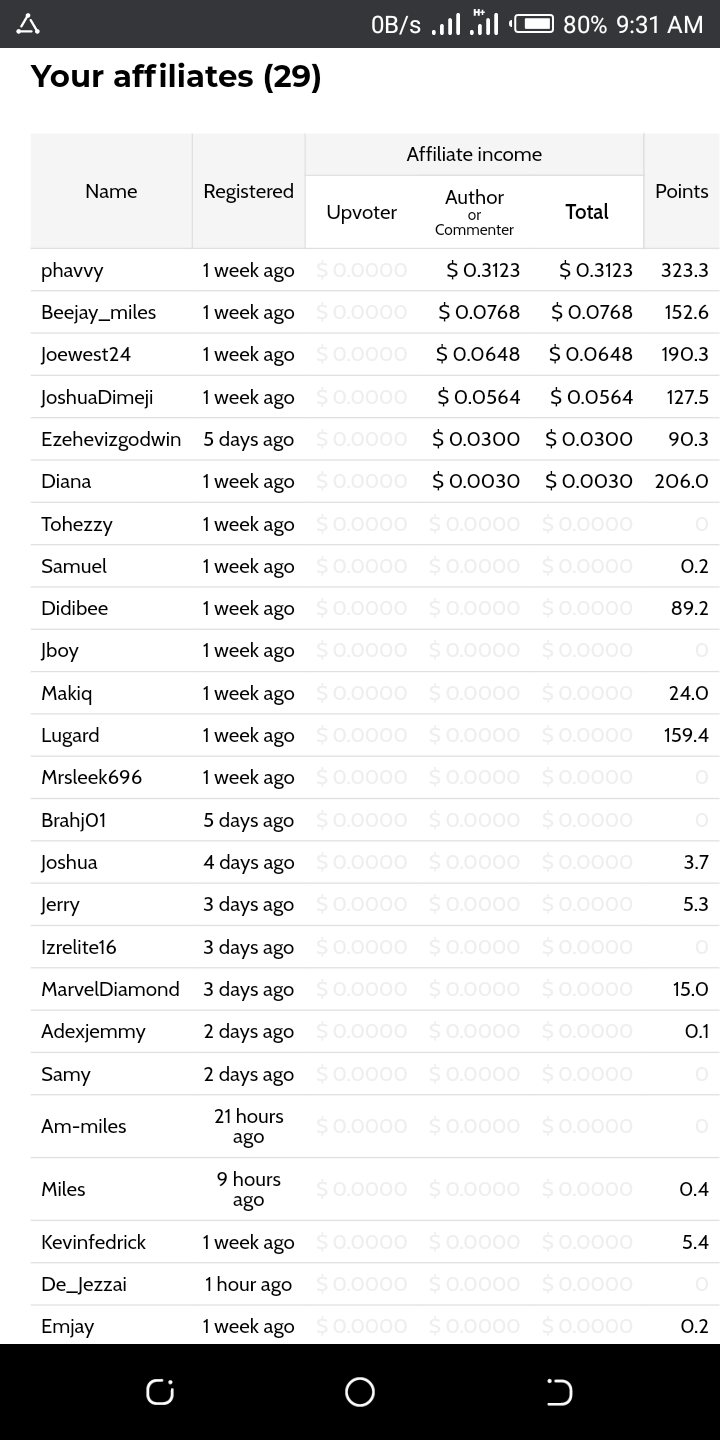
I just woke up this morning and went over to my affiliate page on read.cash, I was really surprised at how many of my social media friends have adopted read.cash and are earning and making good use of their time in the internet. I love what you guys are doing here @read.cash now we don't have to waste our time on the internet... We can share our thoughts and value able contents and earn from it. We sure would do our best to make this platform grow to it full potential. Let's all work together. Invite as much of your friends as possible.
The church!
We all know a church is a place of worship where believer if a particular religion come together to carry out various activities in reverence to their God.
Looking at a Christain... What does it mean to call yourself a Christain?
Well to the best of my knowledge I would say a Christain is a person who potrays the chharacter and attributes of Christ. Christ which is also known as Jesus to Christain's .
Someone who lives in Nigeria is a Nigerian, someone who lives in America is an American so also someone who live in Christ is a Christain.
When you talk about what a church is? It's not real the structure or the building where Christain's come together to worship. A church is it's members. A building is called a church because of the member and the activities they carryout in it. Take the members from the building and it no longer become a Church. It's like same thing for a forest. A forest is called a forest because of the numbers if trees in. It, take the trees away from the forest and it would no longer be a forest.
The church is a place of worship and as Christain's you are expected to fellowship. It's is possible that there is still restrictions in your country so you decided not to go to church but I tell you that you are wrong. You can decide to fellowship right in your house and the lord would accept it. The Bible say if two or three are gather in my name I would be among them. So you have no excuse as a Christain fellow today with your creator.
***You all have a lovely Sunday. Peace.***

The church!
We all know a church is a place of worship where believer if a particular religion come together to carry out various activities in reverence to their God.
Looking at a Christain... What does it mean to call yourself a Christain?
Well to the best of my knowledge I would say a Christain is a person who potrays the chharacter and attributes of Christ. Christ which is also known as Jesus to Christain's .
Someone who lives in Nigeria is a Nigerian, someone who lives in America is an American so also someone who live in Christ is a Christain.
When you talk about what a church is? It's not real the structure or the building where Christain's come together to worship. A church is it's members. A building is called a church because of the member and the activities they carryout in it. Take the members from the building and it no longer become a Church. It's like same thing for a forest. A forest is called a forest because of the numbers if trees in. It, take the trees away from the forest and it would no longer be a forest.
The church is a place of worship and as Christain's you are expected to fellowship. It's is possible that there is still restrictions in your country so you decided not to go to church but I tell you that you are wrong. You can decide to fellowship right in your house and the lord would accept it. The Bible say if two or three are gather in my name I would be among them. So you have no excuse as a Christain fellow today with your creator.
***You all have a lovely Sunday. Peace.***

Wrong idea being passed on about love!
This article came into mind as a result of someone else's article posted on this platform... On my community actually. After going through the article I wasn't pleased, not like what she said was wrong or anything. All she said was right but she was one sided.
The writer in the article said how she has fallen in love over and over again and has at each instant been disappointed and heart broken to the extent that she has decided to never follow or love any man again that she now prefers to be with women instead and on that article she was also advising other ladies to be careful of men that they are cheats and back stabber's and heart breakers but personally I don't think that was right.
In life there is always more than one way to go about things, I get the fact that she was speaking from experience but other people have their own experiences too.
Let me share this story with you. I know of a man who leaves some block away from my house. This man had a girlfriend that he trained all through the university because her parents couldn't take care of her due to financial issue, with the hope of getting married to this girl after her university program. He kept on patiently waiting for her to round up and at the same time taking very good care of her needs. After she finally rounded up with her course he proposed to her of which she accepted. On the day which he was suppose to be their traditional wedding, the man and all his family members went to the girl's house to fulfill all the rights and customs, only for them to get there an see somelse already getting married to the same girl. The man was so devastated that he almost took his life but was stopped by the timely intervention of people around.
After that day the man swore never to look at any lady again. He said he would be alone for the rest of his life and truly he has been single ever since.
So you can see how that lady ruined a man's life even after all he did for her. So most times there is a lot that goes into life. So we shouldn't look at things fron only one perspective. All that matters is that we are careful when it comes to love and emotional matters because anything can happen at anytime, and that situation alone can change your life either for the better or for worse.
***The key to your heart is in your hands, Use it wisely.***

Husband or Wife, who Should die first?
So I I know the topic really sounds wierd but trust me if you think about it for a while you would really find yourself confused.
The idea of getting married to your one true love, your missing rib, and all all is a beautiful scenario but what happens when kids start coming in. Things begin to change a bit, now you have something all so precious that you have to protect because it was formed out of you.
Moving on now there is a child in the home or even children, then Parents starts getting old and definitely would get to the point where they would have to leave this world but would be preferable to go first?
Considering the fact that there are kids now involved and not just the two lovers anymore... Who would be more better for the children to have look after them when the other is gone.
Sorry for this but it's only just an imagination, it's like being ask to pick between your mum and dad.. who would you want to take care of you as a kid?
So I know there are a lot if definitely situation around this that could change the option choose but thinking from the point of the child's future... Whom do you think would be a better fit to stay behind and take care of the child? Who would be able to to take care of the child more in a way that the child wouldn't suffer much both financially and emotional.
Most time we hear of kids who lost one of their parents and after then their lives where ruined and they couldn't do well but do you think it would have had any different result if the other parent had stayed back and the current one gone.
Well, personally I couldn't answer this question, I have been pondering on it this for days but I just couldn't pick one. I just love them both so much that loosing either if them could affect be wrongly. So I just decided to drop something on it here and we if you guys have a different opinion or perspective that could make someone know which to choose. Not like I am saying anyone should choose between their parents, Don't get me wrong but just ponder on this and see what play out in your mind.

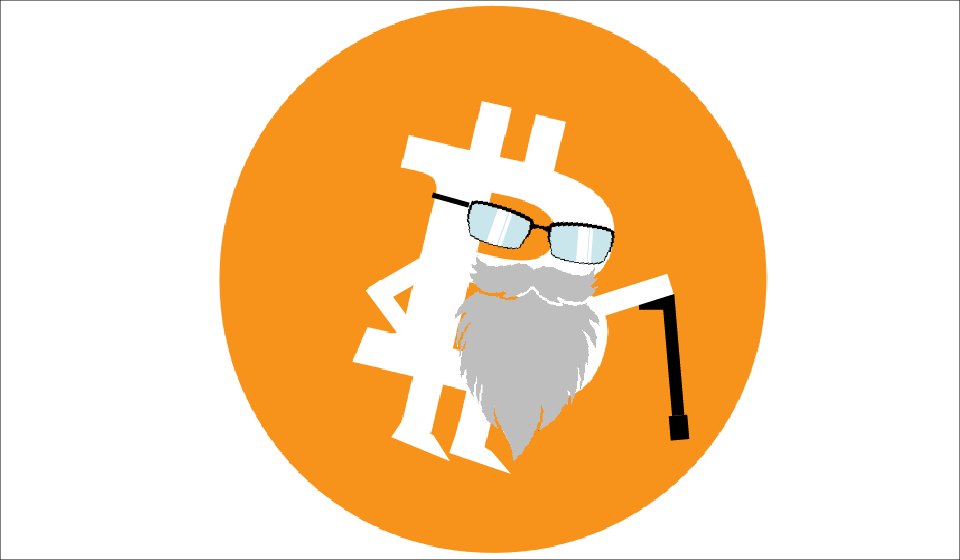
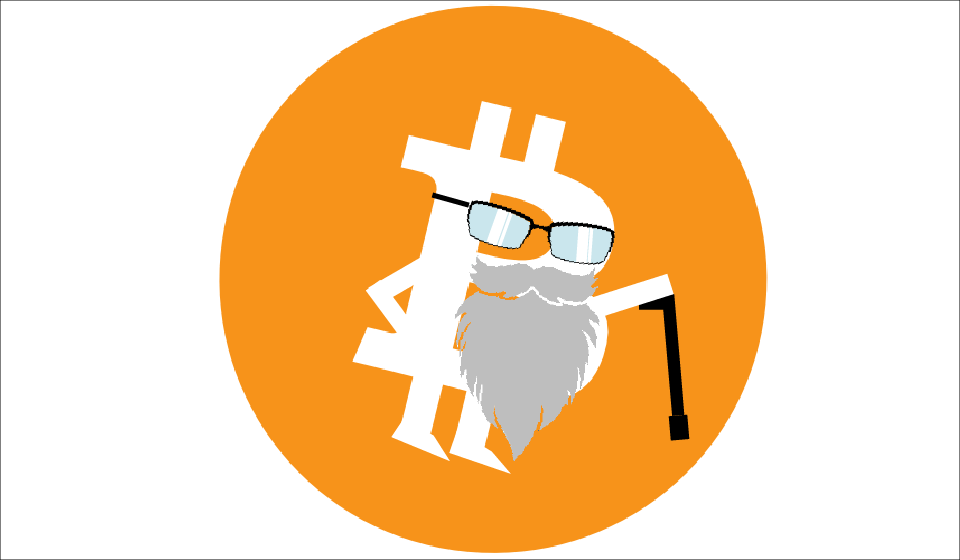
The Old Bitcoin
Hello @Cain, this is my own design... I gave it my all... It sure was fun to work on. Hope this old Bitcoin doesn't fall down!😅
I think its a bug?
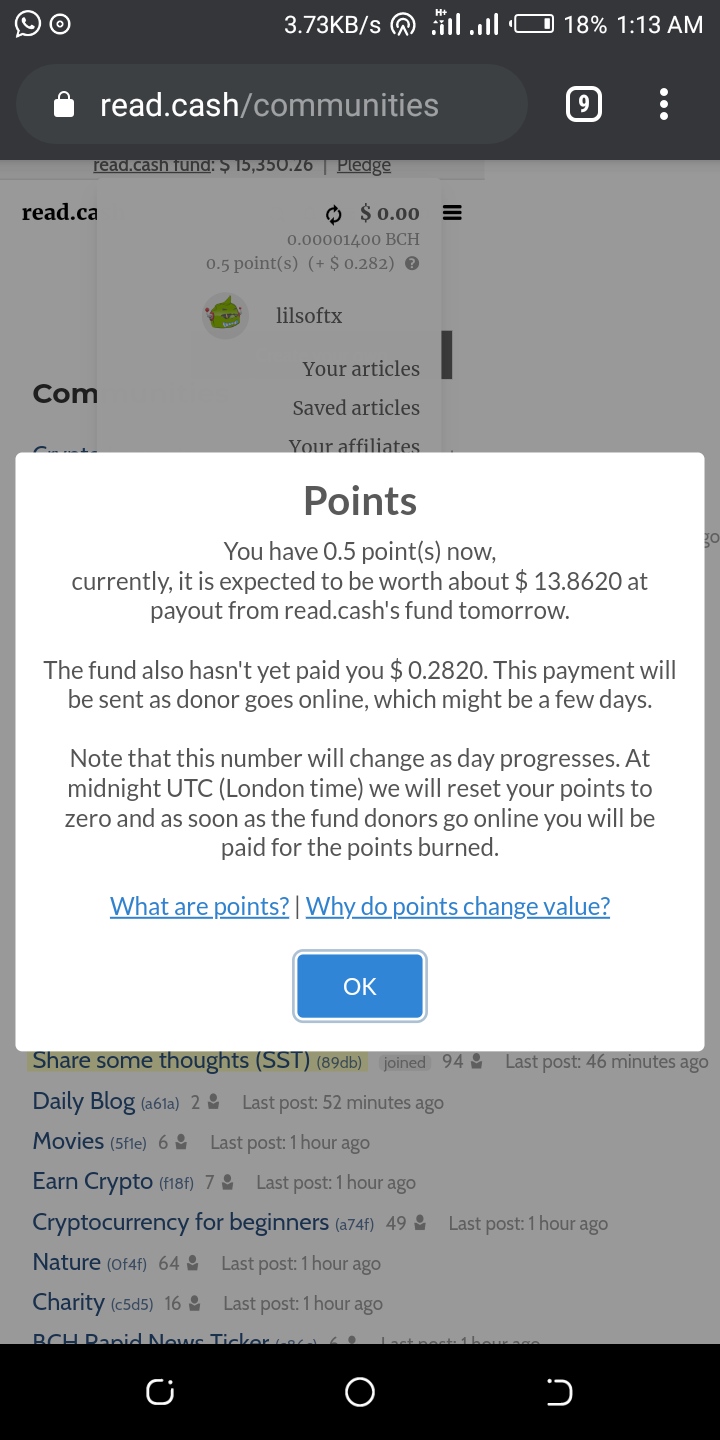
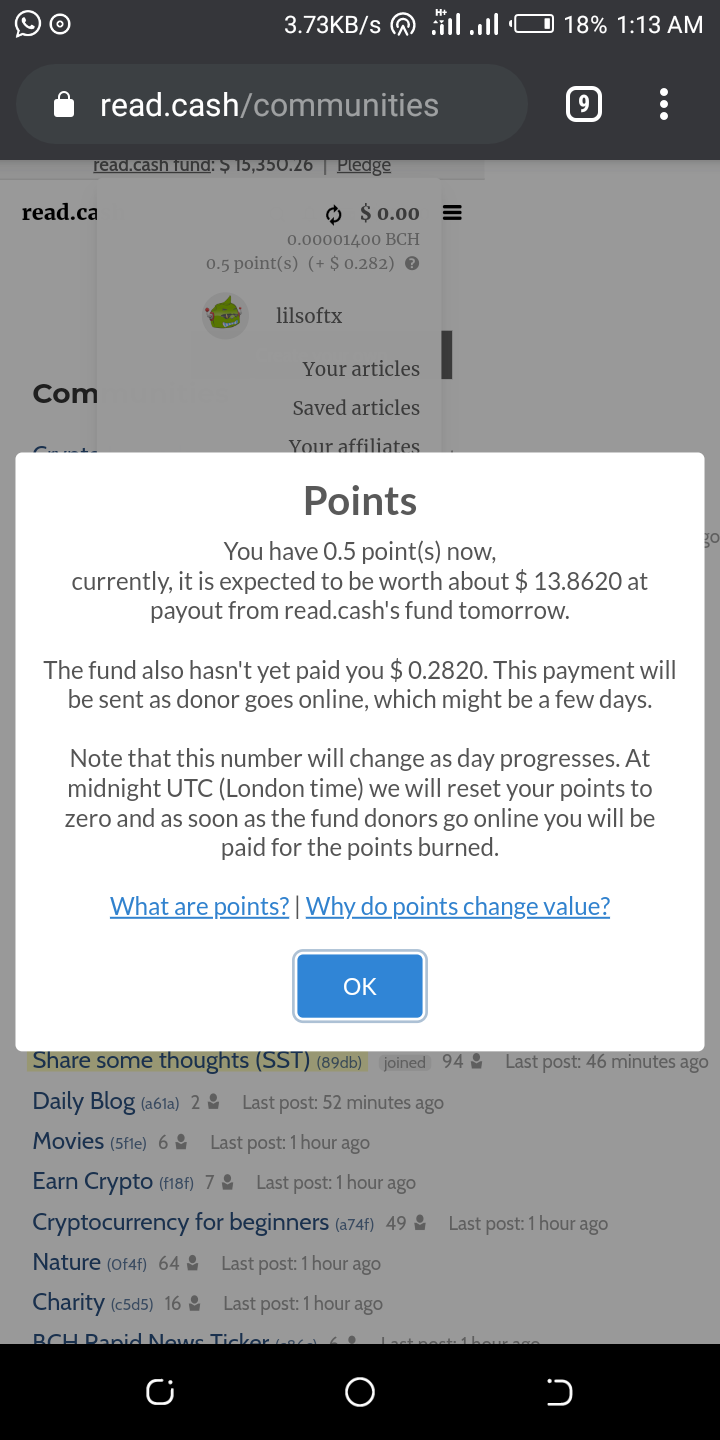
I kept noticing the same bug Everytime just after my points are cleared. Read.cash team please check it out.
The picture above you can see that I have above $13 for just 0.5points which is obviously wrong according to the point system. It happens almost all the time.
read.cash is going viral for our good?
Hello guys, today I am gonna share some of the pictures of how I promote read.cash on my social media page with my friends and family.
Most of my friends on social media are really gaining interest in read.cash after seeing proof of it's originality. I advices all to share our proof of earning in on our social media pages so as to convince more people that real.cash is real there by creating more awareness and growing this great platform.
**read.cash** is awesome. Let's join hands together and make it the best.
Procrastination!
Procrastination is present in all of us in one way or the order. Though some of us might procrastinate unknowingly thinking it's a normal thing but still it is procrastination.
**WHAT IS PROCRASTINATION**?
Procrastination can be seen as the action of postponing or pushing forth activities to be done at a later time.
Procrastination is an enemy of success. Procrastination can make you miss a life time opportunity. Procrastination can make you miss your true love. Procrastination can make you miss heaven. Procrastination can make you not to fulfill your dreams. Procrastination can make you fail your exams.
The list goes on, procrastination is one a the most dead attributes that we as humans can have, that can hinder us from doing what we need to do at the right time. It is said that there is a right time for everything in life but when you begin to let procrastination set in then you could lose that golden opportunity you have been waiting for.
There are things that makes us procrastinate most times of which one of them is fun. We start having too much fun and would want to keep it for as long as we can so we keeping postponing necessary activities just because they might seem boring.
Then again we have the procrastination of time. When a person feel they have enough time on their hands or even no time limit at all, they have this mindset that make them lazy and they feel like it not yet time I could do it anytime beside I still have a long time left.
Even I got in this train of procrastination, like about Bitcoin in it early phase I never wanted to invest I kept saying no let me still wait a bit to see if something goes wrong and that's how I kept procrastinating until I lost that opportunity to invest in it at its early phase.
I urge us all to put off the act of procrastination. Take action now, go back to your to-do list look for that activity you have been putting off since and see it to completion. Talk to that girl you have been meaning to talk to. Learn that skill you have always wanted to learn. Read that book you have always wanted to read.
***Don't let procrastination get hold of you , take actions now not later.***
Thank you for reading. I would like to know what tasks you have been postponing and how you plan to take actions now. Let me know in the comments below. Be sure to leave a like and subscribe to me. Thanks for the support.
[sponsors]

Sundays!!!
Sundays are a wonderful day. They are one of the days of the week where I get to kick back relax and have fun doing what I want.
On Sunday in my country it's kind of necessary you go to church in the morning or maybe in the afternoon which ever one suits you. Then after service the fun can begin. You can go out with friends, go to the beach and relax, play video games, watch movies, chat with the family and many more... It's just a free day where you do basically anything that brings you joy and helps you relax from the activities you did throughout the week.
Sundays are my second most favourite day of the week, don't worry I would tell you guys about my most favorite day on a different post.
So this is just how Sunday are mostly in my country, but I am sure it would probably be different in other regions in the world. I would really love if you could enlighten me on how your Sundays are spend in your country.
***Please leave a like and comment below... I really want to know... Thanks for your support.***

Can I still Mine Crypto for Free?
Yeah... I know many of you would really want to know the answer to this question because now a days you see so many websites online claiming that they can help you mine litcoins while others asking you to invest your litcoins so it can be doubled or multiplied... But often time it turns out to be scam, but we only realize this after wasting our precious time or even our litcoins.
So today I am gonna tell you the truth, can we still mine litcoins. Well, the answer is YES, We still can mine litcoins.
But another situation comes up again, how do we then mine these litcoins.. well there are some legit site out there that really do mine litcoins so it's left for you to figure them out. But for the sake of this article I don't want to leave you guys in the wind... So I have personally went before hand and tried out many and I found one which is verified to mine litcoins and send them to your wallet straight up.
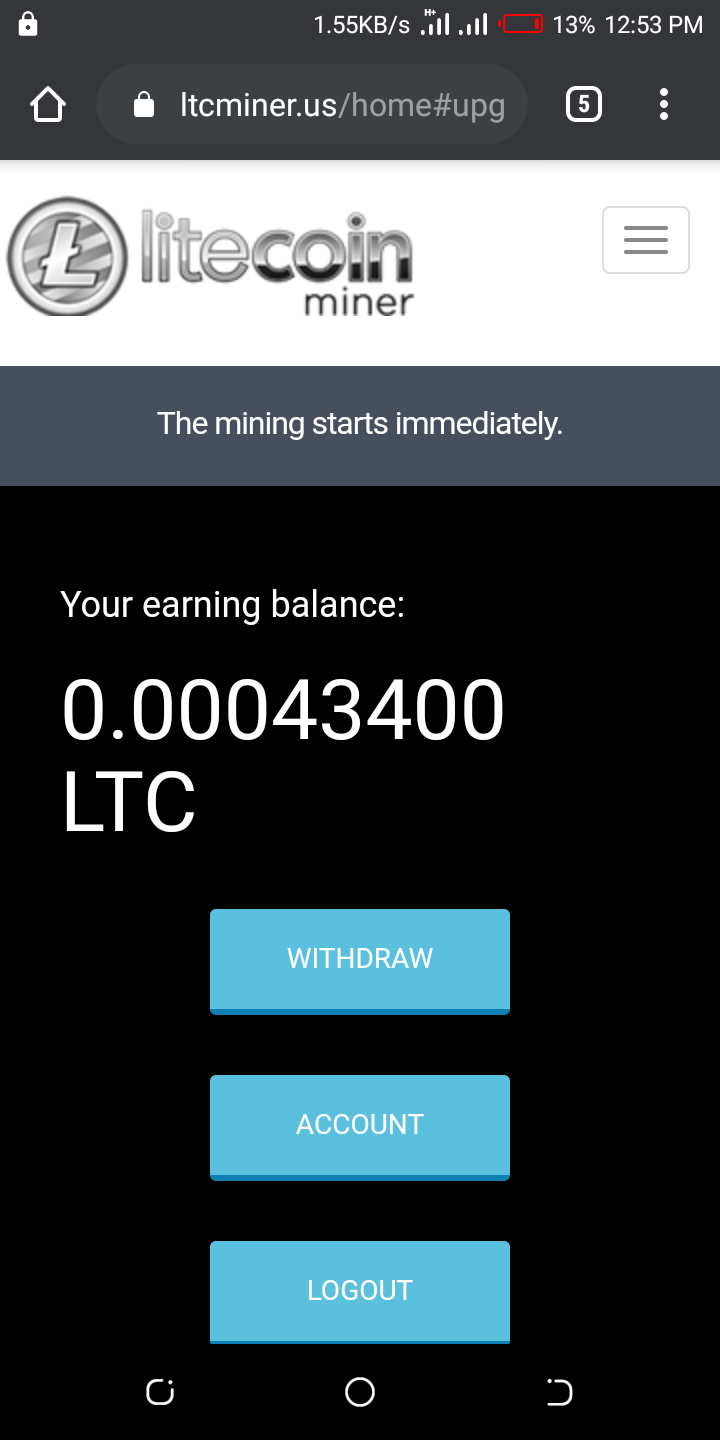
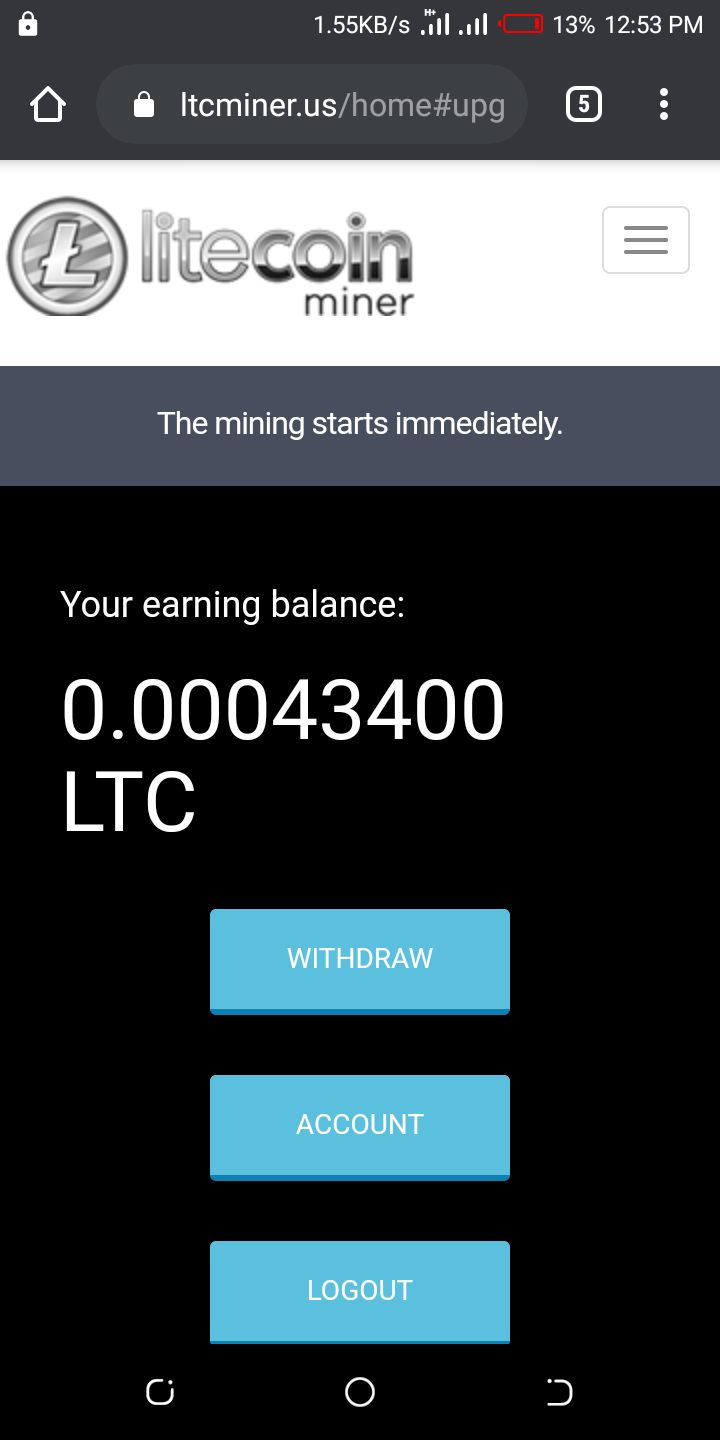
LiteCoin Miner
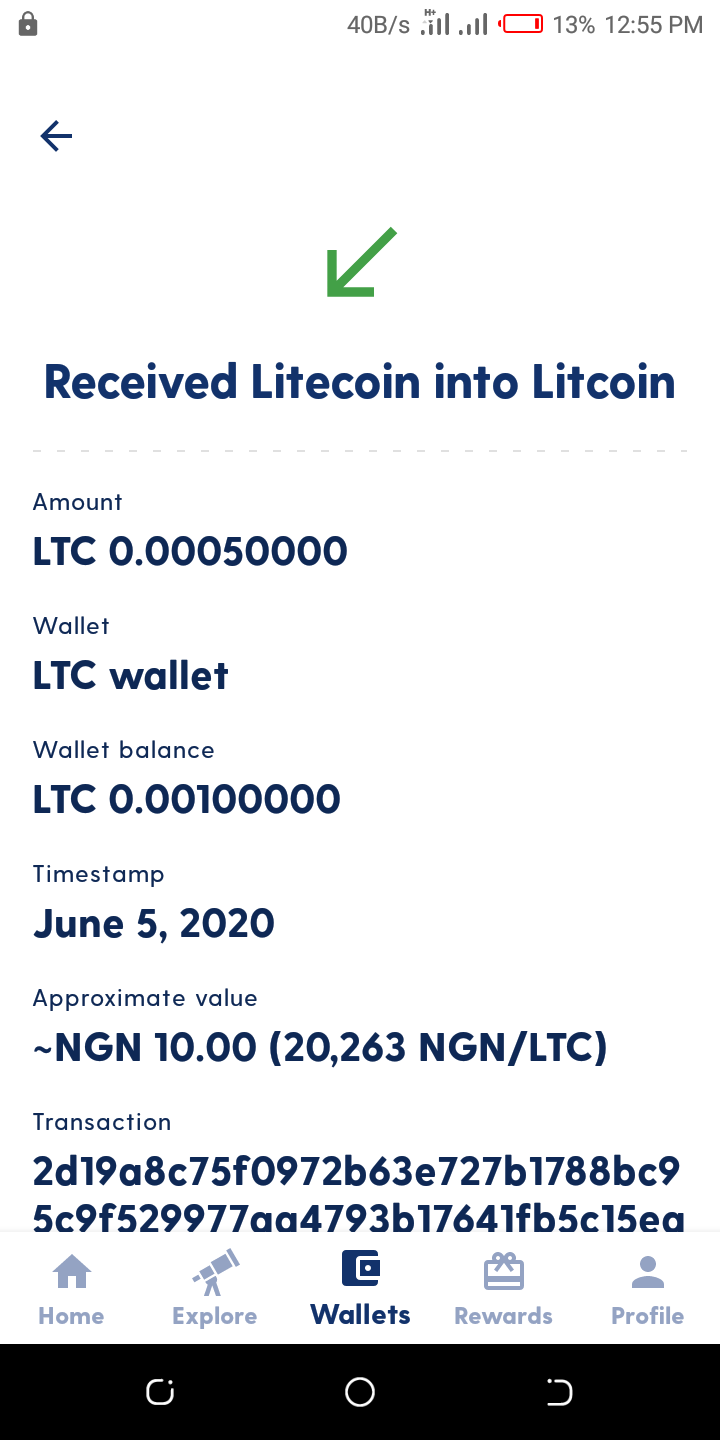
As you can see that is the platform I tested and it works perfectly... I mined for more than 24hrs and I was able to get some litecoins sent directly to my address. The minimum withdrawal is 0.0005 litecoin. You can decide to accumulate or you can decide to withdraw it left for you. I would be dropping my affiliate link down below just in case you want to also try it out because trust me it's a very good passive income because it mines in your browser... You don't have to turn on your data or keep the website open... And it doesn't even affect your battery so it's pretty cool. Check out the withdrawal screen shot from my wallet:
Yeah... I got my litecoins for doing absolutely nothing... Pretty cool right? There are opinions to upgrade your Miner so you mine more lite coins, you can do that if you want to but I would stick to earning free now then probably upgrade when I earn enough litecoins.
Litecoin Miner:https://ltcminer.us/1009420
That the link to the mining website... Enjoy free mining. I am still researching on more legit mining websites and I would be dropping them here when I discover them.
Please leave a like, subscribe and ask any questions in the comment section below. Thanks for your support.
Thank you!
Some months ago I was this happy guy who got up every morning feeling like I had a fresh start that nothing is gonna stop me from going to class, taking lecture and getting good grades and being the best version of myself... But how fickle it all became when the pandemic wind blew in like a tornado and swiped it all away with a fair warning.
It's all memories now, I plan that by this time I would been in my 3rd year in the university and doing best to excel so I could come out good and provide for my parents who are struggling to train me in the university.
Personally I am this tech guy who loves everything about technology I initially wanted to study computer science but I didn't take the write subjects in school... They university said I need biology to study computer science of which I didn't have so I decided to go for electrical and electronics engineering and it turned out to be great though it's really challenging but I love the challenge.
I miss school so much, because my life revolved around it... Now I find it difficult to take care of my need because there isn't much to do here in my country.
But I really want to say a big thank you to the team at read.cash they have really helped me a lot. And also a big thank you to those who have supported me so far... I love you all truely from the core of my heart💓

Change or Constant?
There are two concepts in life that really do matter **change** and **constant**.
Every thing in life fall under this two concepts mentioned above. There are things that change and there are things that are constant. We as humans need to understand the difference between these two concepts in order to leave a more productive life. We need to know what things are meant to change and what things are meant to be constant.
When ever I talk about these two concepts most people can easily get confused based on the terms involved.
***Change is when something is not constant***
***While constant is when something doesn't change***
I hope you got that. But also yet again
***Change is constant***
***And constants can change***
Hope you are not lost yet?
These are yet some words you might have already heard at one point or the other... They generally are talking about the same point which is **Change.**
Change is present in everything. Changes can be recorded from everything even in time. It is said that time heals all wounds, right? But the time itself change in seconds and it constantly moving...
So you can see that even the most valid quantity of measurement in life changes so why do you feel things can't change concerning your situation... Don't belittle yourself because of one situation or the other... Don't stay in one place for too long, try as much as possible to try out new things often if not daily.
***I Believe nothing in constant and everything is subject to change.***
If you have a different opinion do well to let me know. Thanks for the support.

Did you forget your Airtel phone number again?
Well, if you did forget your number or you are a new user and you need instant access of your number then follow the steps below to get your mobile number...
Getting your Airtel phone number with ussd
To check the number on your Airtel SIM card, simply dial ***121#** from your phone, You will be shown some on-screen options.
Select **Manage My Account** by pressing 2
You will be directed to the next screen showing,
***My data balance***
***My Balance***
***My Data Plan***
***My Number***
***My tariff Plan***
***KYC status***
***My Serial Number***
***MY PUK***
Select My Number by pressing 4 to reveal your phone number.
Getting your Airtel number from customer care.
In the event that you at any time forget the code for executing the first two methods above, another way to check your Airtel phone number is by calling customer care.
Dial 111 or 121 using your Airtel line.
Press the option that says “Speak to a customer care representative”
After the call connects, tell the customer care representative attending to you that you forgot your phone number.
Make sure you get a pen and paper to write down the phone number as the customer care representative calls it out.
you can also request that the customer care representative sends your number in the form of an SMS. With that, you’ll receive a message containing your 11-digit Airtel phone number as soon as you drop the call.
I believe this information on Best Methods on How to Check Airtel Data Balance is helpful to you? Why not share it with your friends out there by clicking on the share button on this website. You can as well subscribe to be updated for further information concerning this topic.
How to share data on Glo.
To share data, you must be subscribed to one of the Glo plans that have a feature of gifting and sharing. There are a few options that you can use to share your data and you can choose which one to use, depending on your personal preferences and needs.
In order to share data with someone else using Glo, you must carry out the following:
1. Choose whether you want to dial *127*01*<recipient’s number># or send “Share [Recipient’s number] to 127. Both options will lead to the same outcome; your data plan will be shared with this person.
2. If you want to remove the person from data sharing, you should dial *127*02*<phone number># or send “Remove <phone number>” to the same number 127.
3. If you want to send data to someone as a gift or to fill your other number with data, you can dial *127*<USSD plan number>*<phone number]># or you can send “Gift <phone number]>to the number 127.
4. You can visit the website hsi.glo.com from the phone while using your Glo SIM and performing the operations from there.
Am sure you found this article interesting and educative. Please leave your comments below and don’t forget to subscribe.

How to share data on 9mobile.
To share data with other 9Mobile users, you will have to dial *229*PIN*amount of MB*9Mobile number#. For instance, if you want to share 20 MB, type something like *229*1111*20*08022222222# (of course, with your real pin-code and recipient’s number).
If you wish to change your 9Mobile PIN, it is possible to do. The default PIN on 9Mobile is 0000. In case you would like to change it, you will have to dial *247*old pin-code*new pin-code#. Example if you want to change 0000 to 1111. Dial *247*0000*1111#.
**Note:** The Least amount of data that you can send daily is 10 MB, and the maximum is 50 MB. The daily limit of transferring is 250 MB. This is for the users who do not use the 9Mobile data balance plans. If you purchase the plan, your minimal limit will increase to 200 MB, while the maximum will be 20 GB. Now you can share your data to all networks.
How to share data on Airtel.
it by going to the “My contact account” section and following the instructions that you can find there.
**Note:** You can avoid the long procedure by using the MTN App. You can download it on Google Play-store or Apple Store.
How to Share Data on Airtel.
Sharing your internet data can be done with up to four people. It is also possible for you to share your data monthly. The process is simple and convenient. In case you want to know how to share data online, you will have to complete the following steps:
First, you need to recharge your phone with the packs that include 3G or 4G internet.
1. Check your Airtel data balance (you can do this by dialing *123*11#).
2. If there is enough MB on your account, you can go to the Airtel’s official website. https://www.airtel.in/
3. Enter your phone number and the Airtel password or you can use a temporary password that was sent to you via text message. If you have entered everything successfully, you are logged in into the Airtel account.
4. Then, choose the number that you would like to share your data balance with. Always double-check the number to make sure that you are not sharing with the wrong person. Airtel company does not give the data back in case you have made a typo in the number, and the person who you accidentally sent data most likely will not return it.
5. You can only add up to four numbers and no more.
6. When your procedure is completed, you will receive a confirmation message.
**For sharing Airtel data without the Internet, you could follow the alternative method:**
1. Send “share” to the number 121.
2. You will receive instructions from the customer service of Airtel. You will be told how to share your data with other people.
3. Follow these instructions and add some numbers. The format will be like “add, and you will have to send it to 121. For example, type “add 00000000000” and then send the message to 121.
4. The Airtel customer service is supposed to ask you for the confirmation of your actions. For confirmation, you should press 1.
5. Now you can share your data with this number unless you would like to delete it from your contacts.
**Deleting the number is quite easy. Just do the following:**
SMS “del” and send it to 121. For example “del 0000000000” and press send. When you have deleted the number from your data balance sharing list, this person will no longer be receiving data from you.
Also, you can send 10 MB by entering *141*712*11*phone number#. If you want to send 25 MB, you can dial *141*712*9*phone number#. In case you would like to send 60 MB, then you can enter *141*712*4*phone number#. However, remember that only one transaction can be made per day.

How to share data on MTN.
So today I would show you guys who make use of MTN network, how to share data with other MTN users.
The internet is a major part of our lives without it most people would not be able to run their lives and business comfortably also even without internet read.cash wouldn't have been in existence.
It is no new thing to Nigerians or Africans that telecommunication networks can be subscribed to for data bundles which enables you to access the internet.
So now to what I have for you guys today, sharing data on MTN with friends and family or anyone who uses MTN.
MTN has a DataShare service, which is easy and accessible to everyone. There are some data bundles, which are listed in the price list of MTN service, and you can choose one of them. You will be able to use it together with your family or from another phone. Follow the following instructions:
Dial the number *131*7#. You will meet the following options:
1. Press 1 to transfer data to friends and Family
2. Press 2 to buy data for a friend or Family member
3. Press 3 to request data from a Friend or Family
**Note:** In order to share the data, your monthly plan has to be minimum 250 MB. If you have a smaller amount of MB, this denies you the possibility to share data with the other people.
To be able to share data on MTN, you have to be a customer of the **PayAsYouGo** service or be a user of **TopUp** or **MTNChoice.**
**If you are a PayAsYouGo customer, you will need to complete the following steps:**
1. Dial *141*2*163# in order to buy a set of data.
2. Then, dial *141*5# if you would like to activate the MTN Data Share service. Choose the option “manage data bundles”.
3. Then press Data Share.
**If you use TopUp or MTNChoice, you will have to follow these steps:**
1. Activate the DataShare by calling 808 or going to the MTN office closest to your area.
2. If you called 808, you have to dial *141*5# then press 4, and then press 2.
MTN also gives you an option to share credits between two MTN accounts, you also have an option called Share and Sell, you will be asked to enter your PIN. There are a few ways to do it:
1. You can send a message to 777, with the following information: For example: <08022222222> <2000> <1111>. When you are done, you will receive a message where you will be asked to confirm your transfer, just send to 777.
2. Dial *600*Recipient’s number*amount*PIN# and then press send. For instance, it can be like *600*08022222222*2000*1111#. When you complete the transaction, you will get the confirmation about the successful completion of your operation.
3. You can also share credits by using the official MTN site, https://www.mtnonline.com/. You can do it by going to the “My contact account” section and following the instructions that you can find there.
**Note:** You can avoid the long procedure by using the MTN App. You can download it on Google Play-store or Apple Store.

First Cryptocurrency you can mine on your phone!
Table of content
- introduction
- problem: accessibility of 1st gen. Cryptocurrencies
- solution: pi - mining goes Mobile
- pi economic model: balancing scarcity and access
- utility: Monetizing untapped resources in p2p
- Governance: currency for and by the people
- roadmap / deployment plan
Introduction: Why cryptocurrencies matter
Currently, our everyday financial transactions rely upon a trusted third party to maintain a record of transactions. For example, when you do a bank transaction, the banking system keeps a record & guarantees that the transaction is safe & reliable. Likewise, when Cindy transfers $5 to Steve using PayPal, PayPal maintains a central record of $5 dollars debited from Cindy’s account and $5 credited to Steve’s. Intermediaries like banks, PayPal, and other members of the current economic system play an important role in regulating the world’s financial transactions.
However, the role of these trusted intermediaries also has limitations:
1. Unfair value capture. These intermediaries amass billions of dollars in wealth creation (PayPal market cap is ~$130B), but pass virtually nothing onto their customers - the everyday people on the ground, whose money drives a meaningful proportion of the global economy. More and more people are falling behind.
2. Fees. Banks and companies charge large fees for facilitating transactions. These fees often disproportionately impact lower-income populations who have the fewest alternatives.
3. Censorship. If a particular trusted intermediary decides that you should not be able to move your money, it can place restrictions on the movement of your money.
4. Permissioned. The trusted intermediary serves as a gatekeeper who can arbitrarily prevent anybody from being part of the network.
5. Pseudonymous. At a time when the issue of privacy is gaining greater urgency, these powerful gatekeepers can accidentally disclose -- or force you to disclose -- more financial information about yourself than you may want.
Bitcoin’s “peer-to-peer electronic cash system,” launched in 2009 by an anonymous programmer (or group) Satoshi Nakamoto, was a watershed moment for the freedom of money. For the first time in history, people could securely exchange value, without requiring a third party or trusted intermediary. Paying in Bitcoin meant that people like Steve and Cindy could pay each other directly, bypassing institutional fees, obstructions and intrusions. Bitcoin was truly a currency without boundaries, powering and connecting a new global economy.
Introduction To Distributed Ledgers
Bitcoin achieved this historical feat by using a distributed record. While the current financial system relies on the traditional central record of truth, the Bitcoin record is maintained by a distributed community of “validators,” who access and update this public ledger. Imagine the Bitcoin protocol as a globally shared “Google Sheet” that contains a record of transactions, validated and maintained by this distributed community.
The breakthrough of Bitcoin (and general blockchain technology) is that, even though the record is maintained by a community, the technology enables them to always reach consensus on truthful transactions, insuring that cheaters cannot record false transactions or overtake the system. This technological advancement allows for the removal of the centralized intermediary, without compromising transactional financial security.
Benefits Of Distributed Ledgers
In addition to decentralization, bitcoin, or cryptocurrencies in general, share a few nice properties that make money smarter and safer, although different cryptocurrencies may be stronger in some properties and weaker in others, based on different implementations of their protocols. Cryptocurrencies are held in cryptographic wallets identified by a publicly accessible address, and is secured by a very strong privately held password, called the private key. This private key cryptographically signs transaction and is virtually impossible to create fraudulent signatures. This provides security and unseizability. Unlike traditional bank accounts that can be seized by government authorities, the cryptocurrency in your wallet can never be taken away by anyone without your private key. Cryptocurrencies are censorship resistant due to the decentralized nature because anyone can submit transactions to any computer in the network to get recorded and validated. Cryptocurrency transactions are immutable because each block of transactions represents a cryptographic proof (a hash) of all the previous blocks that existed before that. Once someone sends you money, they cannot steal back their payment to you (i.e., no bouncing checks in blockchain). Some of the cryptocurrencies can even support atomic transactions. “Smart contracts” built atop these cryptocurrencies do not merely rely on law for enforcement, but directly enforced through publicly auditable code, which make them trustless and can potentially get rid of middlemen in many businesses, e.g. Escrow for real estate.
Securing Distributed Ledgers (Mining)
One of challenges of maintaining a distributed record of transactions is security -- specifically, how to have an open and editable ledger while preventing fraudulent activity. To address this challenge, Bitcoin introduced a novel process called Mining (using the consensus algorithm “Proof of Work”) to determine who is “trusted” to make updates to the shared record of transactions.
You can think of mining as a type of economic game that forces “Validators” to prove their merit when trying to add transactions to the record. To qualify, Validators must solve a series of complex computational puzzles. The Validator who solves the puzzle first is rewarded by being allowed to post the latest block of transactions. Posting the latest block of transactions allows Validators to “mine” a Block Reward - currently 12.5 bitcoin (or ~$40,000 at the time of writing).
This process is very secure, but it demands enormous computing power and energy consumption as users essentially “burn money” to solve the computational puzzle that earns them more Bitcoin. The burn-to-reward ratio is so punitive that it is always in Validators’ self-interest to post honest transactions to the Bitcoin record.
Problem: Centralization of power and money put 1st Generation Cryptocurrencies out of reach
In the early days of Bitcoin, when only a few people were working to validate transactions and mining the first blocks, anyone could earn 50 BTC by simply running Bitcoin mining software on their personal computer. As the currency began to gain in popularity, clever miners realized that they could earn more if they had more than one computer working to mine.
As Bitcoin continued to increase in value, entire companies began to spring up to mine. These companies developed specialized chips (“ASICs”) and constructed huge farms of servers using these ASIC chips to mine Bitcoin. The emergence of these enormous mining corporations, known drove the Bitcoin Gold Rush, making it very difficult for everyday people to contribute to the network and get rewarded. Their efforts also began consuming increasingly large amounts of computing energy, contributing to mounting environmental issues around the world.
The ease of mining Bitcoin and the subsequent rise of Bitcoin mining farms quickly produced a massive centralization of production power and wealth in Bitcoin’s network. To provide some context, 87% of all Bitcoins are now owned by 1% of their network, many of these coins were mined virtually free in their early days. As another example, Bitmain, one of Bitcoin’s biggest mining operations has earned billions in revenue and profits.
The centralization of power in Bitcoin’s network makes it very difficult and expensive for the average person. If you want to acquire Bitcoin, your easiest options are to:
1. Mine It Yourself. Just hook up the specialized hardware (here’s a rig on Amazon, if you’re interested!) and go to town. Just know that since you’ll be competing against massive server farms from across the world, consuming as much energy as the country of Switzerland, you won’t be able to mine much
2. Buy Bitcoin on an exchange. Today, you can buy Bitcoin at a unit price of $3,500 / coin at the time of writing (note: you can buy fractional amount of Bitcoin!) Of course, you would also be taking on substantial risk in doing so as the price of Bitcoin is quite volatile.
Bitcoin was the first to show how cryptocurrency could disrupt the current financial model, giving people the ability to make transactions without having a third party in the way. The increase in freedom, flexibility, and privacy continues to drive the inevitable march toward digital currencies as a new norm. Despite its benefits, Bitcoin’s (likely unintended) concentration of money and power present a meaningful barrier to mainstream adoption. As Pi’s core team has conducted research to try to understand why people are reluctant to enter the cryptocurrency space. People consistently cited the risk of investing/mining as a key barrier to entry.
Solution: Pi - Enabling mining on mobile phones
After identifying these key barriers to adoption, the Pi Core Team set out to find a way that would allow everyday people to mine (or earn cryptocurrency rewards for validating transactions on a distributed record of transactions). As a refresher, one of the major challenges that arises with maintaining a distributed record of transactions is ensuring that updates to this open record are not fraudulent. While Bitcoin’s process for updating its record is proven (burning energy / money to prove trustworthiness), it is not very user (or planet!) friendly. For Pi, we introduced the additional design requirement of employing a consensus algorithm that would also be extremely user friendly and ideally enable mining on personal computers and mobile phones.
In comparing existing consensus algorithms (the process that records transactions into a distributed ledger), the Stellar Consensus Protocol emerges as the leading candidate to enable user-friendly, mobile-first mining. Stellar Consensus Protocol (SCP) was architected by David Mazières a professor of Computer Science at Stanford who also serves as Chief Scientist at the Stellar Development Foundation. SCP uses a novel mechanism called Federated Byzantine Agreements to ensure that updates to a distributed ledger are accurate and trustworthy. SCP is also deployed in practice through the Stellar blockchain that has been operating since 2015.
A Simplified Introduction To Consensus Algorithms
Before jumping to introducing the Pi consensus algorithm, it helps to have a simple explanation on what a consensus algorithm does for a blockchain and the types of consensus algorithms that today’s blockchain protocols generally use, e.g. Bitcoin and SCP. This section is explicitly written in a oversimplified manner for the sake of clarity, and is not complete. For higher accuracy, see the section Adaptations to SCP below and read the stellar consensus protocol paper.
A blockchain is a fault-tolerant distributed system that aims to totally order a list of blocks of transactions. Fault-tolerant distributed systems is an area of computer science that has been studied for many decades. They are called distributed systems because they do not have a centralized server but instead they are composed of a decentralized list of computers (called nodes or peers) that need to come to a consensus as to what is the content and total ordering of blocks. They are also called fault-tolerant because they can tolerate a certain degree of faulty nodes into the system (e.g. up to 33% of nodes can be faulty and the overall system continues to operate normally).
There are two broad categories of consensus algorithms: The ones that elect a node as the leader who produces the next block, and the ones where there is no explicit leader but all nodes come to a consensus of what the next block is after exchanging votes by sending computer messages to each other. (Strictly speaking the last sentence contains multiple inaccuracies, but it helps us explain the broad strokes.)
Bitcoin uses the first type of consensus algorithm: All bitcoin nodes are competing against each other in solving a cryptographic puzzle. Because the solution is found randomly, essentially the node that finds the solution first, by chance, is elected the leader of the round who produces the next block. This algorithm is called “Proof of work” and results in a lot of energy consumption.
A Simplified Introduction To Stellar Consensus Protocol
Pi uses the other type of consensus algorithms and is based on the Stellar Consensus Protocol (SCP) and an algorithm called Federated Byzantine Agreement (FBA). Such algorithms don’t have energy waste but they require exchanging many network messages in order for the nodes to come to “consensus” on what the next block should be. Each node can independently determine if a transaction is valid or not, e.g. authority of making the transition and double spending, based on the cryptographic signature and the transaction history. However, for a network of computers to agree on which transactions to record in a block and the order of these transactions and blocks, they need to message each other and have multiple rounds of voting to come to consensus. Intuitively, such messages from different computers in the network about which block is the next would look like the following: “I propose we all vote for block A to be next”; “I vote for block A to be the next block”; “I confirm that the majority of the nodes I trust also voted for block A”, from which the consensus algorithm enables this node to conclude that “A is the next block; and there could be no block other than A as the next block”; Even though the above voting steps seem a lot, the internet is adequately fast and these messages are lightweight, thus such consensus algorithms are more lightweight than Bitcoin’s proof of work. One major representative of such algorithms is called Byzantine Fault Tolerance (BFT). Several of the top blockchains today are based on variants of BFT, such as NEO and Ripple.
One major criticism of BFT is that it has a centralization point: because voting is involved, the set of nodes participating in the voting “quorum” are centrally determined by the creator of the system in its beginning. The contribution of FBA is that, instead of having one centrally determined quorum, each node sets their own “quorum slices”, which will in turn form different quorums. New nodes can join the network in a decentralized way: they declare the nodes that they trust and convince other nodes to trust them, but they don’t have to convince any central authority.
SCP is one instantiation of FBA. Instead of burning energy like in Bitcoin’s proof of work consensus algorithm, SCP nodes secure the shared record by vouching for other nodes in the network as trustworthy. Each node in the network builds a quorum slice, consisting of other nodes in the network that they deem to be trustworthy. Quorums are formed based on its members quorum slices, and a validator will only accept new transactions if and only if a proportion of nodes in their quorums will also accept the transaction. As validators across the network construct their quorums, these quorums help nodes to reach consensus about transactions with guarantee on security. You can learn more about the Stellar Consensus Protocol by watching this short, 7 min explanation video or checking out this technical summary of SCP.
Pi’s Adaptations to Stellar Consensus Protocol (SCP)
Pi’s consensus algorithm builds atop SCP. SCP has been formally proven [Mazieres 2015] and is currently implemented within the Stellar Network. Unlike Stellar Network consisting mostly of companies and institutions (e.g., IBM) as nodes, Pi intends to allow devices of individuals to contribute on the protocol level and get rewarded, including mobile phones, laptops and computers. Below is an introduction on how Pi applies SCP to enabling mining by individuals.
There are four roles Pi users can play, as Pi miners. Namely:
1. Pioneer. A user of the Pi mobile app who is simply confirming that they are not a “robot” on a daily basis. This user validates their presence every time they sign in to the app. They can also open the app to request transactions (e.g. make a payment in Pi to another Pioneer)
2. Contributor. A user of the Pi mobile app who is contributing by providing a list of pioneers he or she knows and trusts. In aggregate, Pi contributors will build a global trust graph.
3. Ambassador. A user of the Pi mobile app who is introducing other users into Pi network.
4. Node. A user who is a pioneer, a contributor using the Pi mobile app, and is also running the Pi node software on their desktop or laptop computer. The Pi node software is the software that runs the core SCP algorithm, taking into account the trust graph information provided by the Contributors.
A user can play more than one of the above roles. All roles are necessary, thus all roles are rewarded with newly minted Pi on a daily basis as long as they participated and contributed during that given day. In the loose definition of a “miner” being a user who receives newly minted currency as a reward for contributions, all four roles are considered to be Pi miners. We define“mining” more broadly than its traditional meaning equated to executing proof of work consensus algorithm as in Bitcoin or Ethereum.
First of all, we need to emphasize that the Pi Node software has not been released yet. So this section is offered more as an architectural design and as a request to solicit comments from the technical community. This software will be fully open source and it will also heavily depend on stellar-core which is also open source software, available here. This means that anyone in the community will be able to read, comment and propose improvements on it. Below are the Pi proposed changes to SCP to enable mining by individual devices.
Nodes
For readability, we define as a correctly connected node to be what the SCP paper refers to as an intact node. Also, for readability, we define as the main Pi network to be the set of all intact nodes in the Pi network. The main task of each Node is to be configured to be correctly connected to the main Pi network. Intuitively, a node being incorrectly connected to the main network is similar to a Bitcoin node not being connected to the main bitcoin network.
In SCP’s terms, for a node to get correctly connected means that this node must chose a “quorum slice” such that all resulting quorums that include this node intersect with the existing network’s quorums. More precisely, a node vn+1 is correctly connected to a main network N of n already correctly connected nodes (v1, v2, …, vn) if the resulting system N’ of n+1 nodes (v1, v2, …, vn+1) enjoys quorum intersection. In other words, N’ enjoys quorum intersection iff any two of its quorums share a node. -- i.e., for all quorums U1 and U2, U1∩U2 ≠ ∅.
The main contribution of Pi over the existing Stellar consensus deployment is that it introduces the concept of a trust graph provided by the Pi Contributors as information that can be used by the Pi nodes when they are setting up their configurations to connect to the main Pi network.
When picking their quorum slices, these Nodes must take into consideration the trust graph provided by the Contributors, including their own security circle. To assist in this decision, we intend to provide auxiliary graph analysis software to assist users running Nodes to make as informed decisions as possible. This software’s daily output will include:
- a ranked list of nodes ordered by their distance from the current node in the trust graph; a ranked list of nodes based a pagerank analysis of nodes in the trust graph
- a list of nodes reported by the community as faulty in any way a list of new nodes seeking to join the network
- a list of most recent articles from the web on the keyword “misbehaving Pi nodes” and other related keywords; a visual representation of Nodes comprising the Pi network similar to what is shown in StellarBeat Quorum monitor [source code]
- a quorum explorer similar to QuorumExplorer.com [source code]
- a simulation tool like the one in StellarBeat Quorum monitor that shows the expected resulting impacts to this nodes’ connectivity to the Pi network when the current node’s configuration changes.
An interesting research problem for future work is to develop algorithms that can take into consideration the trust graph and suggest each node an optimal configuration, or even set that configuration automatically. On the first deployment of the Pi Network, while users running Nodes can update their Node configuration at any time, they will be prompted to confirm their configurations daily and asked to update them if they see fit.
Mobile app users
When a Pioneer needs to confirm that a given transaction has been executed (e.g. that they have received Pi) they open the mobile app. At that point, the mobile app connects to one or more Nodes to inquire if the transaction has been recorded on the ledger and also to get the most recent block number and hash value of that block. If that Pioneer is also running a Node the mobile app connects to that Pioneer’s own node. If the Pioneer is not running a node, then the app connects to multiple nodes and to cross check this information. Pioneers will have the ability select which nodes they want their apps to connect to. But to make it simple for most users, the app should have a reasonable default set of nodes, e.g. a number of nodes closest to the user based on the trust graph, along with a random selection of nodes high in pagerank. We ask for your feedback on how the default set of nodes for mobile Pioneers should be selected.
Mining rewards
A beautiful property of the SCP algorithm is that it is more generic than a blockchain. It coordinates consensus across a distributed system of Nodes. This means that the same core algorithm is not only used every few seconds to record new transactions in new blocks, but also it can be used to periodically run more complex computations. For example, once a week, the stellar network is using it to compute inflation on the stellar network and allocate the newly minted tokens proportionally to all stellar coin holders (Stellar’s coin is called lumens). In a similar manner, the Pi network employs SCP once a day to compute the network-wide new Pi distribution across all Pi miners (pioneers, contributors, ambassadors, nodes) who actively participated in any given day. In other words, Pi mining rewards are computed only once daily and not on every block of the blockchain.
For comparison Bitcoin allocates mining rewards on every block and it give all of the reward to the miner who was lucky enough to be able to solve a computationally intensive randomized task. This reward in Bitcoin currently 12.5 Bitcoin (~$40K) is given to only one miner every 10 minutes. This makes it extremely unlikely for any given miner to ever get rewards. As a solution to that, bitcoin miners are getting organized in centralized mining pools, which all contribute processing power, increasing the likelihood of getting rewards, and eventually sharing proportionally those rewards. Mining pools are not only points of centralization, but also their operators get cuts reducing the amount going to individual miners. In Pi, there is no need for mining pools, since once a day everyone who contributed get a meritocratic distribution of new Pi.
Transaction fees
Similar to Bitcoin transactions, fees are optional in the Pi network. Each block has a certain limit of how many transactions can be included in it. When there is no backlog of transactions, transactions tend to be free. But if there are more transactions, nodes order them by fee, with highest-fee-transactions at the top and pick only the top transactions to be included in the produced blocks. This makes it an open market. Implementation: Fees are proportionally split among Nodes once a day. On every block, the fee of each transaction is transferred into a temporary wallet from where in the end of the day it is distributed to the active miners of the day. This wallet has an unknown private key. Transactions in and out of that wallet are forced by the protocol itself under the consensus of all nodes in the same way the consensus also mints new Pi every day.
Limitations and future work
SCP has been extensively tested for several years as part of the Stellar Network, which at the time of this writing is the ninth largest cryptocurrency in the world. This gives us a quite large degree of confidence in it. One ambition of the Pi project is to scale the number of nodes in the Pi network to be larger than the number of nodes in the Stellar network to allow more everyday users to participate in the core consensus algorithm. Increasing the number of nodes, will inevitably increase the number of network messages that must be exchanged between them. Even though these messages are much smaller than an image or a youtube video, and the Internet today can reliably transfer videos quickly, the number of messages necessary increases with the number of participating nodes, which can become bottleneck to the speed of reaching consensus. This will ultimately slow down the rate, at which new blocks and new transactions are recorded in the network. Thankfully, Stellar is currently much faster than Bitcoin. At the moment, Stellar is calibrated to produce a new block every 3 to 5 seconds, being able to support thousands of transactions per second. By comparison, Bitcoin produces a new block every 10 minutes. Moreover, due to Bitcoin’s lack in the safety guarantee, Bitcoin’s blockchain in rare occasions can be overwritten within the first hour. This means that a user of Bitcoin must wait about 1 hour before they can be sure that a transaction is considered final. SCP guarantees safety, which means after 3-5 seconds one is certain about a transaction. So even with the potential scalability bottleneck, Pi expects to achieve transaction finality faster than Bitcoin and possibly slower than Stellar, and process more transactions per second than Bitcoin and possibly fewer than Stellar.
While scalability of SCP is still an open research problem. There are multiple promising ways one could speed things up. One possible scalability solution is bloXroute. BloXroute proposes a blockchain distribution network (BDN) that utilizes a global network of servers optimized for network performance. While each BDN is centrally controlled by one organization, they offer a provably neutral message passing acceleration. I.e. BDNs can only serve all nodes fairly without discrimination as messages are encrypted. This means the BDN does not know where messages come from, where they go, or what is inside. This way Pi nodes can have two message passing routes: A fast one through BDN, which is expected to be reliable most of the time, and its original peer-to-peer message passing interface that is fully decentralized and reliable but is slower. The intuition of this idea is vaguely similar to caching: The cache is place where a computer can access data very quickly, speeding the average computation, but it is not guaranteed to always have every needed piece of information. When the cache misses, the computer is slowed down but nothing catastrophic happens. Another solution can be using secure acknowledgment of multicast messages in open Peer-to-Peer networks [Nicolosi and Mazieres 2004] to speed up message propagation among peers.
Pi Economic Model: Balancing Scarcity and Access
Pros and cons of 1st Generation Economic Models
One of Bitcoin’s most impressive innovations is its marriage of distributed systems with economic game theory.
Pros
Fixed Supply
Bitcoin’s economic model is simple. There will only ever be 21 million Bitcoin in existence. This number is set in code. With only 21M to circulate among 7.5B people around the world, there is not enough Bitcoin to go around. This scarcity is one of most important drivers of Bitcoin’s value.
Decreasing Block Reward
Bitcoin’ distribution scheme, pictured below, further enforces this sense of scarcity. The Bitcoin block mining reward halves every 210,000 blocks (approximately every ~4 years.) In its early days, the Bitcoin block reward was 50 coins. Now, the reward is 12.5, and will further decrease to 6.25 coins in May 2020. Bitcoin’s decreasing rate of distribution means that, even as awareness of the currency grows, there is less to actually mine.
Cons
Inverted Means Uneven
Bitcoin’s inverted distribution model (less people earning more in the beginning, and more people earn less today) is one of the primary contributors to its uneven distribution. With so much Bitcoin in the hands of a few early adopters, new miners are “burning” more energy for less bitcoin.
Hoarding Inhibits Use As A Medium Of Exchange
Although Bitcoin was released as a “peer to peer electronic cash” system, the relative scarcity of Bitcoin has impeded Bitcoin’s goal of serving as a medium exchange. Bitcoin’s scarcity has led to its perception as a form of “digital gold” or a digital store of value. The result of this perception is that many Bitcoin holders are unwilling to spend Bitcoin on day-to-day expenses.
The Pi Economic Model
Pi, on the other hand, seeks to strike a balance between creating a sense of scarcity for Pi, while still ensuring that a large amount does not accumulate into a very small number of hands. We want to make sure our users earn more Pi as they make contributions to the network. Pi’s goal is to build an economic model that is sophisticated enough to achieve and balance these priorities while remaining intuitive enough for people to use.
Pi’s economic model design requirements:
1. Simple: Build an intuitive and transparent model
2. Fair distribution: Give a critical mass of the world’s population access to Pi
3. Scarcity: Create a sense of scarcity to sustain Pi’s price over time
4. Meritocratic earning: Reward contributions to build and sustain the network
Pi - Token Supply
Token Emission Policy
1. Total Max Supply = M + R + D
a. M = total mining rewards
b. R = total referral rewards
c. D = total developer rewards
2. M = ∫ f(P) dx where f is a logarithmically declining function
a. P = Population number (e.g., 1st person to join, 2nd person to join, etc.)
3. R = r * M
a. r = referral rate (50% total or 25% for both referrer and referee)
4. D = t * (M + R)
5. t = developer reward rate (25%)
M - Mining Supply (Based on fixed mining supply minted per person)
In contrast to Bitcoin which created a fixed supply of coins for the entire global population, Pi creates a fixed supply of Pi for each person that joins the network up to the first 100 Million participants. In other words, for each person that joins the Pi Network, a fixed amount of Pi is pre-minted. This supply is then released over the lifetime of that member based on their level of engagement and contribution to network security. The supply is released using an exponentially decreasing function similar to Bitcoin’s over the member’s lifetime.
R - Referral Supply (Based on fixed referral reward minted per person and shared b/w referrer and referee)
In order for a currency to have value, it must be widely distributed. To incentivize this goal, the protocol also generates a fixed amount of Pi that serves as a referral bonus for both the referrer and the referee (or both parent and offspring :) This shared pool can be mined by both parties over their lifetime - when both parties are actively mining. Both referrer and referee are able to draw upon this pool in order to avoid exploitative models where referrers are able to “prey” on their referees. The referral bonus serves as a network-level incentive to grow the Pi Network while also incentivizing engagement among members in actively securing the network.
D - Developer Reward Supply (Additional Pi minted to support ongoing development)
Pi will fund its ongoing development with a “Developer Reward” that is minted alongside each coin that is minted for mining and referrals. Traditionally, cryptocurrency protocols have minted a fixed amount of supply that is immediately placed into treasury. Because Pi’s total supply is dependent on the number of members in the network, Pi progressively mints its developer reward as the network scales. The progressive minting of Pi’s developer reward is meant to align the incentives of Pi’s contributors with the overall health of the network.
f is a logarithmically decreasing function - early members earn more
While Pi seeks to avoid extreme concentrations of wealth, the network also seeks to reward earlier members and their contributions with a relatively larger share of Pi. When networks such as Pi are in their early days, they tend to provide a lower utility to participants. For example, imagine having the very first telephone in the world. It would be a great technological innovation but not extremely useful. However, as more people acquire telephones, each telephone holder gets more utility out of the network. In order to reward people that come to the network early, Pi’s individual mining reward and referral rewards decrease as a function of the number of people in the network. In other words, there is a certain amount of Pi that is reserved for each “slot” in the Pi Network.
Utility: Pooling and monetizing our time online
Today, everyone is sitting on a veritable treasure trove of untapped resources. Each of us spend hours day on our phones. While on our phones, each of our views, posts or clicks creates extraordinary profits for large corporations. At Pi, we believe that people have the right to capture value created from their resources.
We all know that we can do more together than we can alone. On today’s web, massive corporations like Google, Amazon, Facebook have immense leverage against individual consumers. As a result, they are able to capture the lionshare of value created by individual consumers on the web. Pi levels the playing field by allowing its members to pool their collective resources so they can get a share of the value that they create.
The graphic below is the Pi Stack, where we see particularly promising opportunities for helping our members capture value. Below, we go into each of these areas in more detail.
Introducing the Pi Stack - Unleashing underutilized resources
Pi Ledger And Shared Trust Graph - Scaling Trust Across The Web
One of the biggest challenges on the internet is knowing who to trust. Today, we rely on the rating systems of providers such as Amazon, eBay, Yelp, to know who we can transact with on the internet. Despite the fact that we, customers, do the hard work of rating and reviewing our peers, these internet intermediaries capture the lionshare of the value created this work.
Pi’s consensus algorithm, described above, creates a native trust layer that scales trust on the web without intermediaries. While the value of just one individual’s Security Circle is small, the aggregate of our individual security circles build a global “trust graph” that help people understand who on the Pi Network can be trusted. The Pi Network’s global trust graph will facilitate transactions between strangers that would not have otherwise been possible. Pi’s native currency, in turn, allows everyone who contributes to the security of the network to capture a share of the value they have helped create.
Pi’s Attention Marketplace - Bartering Unutilized Attention And Time
Pi allows its members to pool their collective attention to create an attention market much more valuable than any individual’s attention alone. The first application built on this layer will be a scarce social media channel currently hosted on the home screen of the application. You can think of the scarce social media channel as Instagram with one global post at a time. Pioneers can wager Pi to engage the attention of other members of the network, by sharing content (e.g., text, images, videos) or asking questions that seek to tap into the collective wisdom of the community. On the Pi Network, everyone has the opportunity to be an influencer or to tap into the wisdom of the crowd. To date, Pi’s Core Team has been using this channel to poll the community’s opinion on design choices for Pi (e.g. the community voted on the design and colors of the Pi logo.) We have received many valuable responses and feedback from the community on the project. One possible future direction is to open the attention market for any Pioneer to use Pi to post their content, while expanding the number of channels hosted on the Pi Network.
In addition to bartering attention with their peers, Pioneers may also opt into bartering with companies that are seeking their attention. The average American sees between 4,000 and 10,000 ads a day. Companies fight for our attention and pay tremendous amounts of money for it. But we, the customers, receive no value from these transactions. In Pi’s attention marketplace, companies seeking to reach Pioneers will have to compensate their audience in Pi. Pi’s advertising marketplace will be strictly opt-in only and will provide an opportunity for Pioneers to monetize one of their greatest untapped resources: their attention.
Pi’s Barter Marketplace - Build Your Personal Virtual Storefront
In addition to contributing trust and attention to the Pi Network, we expect Pioneers to be able to contribute their unique skills and services in the future. Pi’s mobile application will also serve as a Point of Sales where Pi’s members can offer their untapped goods and services via a “virtual storefront” to other members of the Pi Network. For example, a member offer up an underutilized room in their apartment for rent to other members on the Pi Network. In addition to real assets, members of the Pi Network will also be able to offer skills and services via their virtual storefronts. For example, a member of the Pi Network could offer their programming or design skills on the Pi marketplace. Overtime, the value of Pi will be supported by a growing basket of goods and services.
Pi’s Decentralized App Store - Lowering The Barrier Of Entry For Creators
The Pi Network’s shared currency, trust graph, and marketplace will be the soil for a broader ecosystem of decentralized applications. Today, anyone that wants to start an application needs to bootstrap its technical infrastructure and community from scratch. Pi’s decentralized applications store will allow Dapp developers to leverage Pi’s existing infrastructure as well as the shared resources of the community and users. Entrepreneurs and developers can propose new Dapps to the community with requests for access to the network’s shared resources. Pi will also build its Dapps with some degree of interoperability so that Dapps are able to reference data, assets, and processes in other decentralized applications.
Governance - Cryptocurrency for and by the people
Challenges w/ 1st Generation Governance models
Trust is the foundation of any successful monetary system. One of the most important factors engendering trust is governance, or the process by which changes are implemented to the protocol over time. Despite its importance, governance is often one of the most overlooked aspects of cryptoeconomic systems.
First generation networks such as Bitcoin largely avoided formal (or “on-chain”) governance mechanisms in favor of informal (or “off-chain”) mechanisms arising from a combination of role and incentive design. By most measures, Bitcoin’s governance mechanisms has been quite successful, allowing the protocol to grow dramatically in scale and value since its inception. However, there have also been some challenges. The economic concentration of Bitcoin has led to a concentration of political power. The result is that everyday people can get caught in the middle of destructive battles between massive holders of Bitcoin. One of the most recent examples of this challenge has been the ongoing battle between Bitcoin and Bitcoin Cash. These civil wars can end in a fork where or where the blockchain. For token holders, hard forks are inflationary and can threaten the value of their holdings.
Pi’s Governance Model - a two-phase plan
In an article challenging the merits of on-chain governance, Vlad Zamfir, one of Ethereum’s core developers, argues that blockchain governance “is not an abstract design problem. It’s an applied social problem.” One of Vlad’s key points is that it is very difficult to design governance systems “a priori” or before observations of the particular challenges arising from a specific political system. One historical example is in the founding of the United States. The first experiment with democracy in the United States, the Articles of Confederation, failed after an eight-year experiment. The Founding Fathers of the United States were then able to draw upon the lessons of the Article of Confederation to craft the the Constitution - a much more successful experiment.
To build an enduring governance model, Pi will pursue a two-phase plan.
Provisional Governance Model (< 5M Members)
Until the network hits a critical mass of 5M members, Pi will operate under a provisional governance model. This model will most closely resemble “off-chain” governance models currently employed by protocols like Bitcoin and Ethereum, with Pi’s Core Team playing an important role in guiding the development of the protocol. However,, Pi’s Core Team will still rely heavily on the input of the community. The Pi mobile application itself is where Pi’s core team has been soliciting community input and engaging with Pioneers. Pi embraces community critiques and suggestions, which is implemented by the open-for-comments features of Pi’s landing page, FAQs and white paper. Whenever people browse these materials on Pi’s websites, they can submit comment on a specific section right there to ask for questions and make suggestions. Offline Pioneer meetups that Pi’s core team have been organizing will also be an important channel for community input.
Additionally, Pi’s Core Team will develop more formal governance mechanics. One potential governance system is liquid democracy. In liquid democracy, every Pioneer will have the ability to either vote on an issue directly or to delegate their vote to another member of the network. Liquid democracy would allow for both broad and efficient membership from Pi’s community.
Pi’s “Constitutional Convention” (> 5M Members)
Upon hitting 5M members, a provisional committee will be formed based on previous contributions to the Pi Network. This committee will be responsible for soliciting and proposing suggestions from and to the wider community. It will also organize a series of on- and offline conversations where Pi’s members will be able to weigh on Pi’s long-term constitution. Given Pi’s global user base, the Pi Network will conduct these conventions at multiple locations across the world to ensure accessibility. In addition to hosting in-person conventions, Pi will also use its mobile application as a platform for allowing Pi’s member to participate in the process remotely. Whether in-person or online, Pi’s community members will have the ability to participate in the crafting Pi’s long-term governance structure.
Roadmap / Deployment plan
Phase 1 - Design, Distribution, Trust Graph Bootstrap.
The Pi server is operating as a faucet emulating the behavior of the decentralized system as it will function once its live. During this phase improvements in the user experience and behavior are possible and relatively easy to make compared to the stable phase of the main net. All minting of coins to users will be migrated to the live net once it launches. In other words, the livenet will pre-mint in its genesis block all account holder balances generated during Phase 1, and continue operating just like the current system but fully decentralized. Pi is not listed on exchanges during this phase and it is impossible to “buy” Pi with any other currency.
Phase 2 - Testnet
Before we launch the main net, the Node software will be deployed on a test net. The test net will use the same exact trust graph as the main net but on a testing Pi coin. Pi core team will host several nodes on the test net, but will encourage more Pioneers to start their own nodes on the testnet. In fact, in order for any node to join the main net, they are advised to begin on the testnet. The test net will be run in parallel to the Pi emulator in phase one, and periodically, e.g. daily, the results from both systems will be compared to catch the gaps and misses of the test net, which will allow Pi developers to propose and implement fixes. After a thorough concurrent run of both systems, testnet will reach a state where its results consistently match the emulator’s. At that time when the community feels its ready, Pi will migrate to the next phase.
Phase 3 - Mainnet
When the community feels the software is ready for production, and it has been thoroughly tested on the testnet, the official mainnet of the Pi network will be launched. An important detail is that, in the transition into the mainnet, only accounts validated to belong to distinct real individuals will be honored. After this point, the faucet and Pi network emulator of Phase 1 will be shut down and the system will continue on its own forever. Future updates to the protocol will be contributed by the Pi developer community and Pi’s core team, and will be proposed by the committee. Their implementation and deployment will depend on nodes updating the mining software just like any other blockchains. No central authority will be controlling the currency and it will be fully decentralized. Balances of fake users or duplicate users will be discarded. This is the phase when Pi can be connected to exchanges and be exchanged for other currencies.
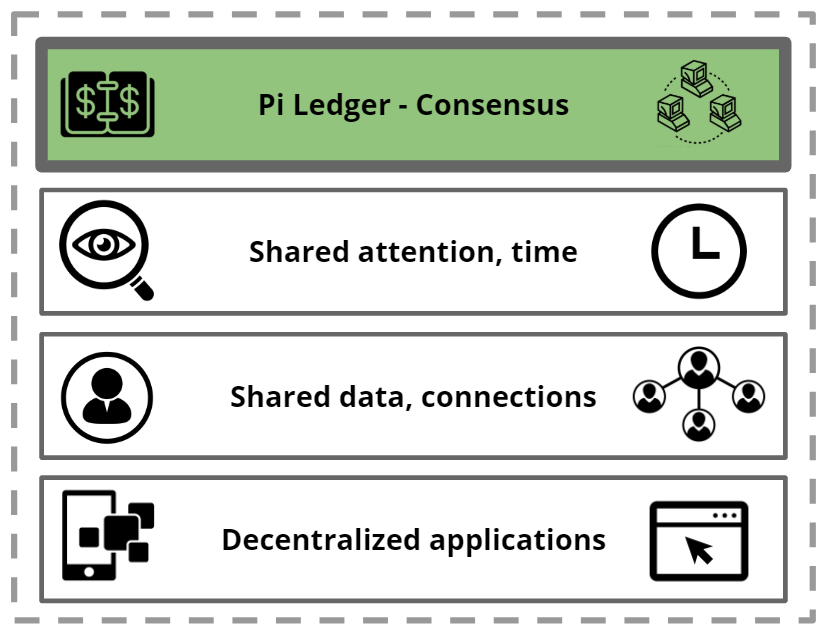
GOT's Mark Donation to the official George Floyd Memorial Funds.
So earlier I wrote an article on the racism that still exist in the modern world and how painful it is especially to the victims and the lives of our children both born and unborn but today my heart was filled with so much joy when I saw a tweet by GOT's Mark who is the latest Korean celebrity posting a screenshot of his Donation to support the "Black Lives Matter" movement.
So on the 31st KST, the Korean celebrity who goes by the name GOT's Mark took his Twitter account to share a screenshot of a donation of $7,000 made by him to support the official George Floyd Memorial fund.
After that tweet I went on research and I discovered that other Korean artists aside Mark has also donated to this course even before mark did, some of which are Jay Park, Crush and Day6's Jae who have also gone public to support the Black rights after the murder of an African American man George Floyd in Minneapolis, Minnesota last week.
On the tweet by GOT's Mark he said "stay strong, stay safe" with an image of his Donation and also adding a link to page informing the public on ways by which they can help support the movement.
This is his tweet below!
This actions by our idols sends good vibes into our hearts and would make us love them more because we believe they care about us. Please support the movement in anyway you can nothing is too big or to small. Let the love for humanity lead.


Do you know about The KoinPRO?
KOINPRO - this platform is made for digital currency users. To use the service your experience for conducting trading on the platform is not so important. The service is convenient for everyone: you are at the first stage of crypto trading or a pro.
On Koinpro you can use Bitcoin, ecoin, the contract for difference (CFD). The user gets at the disposal of a fast, secure platform. If you are determined to manage the world of digital assets you will appreciate the benefits of the service. With Koinpro you can safely make a profit.
Insurance
The highest priority on the platform is given to investor’s safety. All user’s steps are handled with a specific approach. Customer funds are deposited in a cold storage wallet that are supported by Bitgo (it is a well-known as a global platform with the security of digital assets.)
KoinPro investors receive insurance coverage without additional cash. Digital assets will be protected from hacking and access theft.
Demo account
To familiarize customers, if it is especially newcomers, with the ways of making money in the world of cryptocurrencies. Therefore, you are provided with a free account on which there is 10,000 dollars of virtual money. This allows users to conduct service function tests and develop new startups without risk.
Get a sign up Bonus
The platform allocates a certain amount in the form as a bonus for registration. The user receives a registration bonus with which he can carry out transactions.
Profit from deposit
When you make your first deposit, you get a profit that can be withdrawn!
For the 1st deposit> = 0.05 BTC, Bonus = $ 10
For the 1st deposit> = 0.5 BTC, Bonus = $ 100.
Affiliate Program
Three level tracking.
By tracking up to three degrees of affiliate users, on the platform affiliate members can share more profit than in other services.
The affiliate program is organized in a cascading manner. The user receives remuneration for the trading commission, it is transferred from higher-level branches to low-level ones, with a depth of up to 3 degrees.
What is the percentage of remuneration?
The percentage will depend on how many degrees the user is from a source of rewards (trading fees).
In general, affiliate members will receive an amount of 30% of the commission that is charged by everyone they invite. The user also receives 9% of the commissions received, which are generated by second-level affiliates. And the commission is 2.7% of the branches of the third level.
A whole chain of branches receives a total of 41.7% of the fees that come from partners of the fourth level. What is this talking about? The user receives a reward if direct partners, if they have their own branches!
Conclusion
If you are a crypto trader or a supporter of cryptocurrency, you can connect your social network through the platform’s affiliate program. Thus, you can attract your subscribers for profit.
USEFUL LINKS:
Website: https://koinpro.com/
Twitter: https://twitter.com/koinprocom
Telegram: https://t.me/koinpro
Medium: https://medium.com/koinprocom
Facebook: https://www.facebook.com/koinprocom/

The science of Pornographic Addiction
Sexual taste varies from one person to the other but with the current pornography epidemic as some call it, one has to wonder how this may affect our desires and perception of sexuality, more over how does it affect our sex life.
Pornography constitutes about 25% of all search engine requests and it is the 4th most common reason people give for going on the internet.
The truth is pornography has changed over time Ultimately moulding our tastes and desires. The not so shocking truth is that pornography has profound consequences for the brain and acts in many ways like a drug with prolonged exposure your tolerance is increased and many often find themselves addicted, though it's not a physical substance, it leads to the same general loss of control, the compulsiveness to seek out the activity despite the negative consequences and withdraw when it goes away much like that of gambling or running for example.
The issue is that continued exposure can cause long term or even life long neuroplastic change in the brain. Dopamine is released as a reward when ever we accomplish something whether it be eating to sustain life or sexual activity to produce future life and this dopamine consolidates neural connections in order to drive us to perform the same activity in the future. In order words,it alters and forms the brain cells to motivate certain actions.
IT REWIRES YOUR BRAIN.
The national institute of health measured drug addictiveness by testing rats. The rat is trained to press a button in order to get a drug and the harder it works demonstrates how addictive the substance is. It turns out that the more addictive a drug is the more dopamine we see released. Well, while it is unfortunate that there is no rat porn that we can give to the rats, we do know that dopamine is also released during sexual excitement which pornography plays right into.
The more time you spend doing it the more dopamine gets released which reenforces the behavior and which not only makes you desire more in the future but require it and as you begin to imagine those images even when away from your phone, computer or while having sex they become more reenforced.
Further more, each orgasm releases even more dopamine which consolidates the connection made during the session, it's a feed back loop that becomes harder to escape and just like a drug, your tolerance for visual simulation has now compounded therefore making it more difficult to be turned on by reality.
**Pornography addiction can lead to finding your mate less attractive.**
The Good News is, it doesn't have to be permanent. Usually when people understand the mechanism and realized it's affecting their relationships they can stop.
The brain is often described as the use it or loose it system because the neural connections you stimulate grow stronger and desire to be activated while the one you ignore become weakened, much like your muscles which if still all day itches for activity but after prolonged non use they become complaisant.
Luckily because of this use it OR loose it system, the same neuroplastic brain that proliferate these habits can also be used to acquire healthier ones.

Why does racism still linger around the modern world?
This article is been written by a heart in pain. The word racism I thought was already gone from this world but only for it to reappear again in such a very strong form. So recently I heard about a man named Floyd who is a black America that was killed or should I say murder by a group of police officers in the U.S for absolutely no reason.
When I came in contact with the news and video tape caught by CCTV of the police officer kneeling in the Man's chest and telling him to stay down while he was crying out and gasping for air breath saying I can't breath... Tears rolled down my cheek. What did he do to deserve this. Did he create himself? Did he choose to have a black skin? Is it now a crime to be different?
This is so painful, I am a Nigerian but after seeing this news I lost interest in ever wanting to visit the U.S. The part that hurts more is that after all the evidence provided the u.s government are still protecting the individuals who murdered this black American. Imagine if this had happened to a white, would it also be treated in the same way? It's truely is painful... Imagine he just died leaving his child and wife stranded.
I believe and hope that someday just someday we would stop judging ourselves as human beings the colors of their skin but by the content of our character.
Answer This Again!
Did you create yourself?
Did you choose the color of your skin?
Did you choose what family you would be born into?
Did you make yourself grow?
Please love everyone around you irrespective of who you or that person might be. Love is the key.

 @lilsoftx