 @calvy28
more from that month
@calvy28
more from that month
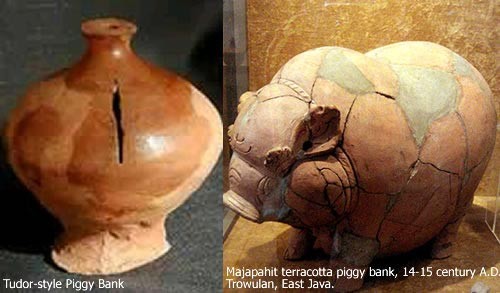
The Accidental Invention: The Origin Of Piggy Banks These days the piggy bank is taken for granted — it’s a coin bank, shaped like a pig. Kids love them. But where did they really come from? Why do people around the world stuff loose change into small pink pigs? The origin of piggy banks dates back nearly 600 years, in a time before real banks even existed. Before the creation of modern-style banking institutions, people commonly stored their money at home — not under the mattress (or hay rack), but in common kitchen jars. During The Middle Ages, metal was expensive and seldom used for household wares. Instead, dishes and pots were made of an economical orange-colored clay called pygg. Whenever folks could save an extra coin or two, they dropped it into one of their clay jars — a pygg pot. Vowels in early English had different sounds than they do today, so during the time of the Saxons the word pygg would have been pronounced “pug.” But as the pronunciation of “y” changed from a “u” to an “i,” pygg eventually came to be pronounced about like “pig.” Perhaps coincidentally, the Old English word for pigs (the farm animal) was “picga,” with the Middle English word evolving into “pigge,” possibly because of the fact that the animals rolled around in pygg mud and dirt. Over the next two hundred to three hundred years, as the English language evolved, the clay (pygg) and the animal (pigge) came to be pronounced the same, and Europeans slowly forgot that pygg once referred to the earthenware pots, jars and cups of yesteryear. So in the 19th century when English potters received requests for pygg banks, they started producing banks shaped like pigs. This clever — albeit accidental — visual pun appealed to customers and delighted children. Early models had no hole in the bottom, so the pig had to be broken to get money out. Some people say that’s where we get the expression “breaking the bank,” but serious academics disagree. The idiom “break the bank” means to ruin one financially, or to exhaust one’s resources. The term is believed to originate in gambling, where it means that a player has won more than the banker (the house) can pay. Western Europeans weren’t the only ones making piggy banks. Indeed the first true piggy banks — terracotta banks in the shape of a pig with a slot in the top for depositing coins — were made in Java as far back as the 14th century. Not many ancient Indonesian piggy banks survive today, since (like all early piggy banks) they needed to be busted apart to get at the coins. Unbroken Javanese piggy banks are very rare. In Great Britain, a 650-year old Majapahit terracotta piggy bank was offered for sale at £6,000.00 (just under USD$10,000). So that explains where the “pig” part came from, but how about the word “bank.” Way back when, the word “bank” originally meant the same thing as “bench.” You see, when money first started changing hands in Northern Italy, lenders did business in open markets, working over a table. These Medieval Venetian banks were set up in main squares by men who both changed and lent money. Their benches would be laden with currencies from the different trading countries. The Italian word for bench or counter is “banco” from which the English word “bank” is derived. (Some argue this is where the term “broke the bank” comes from. The Italian expression “banca rotta” means “broken bench,” with a broken bench possibly symbolizing that a money lender was out of business.
No comments yet