 @calvy28
more from that month
@calvy28
more from that month
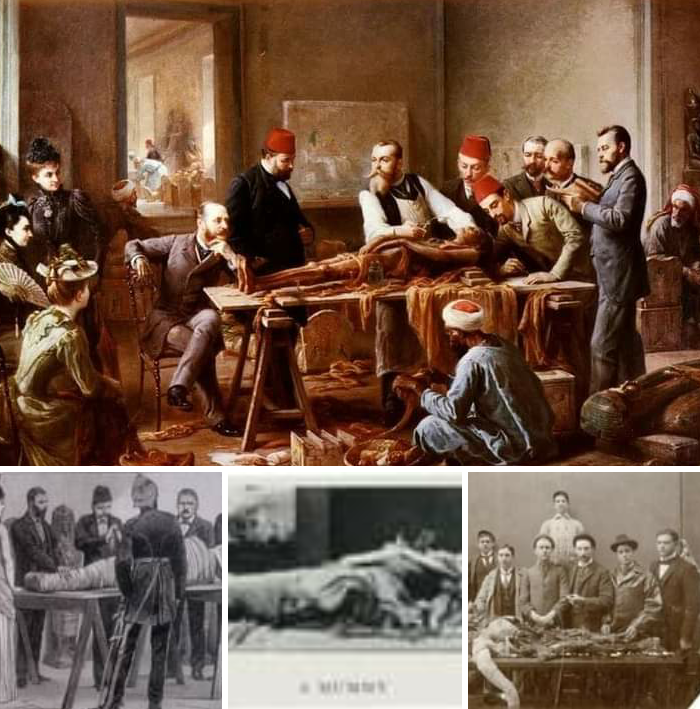
VICTORIAN PARTY PEOPLE UNWRAPPED MUMMIES FOR FUN. If you were looking to have a great night out on January 15, 1834, Thomas Pettigrew's sold-out event was definitely the place to be. The lucky Londoners who had managed to acquire a ticket for the Royal College of Surgeons that night, were looking forward to a rare sensation: before their eyes, Pettigrew was going to slowly unroll an authentic Egyptian mummy of the 21st dynasty–for science! Mummy unrollings were only one symptom of the Egyptomania sweeping England in the 19th century. Europeans had been buying mummies since Shakespeare's times to use them as medicine, pigment or even charms; now, the Napoleonic wars and England's colonial expanse had created a renewed interest in Egypt's past, to the point that, as the French aristocrat and Trappist monk Abbot Ferdinand de Géramb wrote to Pasha Mohammed Ali in 1833, “it would be hardly respectable, on one’s return from Egypt, to present oneself without a mummy in one hand and a crocodile in the other.” Demand was so high that the fledgling tourist industry in Egypt transported mummies from the least visited places of the country to place in their more popular ruins, in order to satisfy foreign visitors. Thomas Pettigrew was uniquely qualified to take this love affair with Egypt's dead to the next level. A highly respected surgeon now focusing on his antiquarian interests, Pettigrew had just published his very well-received History of Egyptian Mummies (1834). As a friend to many artists and authors–including Charles Dickens–he also knew how to spin scientific theory into fascinating spectacle. While he was not the first to unroll a mummy in front of an audience, he was the one to turn the procedure into a performance. The recipe was guaranteed to succeed: mixing Egypt, science and the macabre proved irresistible to the Victorians. The same people who thought it vulgar to take off their gloves in mixed company, delighted in having a millennia old corpse divested of its wrappings in front of them. Englishmen were not the only ones to be swept by this macabre romance with mummies. In his books The Romance of a Mummy and Egypt, French author Theophile Gautier describes one unrolling that took place in the Exhibition of 1857; he suggests that Edgar Allan Poe or E.T.A. Hoffman would find inspiration for their "weird tales" in the spectacle, but his own rendering is no less evocative. According to Gautier, there was, of course, a storm raging outside the Anthropology Museum where the unrolling took place. Nes Khons, the woman to be de-mummified, was placed in a contraption that made it seem like she danced as her bandages unraveled around her. Slowly, as the linens were removed, a number of funerary jewels were revealed on her person (Gautier lets us know that curiosity shops were filled with their likes). Even though he is touched by the addition of the now-colorless but perfectly preserved flowers under the woman's armpits, he also does not fail to point out that the "beautiful microscopic hawk" in her necklace would make for a "lovely watch-charm". Eventually, mummy unrollings fell out of favor with the scientific community as the idea of preserving ancient cultures rose in popularity. One wonders, though, if their most persistent inheritance is not to be found in archaeology but in literature. Perhaps the idea of a mummy as a vengeful monster was brought to life in one of these gatherings, as the sight of a sacred ritual reversed for the sake of science and entertainment struck a buried chord in those present. Such qualms would be hard to admit out loud, but this is what horror stories are for.
No comments yet