 @bitcoincashnode
edited
more from that month
@bitcoincashnode
edited
more from that month
BCHN Technical Bulletin 2022-05-16
**BCHN Network Architecture** **Date: May 16, 2022** Author: matricz ( @mtrycz ) Summary Introduction and rationale The general architecture `CConnman`'s threads Benefits and impact Appendix: Description of relevant classes and files Introduction and rationale The aim of this technical bulletin is to describe the current inner workings of the network management of the Bitcoin Cash Node software. The targeted audience are developers related to the Bitcoin Cash Node software project. Bitcoin Cash is a peer to peer network, so the network code is very important both from a functional and security viewpoint. The current incarnation of the network code (as of v24.0.0) is based on the general architecture set by the original Satoshi code in Bitcoin v0.1.0/v0.1.3 (Reference). https://satoshi.nakamotoinstitute.org/code/ The rationale for this documentation is the assessment of the benefits and impact of changing the general architecture with one that is more parallel (wrt peer communication). In the current implementation, the receiving network thread "commands" the rest of the application; moreover, only one incoming message at a time can be processed. Re-engineering this part of the application can have important performance improvements. No specific recommendations will be proposed in this report. All of the following is based on BCHN v24.0.0 (at `1ef932b1b7`). The general architecture The application has a globally scoped `std::unique_ptr<CConnman> g_connman` which, besides managing connections, as the name suggests, manages most of the aspects of networking. It is started as the last step of initialization, after all other subsystems have are running. In doing so, the initialization thread essentially passes the control of the application to the network threads. A `CNode` represents a node/peer, and it contains all of the information regarding the connection to that peer, including current network-level data buffers and application-level network `CNetMessage`s. `g_connman` maintains a vector of `CNode`s/connected peers. `Start`ing the `CConnman` will start the following threads: `net` running the `ThreadSocketHandler` function, which is responsible for net sockets reading and writing of messages. `msghand` running `ThreadMessageHandler` which handles messages received from peers. `addcon` running `ThreadOpenAddedConnections` and `opencon` running `ThreadOpenConnections` which manage connections to manually-added and network-announced peers. There is a level of decoupling here in that the `net` thread writes to the `CNode`s' `vProcessMsg` message list and reads from the `CNode`s' `vSendMsg` message deque, while the `msghand` thread does the contrary, and they work in parallel. One is a list and the other is a deque because of API requirements (specifically, deque lacks `splice()` used in the code). `CConnman`'s threads The `net` thread is a straightforward read/write loop for network sockets and for each iteration it: Does some initializations Marks each node/peer as "selected for receiving", "selected for sending" or neither Accepts connections from new nodes/peers, if any Makes a copy of the `vNodes` vector (to avoid concurrency issues and release locks quickly); for each node in the copied vector if it was set for receiving, receive data and possibly transform it into `CNetMessage`s; add them to `vProcessMsg` (the node's list of messages to be processed). Also `WakeMessageHandler`. otherwise, if it was set for sending, `SocketSendData` an `InactivityCheck` is done for the node/peer The `msghand` thread is a loop for application-level messages and it: Makes a copy of the `vNodes` vector; for each node in the copied vector processes a single message from the incoming `vProcessMsg` list, if any (via `ProcessMessages`). Processing a message will often have the effect of sending some messages - for example when we recieve a `GETDATA`, we'll end up enqueing the requested data in this `CNode`'s `vSendMsg` (via `CConnman::PushMessage`). If any of the `CNode`s has any more messages in `vProcessMsg` then the `fMoreWork` flag will be set to true. does a `SendMessages`; this will maintain connection with the peer via `ping/pong`, exchange recent peers, manage IBD (?), send `inv`entories for recent blocks and transactions, send `getdata` for transactions we're missing, and some other housekeeping regarding this `CNode` If `fMoreWork` has been set by any of the `CNode`s, the whole loop is repeated immediately; else it waits for the closest Poisson delay of the `CNode`s' `nNextInvSend` and repeats. Optionally, this thread can be woken up for processing with `WakeMessageHandler` (used by the `net` thread loop). The `PeerLogicValidation::ProcessMessages` and `ProcessMessage` functions are really complex. They have a big part of the p2p functionality and application logic. Each `CNode` has a Poisson delay set for sending `inv`s to it. When this delay expires for one node, all of the nodes will be processed again. The `addcon` thread opens connections to peers specified with the `addnode` command line parameter and RPC command. Nodes added using addnode (or -connect) are protected from DoS disconnection and are not required to be full nodes as other outbound peers are. https://docs.bitcoincashnode.org/doc/json-rpc/addnode/ The `opencon` thread will do two different things if the `-connect` parameter is specified. If it's specified, it will enter a loop that will connect to the specified IPs, and any further IPs specified with the `addnode` RPC command; exiting the loop will terminate the thread. Otherwise, it will enter into "normal operation" mode, which has an outer loop which finds seed nodes, calculates nodes to try, and an inner loop that will find one valid connectable address; after that, the outer loop will finish with a connection attempt to that address. Benefits and impact The `net` and `msghand` threads work in parallel, neatly separating the processing of network-level streams and application-level messages. Looking at the details of the `msghand` thread, it is evident that the processing of received messages is essentially single-threaded. This includes mempool admissions of transactions, block validation, or the ability to serve simple peer queries (e.g., GETDATA) while the processing of another message is running. The benefits could possibly be: A great increase in transaction admission rate. The longest steps of transaction admission are UTXO lookups (IO bound) and signature verification (CPU bound) - if they could be done in parallel (while the actual mempool data structure admission remained single-threaded), then the admission could scale out linearly on multicore CPUs, up until other limits are hit (mempool checks and inserts, ...). This cannot be done if only one single message (a TX in this case) can be processed. The ability to process blocks in parallel. Currently, if two blocks arrive in short order, one cannot be processed until the other has finished processing. There are tradeoffs to be made here, it's a functionality that might be useful (for example if I receive one big and then one smaller block, I'd might like to start mining on the smaller right away). The ability to serve simple peer and RPC requests even while some heavy processing is being done. Currently, if a peer asks for INVs, HEADERS or GETDATA, they cannot be satisfied if the processing of a big block is happening. There is no other technical reason for this though, and while it could put a small load on top of my block processing, it would optimize the network as a whole. This is a concrete bottleneck to network propagation in schemes like CompactBlocks. bitcoind is a peer-to-peer application, so the network processing is central to both functionality and security. Reworking the architecture of these central aspects comes with a set of costs and risks: The functionality needs to be either preserved or, where changes are made, they need to be accurately documented. Looking at the `msghand` loop, which works in strange ways, this could be difficult and nuanced. Would a different ordering of processing affect the functionality? The security needs to be preserved. In particular, all known DoS vectors need to be guarded for. This includes all of the explicitly implemented DoS protections, as well as some that could arise from changing the architecture (for example, currently, all peers' messages will be processed on every loop, so no one peer can "overwhelm" the others in my queues). Depending on how we want to go about it, all known and anticipated DoS vectors would need to be protected from with either: Manual verification of the code, while it changes; cheaper but more error prone. Automated verification via encoded tests; possibly more reliable but worth much more initial effort. There is always the possibility of introduction of a DoS vector that is both unknown and unanticipated, though. Moreover, there is always the possibility of introducing programming errors, especially in a big refactor. There are precedents for this, and the reputation hits this could lead to are quite important. This is very important, especially while the Bitcoin Cash Node software remains, to the best of my knowledge, the main node used for mining, and needs to be rock-solid reliable as it has always been. There is distinct but related architectural concern that will also need to be addressed to fully take advantage of an architectural rework: fine-grained locking. The `net` part of the current implementation relays on a multitude of fine locks for synchronization; on the other hand, the `msghand`/processing part grossly uses a single big lock (`cs_main`) most of the time. Even if we do parallelize the message processing, we would see little benefit without also implementing finer grained locks around it. The impact of doing so is out of the scope of the current report. Appendix: Description of relevant classes and files *In the following* `is a` strictly signifies that a class extends another. `has a` strictly signifies composition. A `CNetAddr` (in netaddress.h) represents a network address (IPv6, or IPv4 using mapped IPv6 range (::FFFF:0:0/96)). A `CService` (in netaddress.h) *is a* `CNetAddr` that also has a (TCP) port. A `CAddress` (in protocol.h) *is a* `CService` "with information about it as peer" (i.e. `ServiceFlags`). A `CAddrInfo` (in addrman.h) *is a* `CAddress` with "extended statistics". It is serializable and managed by `CAddrMan` (in addrman.h) which, among other things, is what reads and writes to the peers.dat file (via `CAddrDB`). A `CSubNet` (in netaddress.h) *has a* `CNetAddr` and a `netmask`. It's used by the `BanMan` (in banman.h), via `CBanDB`, and also other parts of the application, like the http server The `netbase.h` file has a number of functions for basic networking. A `NetEventsInterface` (in net_processing.h) is an "interface for message handling". The `PeerLogicValidation`, the class that does most of the network processing (in net_processing.cpp) *is a* `NetEventsInterface` (and also *is a* `CValidationInterface`); it is the only class that implements this interface. A `CNetMessage` (in net.h) contains partial or complete messages. While data is being received, the message can be left partial, until the next read. A complete message *has a* `CMessageHeader` and the `CDataStream`. A `CNode` (in net.h) represents information about a network peer. It *has a* `CAddress` and data structures for exchange of messages and raw data. A `CConnman` (in net.h) manages the connections to peers. It *has a* vector of `CNode` pointers, and methods to connect, disconnect and otherwise manage connections and peers.
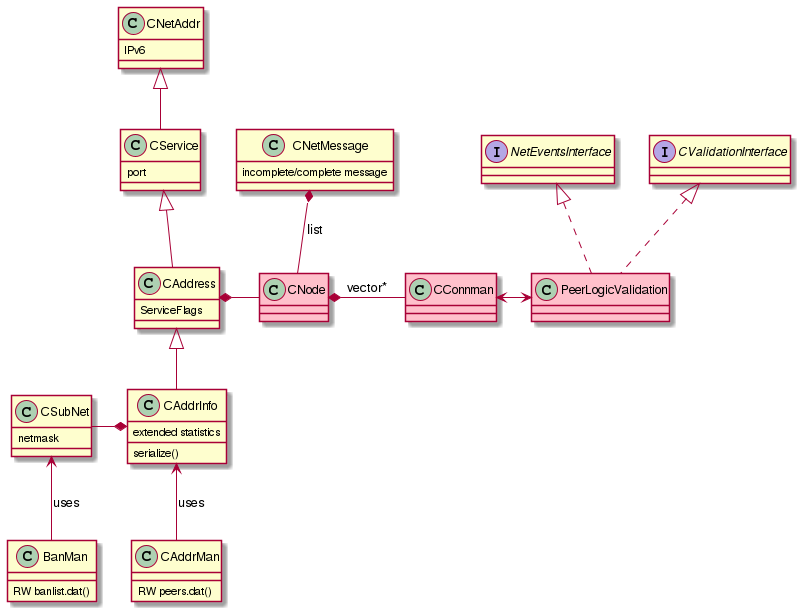
The above image presents the relevant classes and their interactions. The most important are figured in pink. Links: Repository link of BCHN announcements: https://gitlab.com/bitcoin-cash-node/announcements [sponsors]






No comments yet