Today's Fatherday
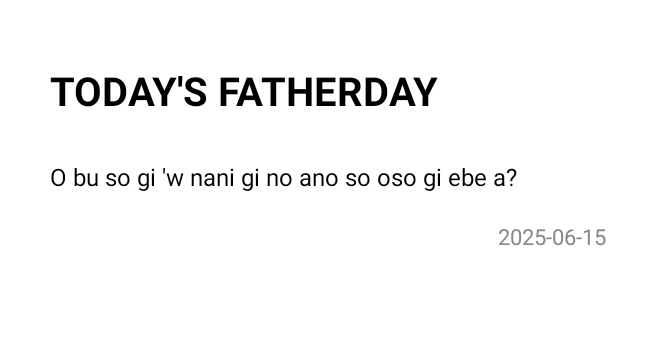
To translate the given Igbo sentence "O bu so gi 'w nani gi no ano so oso gi ebe a?" into Nkanu Igbo, we need to consider the dialectal variations within Igbo, particularly the Nkanu dialect spoken in parts of Enugu State, Nigeria. The Nkanu dialect tends to share much of the Central Igbo (Igbo Izugbe) vocabulary and grammar but may differ in pronunciation, tone, and some lexical choices. The sentence appears to mean something like "Is it only you that is here alone, you alone running here?" in English, though the phrasing suggests a context-specific or rhetorical question about someone being alone or unique in a step-by-step analysis to adapt it to Nkanu Igbo: Break down the original sentence: O bu so gi: "Is it only you" (rhetorical "Is it just you?"). 'w: Contraction of "na" (possibly "and" or a stylistic vocalization in some dialects. nani gi: "only you" (emphatic repetition for "you alone"). no ano: "are/is" (present tense of being/staying). so oso gi: "following your running" or "running with you" (possibly implying "you running alone"). ebe a: "this place" or "here". Consider Nkanu dialect features: Nkanu Igbo uses similar pronouns and verb forms as Standard Igbo, but some words may vary slightly in tone or form. For instance, "so" (only) and "nani" (only) are common across Igbo dialects, likely unchanged in Nkanu. The verb "no" (to be/stay) and "oso" (running) are also standard and likely the same. The phrase "ebe a" (this place/here) is standard Igbo and typically retained in Nkanu. The contraction "'w" might be expanded or pronounced differently in Nkanu, possibly as "na" or omitted depending on context. Adapt to Nkanu dialect: In Nkanu, the sentence structure remains similar, but we ensure natural flow by checking for redundancy or dialect-specific expressions. The double emphasis "so gi nani gi" ("only you, only you") might be streamlined in Nkanu to avoid repetition, as Nkanu speakers might use a single emphatic marker. The phrase "so oso gi" (running with you) might be rephrased for clarity, depending on whether it means "you running" or "following your pace." Proposed translation: A natural Nkanu Igbo rendering might be: "O bu soso gi na-a no ebe a n’oso?" O bu soso gi: "Is it only you" (using "soso" for emphasis, common in many Igbo variants including Nkanu). na-a no: "are" (progressive form of "to be/stay", standard and used in Nkanu). Ebe a: "here" (unchanged). n’oso: "in running" or "running" (simplified from "so oso", implying the act of running alone). This version maintains the rhetorical tone, asking if the person is the only one here or running alone, in a concise way that aligns with Nkanu’s dialectal tendency for clarity. Final Answer: In Nkanu Igbo, the sentence would likely be: "O bu soso n gi na-a no ebe a n’oso n?" Note: Since Nkanu Igbo is not as standardized, slight variations may exist depending on the specific Nkanu community (e.g., Nkanu East or West). If you have a specific context or Nkanu sub-dialect in mind, I can refine this further!
No comments yet