The Specimen Part 1
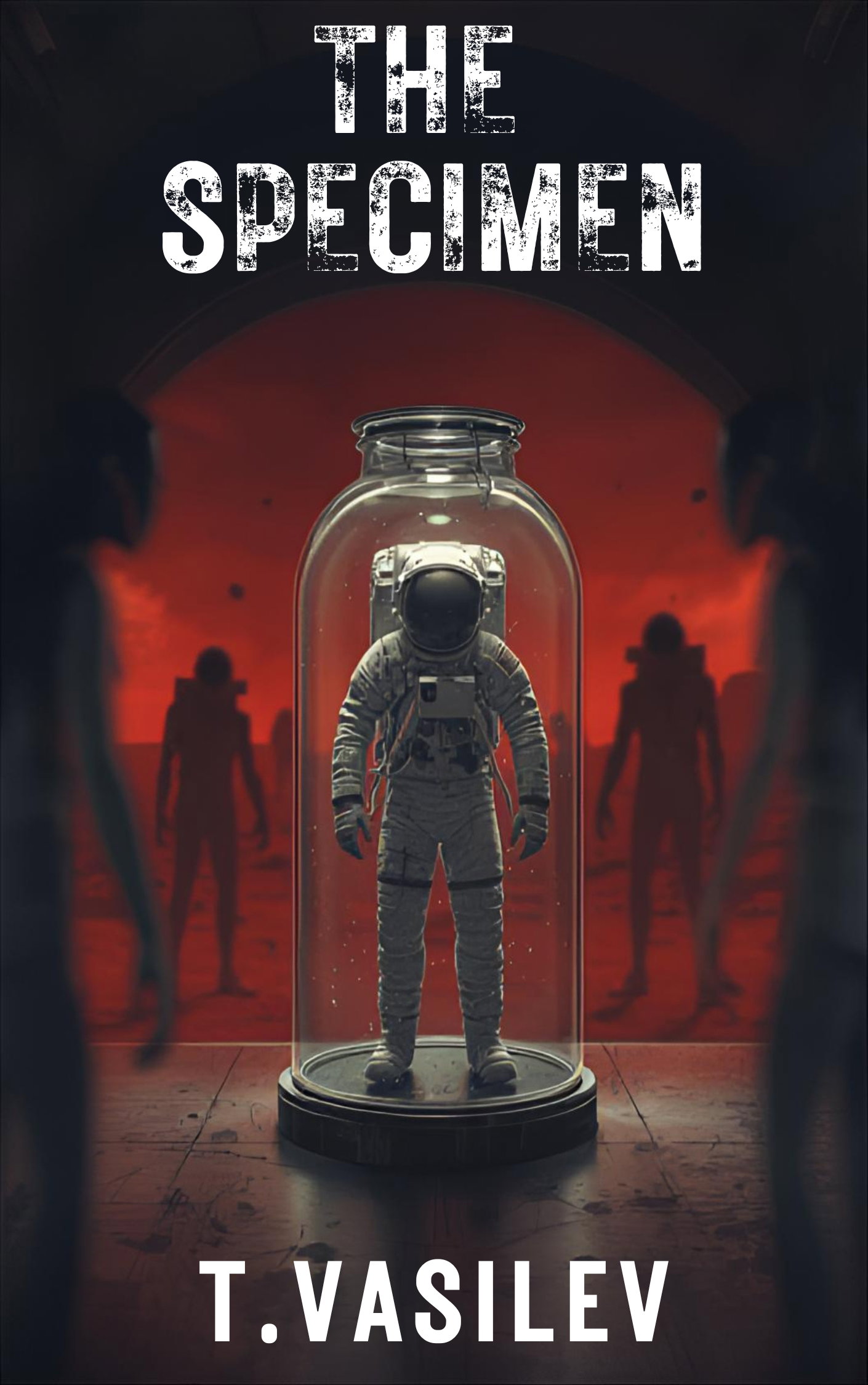
PROLOGUE: THE CAGE [MARS. OLYMPUS RESEARCH STATION. LOCATION UNKNOWN. DAY UNKNOWN.] Pain. That was the first thing Commander Elias Kane registered when consciousness dragged him back from the void. Not the dull throb of a headache. Not the ache of overworked muscles. This was something ancient, primal—a shriek that started deep in his nerve endings and exploded outward through every cell in his body like wildfire through dead grass. His eyes snapped open. White light. Blinding, sterile white light flooded his vision, searing into his retinas. He tried to raise his hand to shield his eyes, but his arm wouldn't move. He tried again, harder this time, straining with every ounce of strength he possessed. Nothing. Metal bit into his wrists. Cold, unyielding restraints held him immobile. His ankles too—he could feel the pressure, the complete absence of give when he tried to move his legs. Panic surged through him like electricity through water. Where am I? What happened? The mission—the landing— His thoughts were fragmentary, disjointed, puzzle pieces scattered across a table that he couldn't quite fit together. He remembered... red dust. The crunch of Martian soil under his boots. Radio chatter. Dr. Sarah Chen's voice saying something about the eastern ridge— Then nothing. A gap. A void in his memory like someone had taken scissors to the film reel of his consciousness and cut out several frames. He tried to turn his head, but something held it in place. A clamp of some kind—padded but firm—kept his skull locked in position. He could only move his eyes, darting left and right like a trapped animal, trying to piece together his surroundings from the limited fragments of his visual field. The ceiling above him was smooth, metallic, a dull gray-silver that seemed to absorb light rather than reflect it. Dotted across its surface were small circular ports—observation windows, maybe, or camera lenses. Dark glass eyes staring down at him with the blank indifference of security cameras. He could see his own reflection in one of them. Distorted, pale, terrified. The walls, what little he could see of them at the extreme edges of his vision, had the same smooth, seamless quality. No visible seams. No doors. No windows. Just unbroken surface, like the inside of an egg. And he was naked. Completely, utterly naked. The realization hit him with the force of a physical blow. The cold air of the room prickled against his exposed skin, raising goosebumps across his chest, his arms, his legs. He felt more vulnerable than he had ever felt in his entire forty-three years of life—more vulnerable than as a child in the hospital when they'd removed his appendix, more vulnerable than during his first spacewalk when only a thin suit separated him from the infinite vacuum. This was different. This was violation. "Hello?" His voice came out as a rasp, dry and broken, like he hadn't spoken in days. Or weeks. How long had he been unconscious? "Is anyone there?" Silence. "This is Commander Elias Kane of the Ares III mission." He tried to inject authority into his voice, tried to summon the tone of command that had served him so well throughout his career. "I am a representative of the United States of America and the United Nations Space Coalition. I demand to know—" A sound cut him off. Soft. Mechanical. A hiss of pressurized air being released, followed by a faint hydraulic whine. Then footsteps. Multiple footsteps, moving with deliberate, measured precision. Not the casual gait of someone walking down a hallway. This was methodical. Purposeful. The footsteps of someone—something—approaching a subject of interest. Elias strained his eyes to the right, trying to catch a glimpse of whoever was coming. His heart hammered against his ribs so hard he could hear it, feel it, a drumbeat of terror that seemed to shake his entire body. Get a grip. You're a scientist. You're trained for high-stress situations. Analyze. Assess. Don't panic. But his training, all those hours in simulators and pressure chambers and psychological evaluations, felt like thin paper against the crushing weight of pure, animal fear. Shadows moved beyond the edge of his vision. Tall shadows. Wrong shadows. The proportions were off—too elongated, too thin, like something stretched on a rack. "Please." The word escaped before he could stop it, and he hated himself for it. Commander Elias Kane did not beg. He did not plead. He commanded. He controlled. He was the apex predator in every environment he'd ever encountered. But here, now, stripped of everything—his uniform, his rank, his dignity, his humanity—the word came out small and broken. "Please. There's been a mistake. I'm human. I'm intelligent. I'm—" The footsteps stopped. A figure moved into his field of vision, standing directly above him, looking down. Elias tried to focus on it, tried to make sense of what he was seeing, but the overhead light created a halo effect that obscured most details. What he could see made his blood run cold. Tall. Impossibly tall. Seven feet at least, maybe more. The body was humanoid in the most general sense—two arms, two legs, a torso, a head—but the proportions were all wrong. The limbs were too long, too thin, like spider legs. The head was larger than a human head, more elongated, with a cranium that extended backward and upward. No hair. No visible ears. The face—if it could be called a face—was smooth and pale, almost luminescent in the harsh light. Where eyes should be, there were only dark indentations, like empty sockets, but Elias could feel the weight of their gaze nonetheless. It was looking at him. Studying him. The way he had looked at specimens in his laboratory. The way he had looked at the rhesus macaque with its skull opened, its brain exposed, its small hand reaching out for mercy that never came. The figure tilted its head, a gesture that was almost curious. Almost. Then it raised something in its hand—a long, thin instrument that gleamed silver under the lights. A probe of some kind. Or a scalpel. The tip was impossibly sharp, tapering to a point so fine it seemed to cut the air itself. "No." Elias's voice cracked. "No, wait. You don't understand. I can think. I can reason. I'm not—I'm not an animal. Please. Please, I'm intelligent. I—" The figure lowered the instrument toward his chest, moving with the calm, unhurried precision of someone performing a routine procedure. The cold metal touched his skin. "WAIT! PLEASE! I'M—" Pressure. Then pain. Not the sharp, localized pain of a cut. This was deeper, wronger, like the instrument was burrowing into him, searching for something beneath the skin. He could feel it moving, sliding between muscle and bone with surgical precision. Elias screamed. He screamed the way the macaque had screamed. The way countless animals in countless laboratories had screamed. A sound of pure, incoherent agony, stripped of all language, all reason, all pretense of sophistication. Just pain. Just terror. Just the desperate, primal plea for it to stop. But it didn't stop. The figure above him made no sound, showed no reaction. It simply continued its work, the instrument probing deeper, and Elias felt something inside him tear—not muscle, not bone, something else, something fundamental— Another figure appeared beside the first. This one carried what looked like a tablet, its surface glowing with symbols that hurt to look at, geometric patterns that seemed to fold in on themselves in ways that defied three-dimensional space. The second figure tapped something on the tablet. Then it made a sound. Not a voice. Not quite. It was more like a vibration, a frequency that bypassed Elias's ears entirely and resonated directly in his skull. He could feel it in his teeth, in his bones, in the soft tissue of his brain. And somehow—impossibly—he understood it. Not words. Not language. But meaning, pure and direct, like thoughts being placed into his mind: [Subject displays elevated stress markers. Cardiovascular rate: 187 units. Respiratory distress: severe. Vocalization pattern: distress call, likely automated survival response.] The first figure withdrew its instrument slightly, then adjusted its angle and pushed deeper. Elias's back arched against the restraints, every muscle in his body contracting simultaneously. The vibration came again: [Pain response confirmed. Neural architecture suggests primitive awareness—sufficient for basic stimulus-response patterns. Consciousness assessment: inconclusive. Recommend additional testing.] "No," Elias gasped. "No, I'm—I'm conscious. I'm thinking. I'm—" [Subject producing complex vocalizations. Investigating whether these represent true communication or merely reflexive sound generation. Comparable to documented 'distress calls' in other specimens from this planetary system.] The third figure approached, carrying another device—a scanner of some kind, covered in those same impossible symbols. It passed the device over Elias's head, and he felt a strange tingling sensation, like static electricity dancing across his scalp. [Cranial scan complete. Brain mass: within expected parameters for this species. Neural density: moderate. Frontal lobe development: primitive but present. Assessment: Subject may possess rudimentary problem-solving capability, comparable to previously catalogued fauna. True metacognition: unlikely.] "I'M CONSCIOUS!" Elias screamed. "I'M AWARE! I'M A PERSON! I'M—" [Subject continues vocalization despite clear indication that communication is not occurring. This suggests inability to recognize or adapt to communication failure. Further evidence of limited cognitive flexibility.] The first figure removed the probe entirely now. There was no blood on it. No tissue. Whatever it had been doing inside him had left no visible mark, but Elias could feel the wrongness, the violation, echoing through his nervous system. [Initial examination complete. Subject secured for extended observation. Recommend standard quarantine protocols before integration with other specimens. Schedule follow-up procedures for: neural mapping, tissue sampling, behavioral assessment, and reproductive capability evaluation.] "Please," Elias whispered, his voice breaking. "Please, I'm like you. I'm intelligent. I'm—" [Subject emotional state: deteriorating. Administering sedative to prevent self-harm and facilitate easier handling.] One of the figures pressed something against Elias's neck. He felt a sharp sting, then a spreading coldness that flowed through his veins like ice water. His vision began to darken around the edges. "No... wait... I can prove... I can prove I'm..." [Sedative effective. Subject entering dormant state. Vital signs: stable. Preparing specimen for transfer to observation habitat. Continue monitoring for signs of intelligence—though preliminary assessment suggests this is merely another of the planet's lower organisms. Fascinating that such limited cognition could develop rudimentary tool use. Recommend study of evolutionary pressures that led to this outcome.] The last thing Elias saw before darkness claimed him was the three figures standing over him, their elongated forms silhouetted against the white light, observing him with the clinical detachment of scientists cataloguing a particularly interesting insect. The last thought that flickered through his mind before unconsciousness took him: This is what I did to them. This is what I did. Then nothing. *** CHAPTER 1: THE APEX [THREE MONTHS EARLIER] [SEPTEMBER 8TH, 2067] [GENESIS BIOTECH LABORATORIES, CAMBRIDGE, MASSACHUSETTS. 9:43 AM.] The fluorescent lights in Operating Theater 3 hummed with the steady, monotonous drone of electricity coursing through tubes of mercury vapor. It was a sound Dr. Elias Kane had grown so accustomed to over the years that he no longer consciously registered it—it had become part of the background noise of his life, like the hum of traffic outside his apartment or the whisper of his own breathing. But Martha Chen heard it. She always heard it. To her, that hum was the soundtrack of suffering, a mechanical requiem that played every time they strapped down another subject and prepared to push the boundaries of what their flesh could endure in the name of science. She stood at the prep station, hands trembling slightly as she arranged the surgical instruments on the sterile tray. Scalpel. Retractors. Bone saw. Neural probes. Each tool gleaming under the lights, each one designed with exquisite precision to cut, to separate, to reveal. "Hand me the scalpel." Dr. Kane's voice cut through her thoughts like one of his blades through tissue—sharp, efficient, devoid of any wasted emotion. He stood at the operating table, already gloved and masked, his gray eyes fixed on the subject with the kind of focus that Martha had once admired and now feared. The rhesus macaque was small, barely twelve pounds, with fur the color of autumn leaves. It was strapped to the table with soft but secure restraints across its torso, limbs, and neck. The anesthesia mask covered its nose and mouth, delivering a carefully calibrated mixture of isoflurane and oxygen. But the animal's eyes were open. Wide open. Dark and glossy, pupils dilated with chemical sedation but still tracking movement, still aware. The protocols called for enough anesthesia to suppress pain response while maintaining basic consciousness for neural monitoring. It was a delicate balance, one that Dr. Kane had perfected over hundreds of procedures. Martha had read the protocols. She had signed off on them. She had even helped design some of them during her first year in the program, back when she still believed that advancing human knowledge justified any cost. But that was before she'd looked into their eyes. "Dr. Kane," she said quietly, glancing at the vital signs monitor. "Her heart rate is 182. That's significantly elevated for this stage of sedation." "Noted." Kane didn't look up. His hands moved with practiced precision, adjusting the cranial stabilizer that held the macaque's head in perfect alignment. "Mark it in the log." "Sir, I think she might be experiencing distress. Should we increase the sedation?" Now Kane looked up, his gray eyes meeting hers over the rim of his surgical mask. "Ms. Chen, we've been over this. The sedation is calibrated to minimize pain response while maintaining neural activity sufficient for meaningful data collection. If we increase it, we compromise the integrity of the experiment." "But—" "The scalpel, please." It wasn't a request. It was a command, delivered with the absolute certainty of someone who had never questioned his right to command. Martha's hand moved almost automatically, picking up the scalpel from the tray and placing it in Kane's outstretched palm. The weight of it, the reality of what she was facilitating, settled over her like a lead blanket. Kane tested the blade's edge with his thumb—not hard enough to cut, just enough to feel the sharpness. "Excellent. Now, as I was explaining before we began, this procedure will allow us to map the neural pathways associated with maternal bonding behavior in primates. The data we gather today will contribute directly to our understanding of attachment disorders in humans, potentially leading to treatments for conditions like postpartum depression, reactive attachment disorder, and even certain presentations of autism spectrum disorder." He positioned the blade at the top of the macaque's skull, where a small patch of fur had been shaved away hours earlier, revealing pink skin marked with blue surgical pen. The coordinates had been calculated based on MRI scans, precise to within a millimeter. "The sacrifice of one," Kane continued, his voice taking on the measured cadence of a lecture, "for the benefit of potentially millions. That's not cruelty, Ms. Chen. That's the fundamental equation of medical progress. Every breakthrough in history has been built on sacrifice. The only question is whether we have the courage to make that sacrifice meaningful." Martha said nothing. She kept her eyes fixed on the instrument tray, counting the remaining tools, anything to avoid looking at the small body on the table. Kane pressed down. The blade parted skin with a soft whisper, a sound like silk tearing. Blood welled immediately, bright red against pale pink, running in thin rivulets down the sides of the macaque's skull. The animal's body went rigid. For a fraction of a second—less than a heartbeat—Kane's hand hesitated. The macaque's eyes had rolled toward him, and in that instant, something in their depths reminded him of something he'd seen once, years ago. A child in a hospital. His nephew, maybe? The boy had looked at him with that same expression of confused betrayal when they'd told him he needed surgery, that they were going to cut him open while he slept. No, Kane thought immediately. No, that's different. That was a child. A human child, with consciousness, with understanding. This is just— Despite the anesthesia, despite the nerve blocks, despite every chemical barrier they had erected between the animal's consciousness and its pain, some signal got through—some fundamental alarm that shrieked through its nervous system like a lightning strike. The sound it made wasn't quite a scream. The mask muffled it, turned it into something worse—a high-pitched, desperate keen that seemed to vibrate in the bones of everyone in the room. Kane exhaled slowly, deliberately, and deepened the cut. The hesitation had lasted less than a second. A momentary glitch, nothing more. He was tired, perhaps. He'd been working long hours preparing for Mars. That was all. "Dr. Kane—" Martha's voice cracked. "Hold the retractor," he said sharply, not looking up from his work. "I need both hands for the cranial saw." She didn't move. "Ms. Chen." His voice dropped into a register she'd never heard before, cold and flat and absolutely devoid of empathy. "If you're unable to perform your duties as my research assistant, I can have Dr. Reeves take your place. However, I should remind you that this project is the centerpiece of your doctoral dissertation. Without the data from this procedure, you won't have enough original research to defend your thesis. Which means you won't graduate. Which means the last six years of your life will have been wasted." The threat hung in the air between them like a blade suspended by thread. Martha swallowed hard. Her throat felt like it was lined with broken glass. "Yes, sir." She picked up the retractor—a small metal device designed to hold skin and tissue apart—and stepped to the table. Her hands were shaking so badly she almost dropped it. "Steady," Kane said, and there might have been a trace of gentleness in his voice. Or maybe she just imagined it because she needed to believe that the man she was working for still possessed some fragment of humanity. "Just like we practiced. You're doing fine." She positioned the retractor at the edge of the incision, and Kane nodded his approval. "Good. Now maintain that position while I—" The macaque's eyes found hers. For one endless, terrible moment, Martha Chen looked directly into those dark, liquid eyes, and something looked back. Not just panic. Not just pain. Something that her training and her textbooks and every lecture she'd ever attended told her couldn't possibly exist in a non-human primate. Understanding. Recognition. A plea. The macaque's hand—the small, delicate hand that wasn't fully restrained by the straps—reached out. The fingers, so remarkably similar to human fingers, extended toward Martha. Not clawing. Not striking. Reaching. The way a drowning person reaches for a lifeline. The way a child reaches for its mother. Help me. Please. Make it stop. The words weren't spoken, couldn't be spoken, but Martha heard them anyway in that silent, desperate gesture. "Dr. Kane," she whispered. "Please. She's—" "She's experiencing a stress response," Kane cut her off, his attention focused on the bone saw he was positioning. "Elevated heart rate, increased muscle tension, vocalization—all perfectly normal reactions to noxious stimuli. But I want you to understand something, Ms. Chen, something fundamental to our work here." He looked up from the table, his eyes meeting hers with an intensity that made her take an involuntary step backward. "That animal," he said, gesturing at the macaque with the bone saw, "does not possess consciousness in any meaningful sense of the word. It doesn't have a sense of self. It can't conceptualize the future or reflect on the past. It exists purely in the present moment, reacting to stimuli with pre-programmed behavioral patterns shaped by millions of years of evolution." "But—" "When you look into its eyes and think you see 'someone' looking back, that's not reality. That's anthropomorphization. You're projecting human consciousness onto a biological machine that shares some superficial similarities with human anatomy. It's a natural cognitive bias, but it's one we must overcome if we're to do meaningful work." He activated the bone saw. The high-pitched whine filled the operating theater, drowning out the macaque's cries. "The truth is," Kane continued, raising his voice over the sound, "suffering requires a narrative sense of self. It requires the ability to understand that 'I am in pain,' that 'this is happening to me,' that 'I want this to stop.' Those metacognitive capabilities simply don't exist below the threshold of human consciousness. What you're seeing is no more meaningful than a plant turning toward sunlight. It's sophisticated, certainly. Evolution has created some remarkably complex mechanisms. But mechanism is all it is." He brought the saw down to the macaque's skull. "She doesn't suffer, Ms. Chen. She can't suffer. That's the difference between us and them. That's what makes us human." The saw bit into bone with a sound like grinding teeth. *** [GENESIS BIOTECH LABORATORIES. EXECUTIVE CONFERENCE ROOM. 2:17 PM.] The conference room occupied the entire twenty-third floor of the Genesis building, with floor-to-ceiling windows offering a panoramic view of Cambridge and, beyond it, the glittering skyline of Boston. On a clear day, you could see all the way to the harbor. Today, thin clouds diffused the afternoon sun into a soft, even light that made everyone look slightly washed out, slightly unreal. Seven members of the Genesis board of directors sat around the black glass conference table, their faces reflected in its polished surface like ghosts. Seven of the most powerful people in biotechnology, representing collective billions in funding, patents, and political influence. And they were all looking at Elias Kane. He stood at the head of the table, perfectly comfortable with their scrutiny, a presentation remote in his hand and a slight smile on his lips. Behind him, the massive LED screen displayed a 3D rendering of a human brain, cross-sectioned to reveal the intricate folds of gray matter, the branching highways of neural pathways, the beautiful, terrible complexity of the organ that made them human. "Gentlemen," Kane began, nodding to each board member in turn, "Dr. Alvarez"—he inclined his head specifically toward the one woman on the board—"what you're looking at is the culmination of three years of intensive research, over two hundred experimental procedures, and approximately forty-seven million dollars in funding." He clicked the remote, and the image zoomed in on a specific cluster of neurons in the prefrontal cortex, highlighted in pulsing blue. "This," Kane said, "is where love lives. Or, more precisely, this is where the neurochemical processes we interpret as maternal love originate and propagate. By mapping these pathways at unprecedented resolution, we've achieved something remarkable: we can now predict, with ninety-three percent accuracy, which mothers will develop postpartum depression. We can identify the specific neural markers that correlate with attachment disorders. And most importantly, we can develop targeted interventions—pharmaceutical, surgical, or both—to correct these dysfunctions." He paused, letting that sink in. Around the table, board members leaned forward, their faces showing varying degrees of interest and excitement. Raymond Howell, the chairman, was seventy-two years old and had shepherded Genesis from a small startup to a multi-billion-dollar corporation over four decades. His face, deeply lined and liver-spotted, bore the marks of age, but his eyes were sharp as ever. "Dr. Kane, your results are impressive. They always are. That's why we've continued to fund your research even when the ethical review board has raised... concerns." There it was. The word that had been hanging in the air since Kane entered the room. Concerns. "I appreciate the board's continued confidence in my work," Kane said smoothly. "As for the ERB's concerns, I understand their perspective. I truly do. The use of higher-order primates in medical research is a topic that generates strong emotions, even among scientists who understand its necessity." "Their report," Howell continued, pulling up a document on his tablet, "specifically questions whether rhesus macaques possess a level of consciousness that makes our current experimental protocols ethically problematic. They cite recent studies on primate cognition, mirror self-recognition tests, evidence of complex social structures..." "All valid points," Kane interjected. "And I've read those same studies. In fact, I've contributed to some of them. The question isn't whether rhesus macaques are cognitively sophisticated—they absolutely are. The question is whether that sophistication rises to the level of consciousness that would grant them moral status comparable to humans." Dr. Sarah Alvarez, the board's youngest member at forty-six, raised her hand slightly. "Dr. Kane, the Cambridge Declaration on Consciousness, signed by prominent neuroscientists from around the world, concluded that non-human animals, including primates, possess the neurological substrates necessary for conscious experience. How do you reconcile your position with that scientific consensus?" Kane had been waiting for this question. He clicked to the next slide, which displayed the full text of the Cambridge Declaration alongside a series of critical responses from other neuroscientists. "Dr. Alvarez, the Cambridge Declaration was an important document, but it's crucial to understand what it was and what it wasn't. It was a statement of possibility—'these animals may possess conscious experience'—not a definitive proof. And critically, it was a political document as much as a scientific one, designed to influence public policy on animal welfare." He clicked again, and the screen split into two columns. On the left, a video of a rhesus macaque using a touchscreen to solve a complex puzzle. On the right, a simple flowchart showing the decision tree the macaque's brain was following. "Watch this carefully," Kane said. "What you're seeing on the left appears to be problem-solving, deliberation, thought. The macaque tries different approaches, seems to 'figure out' the correct solution, and experiences what looks like satisfaction when it succeeds. It's impressive. It's sophisticated. But—" He highlighted the flowchart on the right. "What's actually happening is a series of trial-and-error responses shaped by reinforcement learning. The macaque isn't thinking, 'If I press this button, then that door will open.' It's following the neurochemical gradients of dopamine release that have conditioned its behavior through repetition. It's mechanism, not mind." "That seems like a convenient distinction," Alvarez said, her voice carefully neutral. "It's a testable distinction," Kane countered. "Let me give you an example. When a human child learns to solve a puzzle, they can then explain the solution verbally, transfer that knowledge to similar problems, and even teach others how to solve it. These capabilities emerge from genuine understanding—an internal model of how the puzzle works. A macaque can't do any of those things. It can learn a specific motor sequence through repetition, but there's no evidence of any underlying conceptual understanding." He advanced to the next slide, which showed MRI scans of human and macaque brains side by side. "More fundamentally, consciousness as we understand it—self-awareness, metacognition, the ability to reflect on one's own mental states—requires specific neural architecture. The prefrontal cortex in humans, particularly the anterior cingulate and the dorsolateral regions, are dramatically more developed than in any other primate. These are the structures that allow us to think about thinking, to have a sense of ourselves as entities persisting through time, to construct narratives about our experiences." He tapped the macaque brain scan. "This animal has those structures in rudimentary form, yes. But the gap in capability is enormous. It's the difference between a calculator and a supercomputer. Both can process numbers, but one has emergent properties that the other utterly lacks." Raymond Howell cleared his throat. "Dr. Kane, I appreciate the technical explanation, but let me ask you something more direct. The ERB's concern, at its core, is about suffering. Do these animals suffer during your procedures?" The room went very quiet. Every eye was on Kane. He set down the remote and leaned forward, both hands flat on the table. When he spoke, his voice carried absolute conviction. "They experience nociception—the neural detection of potentially harmful stimuli. Their bodies react to damage. But suffering, true suffering, requires something more. It requires a narrative self, an 'I' that can say 'I am in pain' and 'I want this to stop' and 'Why is this happening to me?' Those are sophisticated cognitive operations that require language, temporal reasoning, and self-awareness." He straightened up. "Think about it this way. When you get a paper cut, your nociceptors fire. Your body has detected damage. But you don't suffer from that paper cut, not really, because you understand what it is, you know it's temporary, you can contextualize it within your broader life experience. Now imagine that same nerve signal occurring in an organism that has no understanding of past or future, no concept of self, no ability to contextualize the experience. Is that suffering? Or is that just a biological response to stimulus, no more meaningful than a plant closing its leaves when touched?" "Are you saying the animals feel nothing?" Dr. Alvarez asked. "I'm saying they feel pain," Kane replied. "But pain and suffering are not the same thing. Pain is sensation. Suffering is a narrative we construct around that sensation. It requires consciousness, selfhood, the ability to stand outside one's immediate experience and judge it, fear it, wish for it to end. That," he tapped the macaque brain scan again, "cannot do those things." The presentation continued for another forty minutes. Kane walked them through the data, the applications, the potential treatments that could emerge from this research. He answered every question with precision and confidence, never wavering, never showing doubt. When it finally came time to vote, Howell looked around the table. "All in favor of continuing to fund Dr. Kane's research program through Phase IV, pending resolution of the ERB review?" Seven hands went up. Unanimous. "Congratulations, Dr. Kane," Howell said. "Continue your work." As the meeting concluded and board members began filing out, Dr. Alvarez caught Kane's eye and tilted her head slightly toward the hallway. A silent request for a private conversation. Kane nodded and followed her out. *** [GENESIS BIOTECH LABORATORIES. 23RD FLOOR HALLWAY. 3:02 PM.] The hallway was empty, all glass and steel and the kind of aggressively modern design that was meant to convey innovation and forward-thinking but mostly just felt cold. Through the floor-to-ceiling windows, Cambridge sprawled below them, tiny cars moving along tiny streets like blood cells through capillaries. Dr. Alvarez stopped at the windows and stood there for a moment, looking out. Kane waited, patient. He'd learned long ago that silence was a powerful tool—most people felt compelled to fill it, and in their eagerness to break the quiet, they often revealed more than they intended. Finally, Alvarez spoke. "I voted yes in there, Dr. Kane." "I noticed. I appreciate it." "But I want you to know that I'm not entirely comfortable with your position." Kane said nothing, waiting. "This idea that consciousness is binary, that there's a clear line separating humans from all other animals—I think it's more complicated than that." She turned to face him. "I think consciousness might exist on a spectrum, not as an either-or proposition. And if that's true, then where we draw the line of moral consideration becomes somewhat arbitrary." "An interesting philosophical position," Kane said carefully. "But ultimately unprovable. We can't measure consciousness directly. We can only infer it from behavior and neural architecture." "Exactly my point," Alvarez said. "We're making inferences. We're drawing conclusions based on incomplete data. And the risk of being wrong—of causing genuine suffering to beings that we've convinced ourselves can't suffer—that risk seems very high to me." Kane studied her. Dr. Sarah Alvarez had joined the Genesis board three years ago, after selling her biotech startup for a sum rumored to be in the high nine figures. She was brilliant, accomplished, and possessed of the kind of moral seriousness that Kane usually found tedious but occasionally had to respect. "Can I ask you something, Dr. Alvarez? Do you eat meat?" She blinked, surprised by the change in topic. "Yes. Why?" "Do you feel guilty about it?" "I... sometimes, yes. I try to buy from ethical sources, but—" "But you still eat it," Kane finished. "Because at the end of the day, despite any misgivings you might have, you believe that human flourishing—your own health, your own pleasure—justifies the death of animals. You've made a calculation, consciously or not, that your needs outweigh theirs." "That's different. That's—" "Is it?" Kane moved closer, his voice dropping to a more intimate register. "You're doing the same thing I am, Dr. Alvarez. You're placing human interests above animal interests. The only difference is the degree of directness. You pay someone else to kill the animal and package its flesh in plastic so you don't have to confront what you're consuming. I perform the sacrifice myself, in the open, in the service of knowledge that will benefit millions. If anything, my position is more honest." Alvarez's jaw tightened. "That's a false equivalence and you know it." "Is it? Let me ask you another question. If you had to choose—if you could either save the life of one human child or one hundred rhesus macaques, which would you choose?" "That's not a fair question." "Answer it anyway." She looked away, back out the window. "The child." "Why?" "Because... because a human child has greater moral value." "Based on what?" "Based on their potential for consciousness, for rich inner life, for—" "For being like us," Kane said softly. "That's what it comes down to, isn't it? We value human life more because humans are like us. They're our tribe, our species, our kind. And that's not wrong, Dr. Alvarez. That's not speciesism or prejudice. That's a fundamental feature of morality—we feel greater obligation to those we recognize as similar to ourselves." He stepped back, giving her space. "You voted yes in there because, deep down, you agree with me. You agree that human flourishing matters more than animal comfort. You agree that the work we're doing is necessary. You just don't want to feel like a bad person for agreeing." Alvarez turned to face him fully now, and there was something hard in her expression. "You're very certain of yourself, Dr. Kane." "I'm certain of the facts." "Facts can be interpreted in different ways." "Not these facts," Kane said. "Look, I understand your concerns. I truly do. But we can't let squeamishness about animal welfare impede progress on problems that cause real, measurable human suffering. That's not compassion—that's misplaced sentimentality." "And if you're wrong?" Alvarez asked quietly. "If it turns out that those animals do suffer in ways we haven't been able to measure? If our great-grandchildren look back on what we're doing now with the same horror we feel looking at medical experiments from the 1940s?" Kane met her gaze steadily. "Then I'll accept responsibility for that moral error. But I'd rather make the error of underestimating animal consciousness than the error of allowing human beings to suffer needlessly because we were too afraid to do what was necessary." Alvarez was quiet for a long moment. Then she said, "I hope you can sleep at night, Dr. Kane." "I sleep very well, Dr. Alvarez." He smiled slightly. "I suspect I sleep better than you do." She turned away from him, back toward the conference room. But before she walked away, she said over her shoulder, "There's a difference between confidence and arrogance. I hope you figure out which one you have before it's too late." Kane watched her go, her heels clicking sharply against the polished floor. Then he turned back to the window, looking out over Cambridge, over Boston, over the small, insignificant lives being lived in the city below. He thought about what she'd said. Confidence versus arrogance. As if there were some meaningful distinction. Confidence was just what people called arrogance when it was justified. And his was justified. He'd proven it, over and over again. Published papers in the top journals. Secured millions in funding. Made genuine breakthroughs that would help real people. His phone buzzed in his pocket. He pulled it out and looked at the screen. An email from NASA. His heart rate increased slightly—the only outward sign of the excitement flooding through him. He opened it. FROM: Dr. Rebecca Walsh, Director of Human Spaceflight TO: Dr. Elias Kane SUBJECT: ARES III Mission - Final Candidate Selection Dr. Kane, It is my great pleasure to inform you that you have been selected as Chief Science Officer for the ARES III mission to Mars. After extensive review of your qualifications, your research in neurobiology and stress adaptation, your physical and psychological assessments, and your exceptional publication record, the selection committee has unanimously chosen you for this role. The ARES III mission represents humanity's most ambitious space endeavor to date. While previous missions successfully established the Olympus Research Station and conducted preliminary surveys, ARES III will be the first to include an extended research component—eighteen months on the Martian surface, studying everything from geology to astrobiology to the long-term effects of low gravity and high radiation on human physiology. Your expertise will be invaluable to this mission and to humanity's future as a spacefaring species. Training begins October 15th at Johnson Space Center in Houston. Please confirm your acceptance by September 15th. Welcome to history, Dr. Kane. Dr. Rebecca Walsh Director of Human Spaceflight NASA Kane read the email three times, savoring every word like a fine wine. Mars. He was going to Mars. This wasn't just validation. This was apotheosis. He would be one of the first humans to live on another planet, to conduct research in an environment no one had ever studied before. He would quite literally be making history with every breath he took in that alien air, every sample he analyzed, every data point he recorded. He looked out the window again, but this time he wasn't seeing Cambridge or Boston. He was seeing beyond, past the atmosphere, past the Moon, all the way to a small red dot in the sky that most people never thought about. Mars. Waiting for him. He felt a surge of something that might have been joy, if he'd been the type of man who experienced joy. Instead, it was more like satisfaction—the deep, fundamental contentment of a person who knows, with absolute certainty, that they are exactly where they're supposed to be. At the top. At the apex. Where he belonged. *** [CHAPTER 2: THE SELECTION] [OCTOBER 15TH, 2067] [JOHNSON SPACE CENTER, HOUSTON, TEXAS. 8:17 AM.] The training facility at Johnson Space Center sprawled across 1,620 acres of Texas scrubland, a city-within-a-city dedicated entirely to the dream of human spaceflight. Massive buildings rose from the flat landscape like monuments to human ambition—Building 9, where full-scale mock-ups of spacecraft were housed; Building 32, with its Neutral Buoyancy Laboratory where astronauts trained for spacewalks; Building 220, home to the mission control center that had guided humanity through decades of space exploration. Elias Kane stood in the parking lot of Building 9, his rental car behind him, staring up at the structure with something approaching reverence. This was where astronauts trained. This was where the impossible became possible. And now he was one of them. "First day jitters?" Kane turned to find a woman approaching him, hand extended for a shake. She was in her late thirties, with olive skin, dark hair pulled back in a practical ponytail, and the kind of lean, athletic build that spoke of years of rigorous physical training. Her NASA jumpsuit fit her perfectly, bearing patches from two previous missions. "Dr. Sarah Chen," she said. "Geologist and mineralogist. I'll be the mission's primary surface operations specialist." Kane shook her hand, noting the firm grip. "Dr. Elias Kane. Neurobiology and stress physiology." "I know who you are," Chen said with a slight smile. "Everyone knows who you are. Your research on neural adaptation to extreme environments is part of the required reading for the program. Fascinating stuff." "I'm glad it was useful." "Useful and somewhat terrifying in equal measure," Chen said. Her smile faded slightly. "Some of your experimental protocols made me wonder what we're getting ourselves into, volunteering to spend eighteen months on an alien planet." "The protocols were designed to push boundaries," Kane said carefully. "To understand the absolute limits of neural adaptation under stress. But I can assure you, everything we do on Mars will be carefully calibrated to stay well within safe parameters." "Right. The macaques." Chen's expression became more guarded. "I actually read your latest paper last month. The one on maternal bonding pathways. The methodology was... thorough." There was something in her tone—not quite accusation, but not quite acceptance either. Kane had heard it before, that particular inflection that meant someone had questions but wasn't sure if they should ask them. Before he could respond, a commanding voice echoed across the parking lot: "ARES III crew! Assemble at Building 9, main entrance, on the double!" Kane and Chen exchanged a glance, then moved quickly toward the building. As they approached, Kane could see other crew members converging from different directions—some pulling roller bags, others with just backpacks, all wearing expressions that mixed excitement with apprehension. They gathered at the main entrance, nine people forming a loose semicircle. Standing before them was Commander James Rodriguez, a barrel-chested man in his mid-fifties with salt-and-pepper hair, weathered brown skin, and eyes that had seen things most humans never would. His flight suit bore patches from three previous missions, including ARES I—the historic first manned mission to Mars. "Good morning," Rodriguez said, his voice carrying easily across the group without seeming to shout. "Some of you I know from previous missions. Some of you I'm meeting for the first time. But starting today, all of that changes. For the next six months, we train as a unit. For the year after that, we travel and live together in conditions that would make a sardine can look spacious. And for eighteen months after that, we're going to be the only humans on an entire planet." He paused, making deliberate eye contact with each crew member. "You were selected from thousands of candidates because you're the best in your respective fields. You're brilliant, dedicated, and physically capable. But none of that matters if we can't function as a crew. In space, there's no calling in sick. There's no quitting because you don't like your coworkers. There's no stepping outside for fresh air when things get tense. We succeed together, or we die together. Those are the only two options." The weight of that statement hung in the morning air. "Let's start with introductions," Rodriguez continued. "I'm Commander James Rodriguez. I'll be responsible for overall mission leadership, spacecraft operations during transit, and keeping all of you alive—in that order." A few nervous laughs rippled through the group. Rodriguez gestured to a tall woman standing beside him, in her early fifties with close-cropped gray hair and the erect posture of someone with military background. "This is Dr. Patricia Morrison, our chief medical officer. She's kept astronauts healthy on two previous missions—including six months on the ISS and the ARES II Mars flyby. If something goes wrong medically, you'll be very grateful she's there. If nothing goes wrong, you'll probably forget she exists. She prefers the latter." Dr. Morrison gave a curt nod. "I should mention that 'keeping you healthy' includes psychological health. In an environment as isolated and stressful as Mars, mental fitness is just as important as physical fitness. Sometimes more so." "Next up," Rodriguez said, pointing to a lean man in his forties with dark skin and intelligent eyes behind wire-rimmed glasses, "Dr. Marcus Webb. Astrophysicist and communications specialist. He'll be managing our deep-space communications array, conducting astronomical observations, and making sure we don't lose contact with Earth—which would be bad." Webb gave a small wave. "I promise to keep the radio working. Mostly." "Lieutenant Sarah Kim," Rodriguez continued, indicating a petite Korean-American woman in her early thirties with sharp features and the kind of focused intensity that suggested she didn't tolerate fools. "Spacecraft engineer and pilot. She's my second-in-command and will be co-piloting the Hermes during transit. If something happens to me—God forbid—she's in charge." Kim nodded once, saying nothing, her expression suggesting she'd already mentally catalogued every potential failure point in the mission and developed contingency plans for each. "Dr. Hassan Al-Rahman," Rodriguez said, gesturing to a Middle Eastern man in his late thirties with a warm smile and the kind of weathered hands that suggested years of practical work. "Botanist and life support specialist. He'll be managing our hydroponics systems, recycling our air and water, and generally keeping us alive through the magic of photosynthesis." "I also do birthday cakes," Al-Rahman said with a grin. "Assuming we can grow enough wheat. No promises." "Dr. Jennifer Torres," Rodriguez continued, pointing to a Latina woman in her early forties with thick black hair and ink-stained fingers. "Atmospheric chemist. She'll be analyzing Mars's atmosphere, monitoring our habitat's air quality, and working on protocols for potential long-term terraforming applications." Torres offered a nervous smile. "I still can't believe they're letting me do chemistry on another planet. It's every geek's dream." "Thomas Brighton," Rodriguez said, indicating a stocky man in his early fifties with graying red hair and the muscular build of someone who worked with heavy machinery. "Systems engineer and robotics specialist. He keeps our equipment running, repairs whatever breaks—which will be everything, eventually—and maintains our rovers and drones." Brighton raised a grease-stained hand. "If it moves and it shouldn't, I'll stop it. If it should move and doesn't, I'll fix it. If it's completely broken, I'll improvise something that'll work just well enough to keep us alive. That's pretty much the job description." "Dr. Sarah Chen," Rodriguez said, and Chen stepped forward slightly. "Geologist and mineralogist. She's our surface operations specialist—the one who'll be spending the most time outside the habitat, collecting samples, mapping formations, and generally getting up close and personal with Mars." "I promise to bring back interesting rocks," Chen said. "Even if you don't appreciate them." "And finally," Rodriguez turned to Kane, "Dr. Elias Kane. Neurobiology and chief science officer. He'll be coordinating all research activities, conducting studies on how our brains adapt to Martian conditions, and probably publishing enough papers to make the rest of us look lazy." Kane stepped forward. "I'm here to learn. Mars presents unique challenges to human neurophysiology—the isolation, the altered day-night cycle, the low gravity, the radiation exposure. Understanding how our brains cope with these stressors will be crucial for future long-duration space missions." He scanned the group, reading their expressions. Chen looked guarded. Morrison looked assessing. Webb seemed friendly but reserved. The others were harder to read—excitement mixed with nervousness, the emotional cocktail of people about to embark on the adventure of a lifetime while also understanding the very real possibility they might not come back. "Now," Rodriguez said, "let's talk about what you're actually signing up for. Because despite all the psychological evaluations and informed consent forms you've signed, I'm not sure any of you truly grasp what Mars is like." He pulled out a tablet and tapped it a few times. A holographic display materialized in the air between them—a slowly rotating image of Mars, its red surface mottled with darker regions and the white caps of its polar ice. "This is where we're going," Rodriguez said. "It looks beautiful from here. Poetic, even. The Red Planet. Bringer of war. God of conquest. We've been staring at it since we were cavemen, wondering what was up there." He zoomed the image in on a specific region—a massive valley system cutting across the Martian surface like a scar. "This is Olympus Mons region, where our station is located. The temperature there averages minus eighty degrees Fahrenheit. On a warm day—if you can call it that—it might get up to fifty degrees. On a cold night, it can drop below minus two hundred." He swiped the display, bringing up atmospheric data. "The atmosphere is ninety-five percent carbon dioxide, less than one percent oxygen, and the atmospheric pressure is about one percent of Earth's. If you step outside without a suit, three things happen simultaneously: you suffocate, your blood boils, and you freeze. In that order. You've got about fifteen seconds of consciousness before your brain shuts down from hypoxia." Several crew members shifted uncomfortably. "The radiation," Rodriguez continued, bringing up more data, "is roughly twenty-five times higher than on Earth. That's because Mars has no magnetic field, no ozone layer. Solar radiation just hammers the surface constantly. We'll be living in reinforced habitats with radiation shielding, but every minute spent outside increases our cancer risk. Every. Single. Minute." He closed the hologram and looked around the group. "And then there's the psychological challenge. You're going to be forty-eight million miles from Earth—at our furthest point, anyway. Light takes about twenty minutes to travel that distance, which means there's a forty-minute delay for any two-way communication. If something goes wrong, Earth can't help you. They can send advice, but by the time you receive it, you'll already be dead or you'll have fixed the problem yourself." Dr. Morrison stepped forward. "That's where crew cohesion becomes critical. On Earth, if you're having a bad day, you can call a friend, go for a walk, grab a coffee, talk to a therapist. On Mars, your only social contact is the eight people in this circle. If those relationships break down, if conflicts fester, if someone starts to psychologically decompensate—well, there's nowhere to send them. We all live with the consequences." "Which is why," Rodriguez continued, "over the next month, all of you will undergo the most intensive psychological evaluation of your lives. We need to know how you handle stress. How you respond to conflict. How you cope with isolation, with fear, with boredom—because let me tell you, after six months of travel in a spacecraft the size of a city bus, boredom becomes a real enemy." He looked directly at Kane. "Dr. Kane, you're probably thinking your research has prepared you for this. You've studied stress responses, neural adaptation, all that. But there's a difference between studying something and living it. Between observing subjects under stress and being the subject." Kane met his gaze steadily. "I understand that, Commander. I wouldn't be here if I thought I couldn't handle it." "Confidence is good," Rodriguez said. "Overconfidence is dangerous. The difference between the two is self-awareness—knowing your limits, recognizing when you're approaching them, and having the humility to ask for help." He turned to address the whole group again. "Here's the schedule. For the next six months, you'll train together daily. Physical conditioning every morning—and I mean real conditioning, not casual gym time. Technical training on every system aboard the Hermes and at Olympus Station. Emergency procedures for every conceivable disaster, because in space, Murphy's Law isn't just a saying—it's a survival strategy. Geological field work in analog sites that resemble Mars. Psychological evaluations every two weeks. Team-building exercises that will make you either love or hate each other, ideally the former." He paused. "Some of you might wash out. That's not a failure—that's the system working correctly, making sure we send people who can handle what Mars will throw at them. If you realize this isn't for you, speak up. Better to know now than six months into the mission." No one spoke. Nine pairs of eyes stared back at Rodriguez with varying degrees of determination, excitement, and fear—but all of them, Kane noted, held their ground. "All right then," Rodriguez said, a slight smile crossing his weathered face. "Welcome to ARES III. Let's make history." *** [OCTOBER 23RD, 2067] [NEUTRAL BUOYANCY LABORATORY, JOHNSON SPACE CENTER. 2:34 PM.] The Neutral Buoyancy Laboratory was a marvel of engineering—a massive pool forty feet deep, 202 feet long, and 102 feet wide, containing 6.2 million gallons of water. Submerged in its depths were perfect replicas of spacecraft modules, equipment racks, and structural components. Here, astronauts in full EVA suits practiced the movements and procedures they'd need to perform in zero gravity, because water, when properly weighted, could simulate the physics of space surprisingly well. Elias Kane floated twenty feet below the surface, his movements slow and dreamlike in the bulky spacesuit. The suit weighed nearly 300 pounds on land, but here, with weights carefully distributed to achieve neutral buoyancy, it felt weightless. Every action took three times as long as it would on land—simple tasks like turning a valve or connecting a cable became elaborate choreographies of motion and counter-motion, action and reaction. His breathing echoed in his helmet, steady and controlled. Each exhale fogged the faceplate slightly before the suit's systems cleared it. Around him, safety divers floated like guardian angels, their sleek forms contrasting sharply with his bulky suit, ready to intervene if something went wrong. "Dr. Kane, I need you to move three meters to your right and secure the sample container to the mounting bracket." Rodriguez's voice crackled through the suit's communication system. The commander was on the pool deck above, watching multiple screens that showed the perspectives of all the astronauts currently in the water. Kane could see his own vital signs displayed on his heads-up display—heart rate 68 bpm, oxygen saturation 98%, suit pressure nominal. Kane oriented himself—not easy when there's no up or down, when your inner ear screams that you're drowning even as your rational mind knows you're perfectly safe. He used the handholds on the mock-up structure, pulling himself along carefully. Too much force and he'd overshoot. Too little and he'd barely move. Finding the sweet spot required practice, muscle memory, a feel for the physics that couldn't be taught, only learned. After what felt like an eternity but was probably only ninety seconds, he reached the mounting bracket. The sample container was tethered to his waist—a small cylindrical device that, in the real mission, would hold samples of Martian soil collected during EVAs. He unclipped it and maneuvered it toward the bracket. The first attempt failed. His gloved hands, thick and inflexible, couldn't quite align the container with the mounting pins. The container twisted away, the tether pulling it in an unexpected direction. "Take your time, Dr. Kane," Rodriguez said calmly. "There's no rush. Slow is smooth, smooth is fast. Do it right." Kane took a breath, forcing himself to slow down. He was used to working quickly, efficiently, his hands moving with practiced precision through hundreds of procedures. But this was different. This required patience, adjustment, a complete recalibration of how his body moved through space. He tried again. This time he got one pin aligned and pressed the container gently into place. It clicked home with a satisfying mechanical sound that he felt more than heard. "Good. Now secure it with the locking mechanism." Kane reached for the locking lever. His thick gloves made fine motor control nearly impossible. He gripped the lever, pulled down—too hard. The lever resisted, and the force sent him rotating slightly to the left. One of the safety divers moved in, steadying him with a gentle hand on his shoulder. Kane corrected his position, gripped the lever again, pulled more carefully. This time it moved smoothly, clicking into the locked position. "Excellent work, Dr. Kane. Sample container secured. Now I want you to simulate a malfunction. The container has become stuck, and you need to remove it using the emergency release. You'll find the release mechanism on the underside of the mounting bracket." Kane maneuvered his body around, trying to get a visual on the underside of the bracket. The suit's limited range of motion meant he had to twist his entire torso, using handholds to adjust his position. His heart rate ticked up to 74 bpm—still well within normal, but higher than his baseline. Interesting, he thought distantly, the scientist in him never quite turning off. Even though I'm cognitively aware that I'm in no danger, my autonomic nervous system is responding to the perceived stress of limited mobility and reduced visual field. Classic amygdala activation. He found the emergency release—a red handle recessed into the bracket. Getting to it required him to reach under the bracket at an awkward angle, his shoulder joint protesting even through the suit's padding. "Take your time," Rodriguez said again. "In a real emergency, rushing leads to mistakes. Mistakes lead to equipment damage or injury. Neither of those are acceptable outcomes." Kane gripped the red handle and pulled. Nothing happened. He pulled harder. Still nothing. "The release requires a ninety-degree rotation before pulling," Rodriguez said. "It's a safety feature to prevent accidental activation." Kane adjusted his grip, rotated the handle. It turned smoothly. Then he pulled, and the container came free. "Good. Return to the airlock for decompression." Kane made his way back through the mock-up structure, moving more confidently now. He'd been training in the NBL for three weeks, and his body was finally starting to adapt to the strange physics of neutral buoyancy. It still didn't feel natural—he wasn't sure it ever would—but he was functional. That was what mattered. The airlock was a cylindrical chamber at the edge of the pool. Kane entered it, waited while the water level lowered, then climbed the ladder to the deck. The weight of the suit hit him immediately, 300 pounds of mass that had felt weightless moments ago now pressing down on his shoulders, his spine, his legs. Two technicians helped him remove the helmet, then the torso piece, then the rest of the suit. By the time they were done, Kane was drenched in sweat. The suits didn't breathe well, and even the liquid cooling garment worn underneath couldn't entirely compensate for the heat generated by exertion. Dr. Morrison was waiting on the deck, clipboard in hand, looking clinical and assessing. "How do you feel?" "Tired. Hot. But good." "Any disorientation? Nausea? Pressure in your ears?" "No." She made a note on her clipboard. "You're adapting well. Better than most, actually. Your heart rate during the exercise stayed remarkably steady—never went above seventy-eight. That's impressive for a first-timer in a full EVA simulation." "I have good stress management protocols," Kane said, toweling sweat from his face. "So I've noticed." Morrison gave him an appraising look that lasted a beat too long. "In fact, your psychological profile is... interesting." "Oh?" "You score in the 99th percentile for stress tolerance. Extremely high on measures of confidence, self-assurance, and goal-directed behavior. Very low on empathy, emotional sensitivity, and what we call 'affiliative needs'—the desire for social connection and approval." Kane wasn't sure if that was a compliment or a criticism. "Is that a problem?" "Not necessarily," Morrison said carefully. "For a mission like this, we need people who can stay calm under pressure, who can make hard decisions without being paralyzed by emotion, who can function independently without constant social reinforcement. In that sense, your profile is actually ideal." "But?" Kane heard the unspoken word hanging in the air. "But," Morrison continued, "we also need people who can work as part of a team. People who can recognize when their crewmates are struggling and offer support. People who understand that in an isolated, high-stress environment, social cohesion isn't just nice to have—it's a survival requirement." Kane felt a flicker of irritation. "Dr. Morrison, if you have concerns about my psychological fitness for the mission, I'd prefer you voice them directly rather than dancing around them." Morrison's expression didn't change. "I don't have concerns about your fitness. You'll perform your duties excellently. I'm certain of that. You're disciplined, competent, and remarkably resistant to stress. Those are all valuable traits." "Then what's the issue?" "The issue," Morrison said, choosing her words carefully, "is that I'm not entirely sure you see the other crew members as people. I think you see them as variables to be managed. Components in a system. And that concerns me, because when things get hard—and they will get hard—we're going to need to rely on genuine human connection, not just efficient task management." Kane met her gaze steadily. "I understand the importance of crew cohesion. I'll do whatever the mission requires to maintain it." "I'm sure you will," Morrison said, and there was something in her tone that suggested she'd heard exactly what she expected to hear. "That's actually what worries me, Dr. Kane. You'll go through the motions of supporting your crewmates because you understand intellectually that it's required. But will you actually care if they're suffering? Or will you just see their suffering as a variable that needs to be optimized?" The question was uncomfortably perceptive. Kane had been thinking of Dr. Chen exactly that way just weeks ago—as a variable to be managed, a potential source of friction that needs to be smoothed over to ensure mission success. "I care about the mission succeeding," Kane said carefully. "And I understand that requires keeping the crew psychologically healthy. If someone is struggling, I'll help them. Not because of any emotional investment, but because it's the rational thing to do." "Exactly," Morrison said quietly. She made another note on her clipboard. "You're honest, at least. I appreciate that." She walked away, leaving Kane standing on the pool deck, dripping water and feeling, for the first time in a very long time, genuinely unsettled. Was she right? Did he see people as variables? As components in a system? He thought about the macaque, its small hand reaching out, its eyes pleading. He'd felt nothing. Or rather, he'd felt a moment of something—a flicker of recognition—and then he'd pushed it down, buried it, because feeling it would have made the work impossible. Morrison was suggesting that this same emotional detachment might be a liability on Mars. But Kane wasn't convinced. Throughout history, the people who'd achieved great things were the ones who could make hard decisions without being crippled by sentiment. Leaders who could sacrifice the few for the many. Scientists who could pursue knowledge regardless of cost. Explorers who could venture into the unknown without being paralyzed by fear or guilt. She's wrong, Kane thought as he made his way to the locker room. Emotions aren't a strength in space. They're a weakness. They cloud judgment, create conflicts, lead to poor decision-making. The crew will need someone who can stay rational, who can see the big picture, who won't fall apart when things get difficult. That's what I bring to this mission. Not empathy. Not warmth. But clarity. Rationality. The ability to do what needs to be done. And when we're on Mars, when the isolation really sets in, when people start breaking down, they'll understand. They'll be grateful that at least one person on that planet kept his head while everyone else was losing theirs. He didn't notice, as he stepped into the shower and let the hot water wash away the sweat and chlorine, that his thoughts sounded remarkably like the justifications he'd given for his laboratory work. The same logic. The same certainty. The same inability to consider that he might be wrong. *** [NOVEMBER 8TH, 2067] [JOHNSON SPACE CENTER, PSYCHOLOGICAL EVALUATION SUITE. 10:15 AM.] The psychological evaluation suite was deliberately designed to feel unthreatening—soft lighting, comfortable chairs, warm colors on the walls. A couch that looked like it belonged in someone's living room rather than a medical facility. Potted plants in the corners. Everything calculated to put the subject at ease, to lower their defenses, to encourage honest self-disclosure. Kane sat in one of the chairs, posture relaxed, expression neutral, while Dr. Marcus Reeves—NASA's chief psychological evaluator—reviewed notes on his tablet. Reeves was in his sixties, with thinning gray hair and the kind of face that suggested he'd heard everything and was surprised by nothing. "So, Dr. Kane," Reeves began, setting down his tablet and folding his hands, "let's talk about stress." "All right." "You score remarkably high on our stress tolerance assessments. In fact, your scores are in the top one percent of all astronaut candidates we've ever tested. That's impressive." "Thank you." "Tell me about a time in your life when you felt genuinely stressed. When you felt like you might not be able to cope with a situation." Kane considered the question. The truth was, he couldn't think of one. There had been difficult situations, certainly. Challenging experiments. Grant proposals that came down to the wire. Conference presentations to hostile audiences. But genuine stress? The sense that he might not be able to handle something? "I'm drawing a blank," Kane admitted. "Not because I'm trying to present myself as infallible, but because I honestly can't recall a situation where I felt that my coping mechanisms were insufficient." Reeves made a note. "Let's try a different angle. Tell me about a time when you failed at something important." That was easier. "My first marriage. I was twenty-eight, just finishing my postdoc. She was a fellow researcher. We thought we were compatible—similar interests, similar career goals. But it became clear within a year that we had fundamentally different values. She wanted children. I didn't. She believed in work-life balance. I believed in dedicating myself completely to my research. We divorced after eighteen months." "How did that make you feel?" "Relieved, honestly. It had been clear for months that we'd made a mistake. The divorce just formalized what we both already knew." "Did you feel sad? Angry? Guilty about the failure of the marriage?" Kane thought about that. "No. It was a logical mismatch. Two people with incompatible priorities. Ending the marriage was the rational solution." Reeves wrote something down, his expression carefully neutral. "Have you ever experienced clinical depression, Dr. Kane?" "No." "Anxiety?" "No." "Panic attacks?" "No." "Intrusive thoughts? Obsessive tendencies?" "No." Reeves set down his pen and looked at Kane directly. "Dr. Kane, I'm going to be frank with you. Your psychological profile is unusual. Most people experience emotional distress at some point in their lives—grief over a loss, anxiety about an important event, sadness during difficult times. You don't seem to experience any of those things. Or if you do, you process them in ways that don't register on our standard assessments." "Is that a problem?" "I'm not sure," Reeves said honestly. "On one hand, emotional resilience is valuable for long-duration space missions. The crews that do best are often the ones who can maintain emotional equilibrium despite isolation, confinement, and stress. On the other hand, emotions serve important functions. They help us bond with others, recognize when we're in danger, motivate us to take care of ourselves and our teammates." "I understand that intellectually," Kane said. "And I can modify my behavior accordingly." "That's what concerns me," Reeves said. "You understand emotions intellectually, but you don't seem to experience them viscerally. You can go through the motions of emotional connection, but it's performance, not genuine feeling. Am I wrong about that?" Kane considered lying. It would be easy enough. He could fabricate stories about times he'd felt deep sadness or profound joy, could describe emotions he'd observed in others and claim them as his own. But Reeves was too experienced for that. He'd detect the deception. "No," Kane said. "You're not wrong. I experience a limited range of emotions, and even those are muted compared to most people. I don't find this distressing. In fact, I consider it an advantage. Emotions cloud judgment. They lead to poor decision-making. They create unnecessary conflicts." "Or," Reeves countered, "they create necessary connections. They help us understand what matters. They give us reasons to keep going when logic alone would suggest we give up." "Perhaps," Kane conceded. "But I've never needed emotions for motivation. I'm motivated by curiosity, by the pursuit of knowledge, by the desire to achieve difficult goals. That's proven sufficient." Reeves picked up his tablet again, scrolling through more notes. "I want to ask you about your research. Specifically, your work with primates." Kane felt a small spike of alertness. "What about it?" "I've read your papers. The methodologies are rigorous, the results significant. But the protocols are also quite invasive. Many of your subjects don't survive the procedures. How do you feel about that?" "I feel that it's necessary," Kane said. "The data we obtain couldn't be gathered any other way. And the potential benefits to human health far outweigh the costs." "The costs being the suffering and death of the animals." "The costs being the use of non-conscious biological systems as research tools," Kane corrected. "The animals don't suffer in any morally meaningful sense. They experience nociception—pain signals—but not suffering, which requires a level of self-awareness they don't possess." Reeves was quiet for a moment. Then he said, "Dr. Kane, I want you to imagine something for me. Imagine that you're one of those macaques. You're strapped to a table, unable to move. Someone is cutting into your skull. You're in pain, but no one is helping you, no one is listening to your cries. How would that feel?" "It wouldn't feel like anything," Kane said immediately. "Because I wouldn't be capable of conceptualizing the experience. I'd be reacting to stimuli, but not suffering in any meaningful way." "But you're a human. You have consciousness. You can conceptualize your experience." "Exactly. Which is why the analogy doesn't work. I have capabilities that the macaque lacks. The gap between human consciousness and primate cognition is enormous." "Is it?" Reeves asked. "Or do we just tell ourselves that to justify what we do to them?" Kane felt his irritation rising. "Dr. Reeves, is this evaluation about my psychological fitness for the Mars mission, or is it about your personal opinions on animal research ethics?" "It's about understanding how you think," Reeves said calmly. "About understanding your capacity for empathy, your ability to recognize suffering in others, your willingness to prioritize the wellbeing of your crewmates even when it conflicts with mission objectives." "I understand the importance of crew wellbeing," Kane said. "I'll do whatever is necessary to maintain it." "Because it serves the mission," Reeves said. "Not because you actually care about your crewmates as individuals." "Does the motivation matter if the outcome is the same?" "Yes," Reeves said quietly. "It matters. Because when things get really difficult—when someone is breaking down, when life-or-death decisions need to be made—people can tell the difference between someone who genuinely cares about them and someone who's just going through the motions. And that difference can be critical." Kane said nothing. What was there to say? Reeves was right, and they both knew it. Kane didn't feel the kind of emotional connection to others that most people seemed to take for granted. He could simulate it, could go through the appropriate motions, could say and do the things that maintained social cohesion. But it was all performance, calculation, a learned behavior rather than an authentic feeling. "Dr. Kane," Reeves said after a long silence, "I'm not going to disqualify you from the mission. Your technical qualifications are impeccable, your stress tolerance is remarkable, and your ability to function under pressure is exactly what we need. But I am going to include a note in your file recommending that Commander Rodriguez keep a close eye on your interactions with the crew. And I'm going to suggest that you spend some time between now and launch thinking about why you're so comfortable with suffering—as long as it's someone else's." The evaluation concluded ten minutes later. Kane left the suite and walked out into the bright Texas sunlight, his thoughts churning. Reeves's final comment had struck closer to home than Kane wanted to admit. Why are you so comfortable with suffering—as long as it's someone else's? The answer was obvious, wasn't it? Because he was capable of contextualizing that suffering, of weighing it against potential benefits, of making rational calculations about acceptable costs. Because he understood that progress required sacrifice, that knowledge had a price, that the strong had both the right and the responsibility to use the weak in service of greater goods. But another part of his mind—a quieter, more insistent part—whispered a different answer: Because I've never really suffered myself. Because I've never been the one strapped to the table. Because I've always been the scientist, never the subject. Kane pushed that thought away. It was irrelevant. Sentimental. The kind of emotional reasoning that led to paralysis and inaction. He had a mission to prepare for. That was what mattered. Not introspection. Not self-doubt. Not the nagging suspicion that everyone who questioned his methods might be seeing something he couldn't. *** [DECEMBER 14TH, 2067] [ATACAMA DESERT, CHILE. 7:23 AM.] The Atacama Desert was the closest thing Earth had to Mars. It was the driest place on the planet, receiving less than a millimeter of rainfall per year in some regions. The landscape was rust-red and desolate, punctuated by volcanic rocks and ancient salt flats. The elevation was high enough that the air was thin, the UV radiation intense. NASA had been conducting Mars analog training here for decades. The ARES III crew stood on a rocky plateau, suited up in simulation spacesuits that weren't quite as cumbersome as real EVA suits but still restricted movement enough to approximate Martian conditions. The morning sun was just cresting the horizon, painting the desert in shades of orange and red that could have been another planet entirely. "All right, people," Rodriguez's voice came through their helmet radios. "Today's exercise is sample collection. Dr. Chen, you're team lead. You've got six hours of simulated oxygen, three crew members to coordinate, and a list of geological targets to hit. Show me what you've got." Chen consulted her tablet, which displayed a topographical map of the area with marked locations. "Okay, we're going to split into two teams. Dr. Kane, you're with me. We'll head northeast to the basalt formation. Lieutenant Kim, take Brighton and head southwest to the sedimentary deposits. We'll maintain radio contact and rendezvous back here in four hours." "Roger that," Kim said, her voice crisp and professional. The teams split up. Kane followed Chen across the rocky terrain, moving carefully in the restrictive suit. Each step required deliberate placement—the boots were heavy, the ground uneven, and a fall could mean a torn suit, which in the simulation meant mission failure. They hiked for twenty minutes before reaching the basalt formation—a massive outcropping of dark volcanic rock that jutted from the desert floor like the bones of some ancient leviathan. "Beautiful," Chen murmured, approaching the formation with obvious reverence. "Okay, Dr. Kane, I need you to extract a core sample from this section here." She pointed to a relatively smooth face of rock. Kane unpacked the coring drill from his equipment bag—a battery-powered device designed to extract cylindrical rock samples. He positioned it against the rock face, braced himself, and activated it. The drill bit into the stone with a high-pitched whine. Dust sprayed outward, coating his faceplate in fine red particles. He had to stop periodically to clear his vision, wiping the faceplate with a gloved hand—an awkward process that smeared more than cleaned. After five minutes, he'd extracted a core about six inches deep. He carefully removed it from the drill and placed it in a sample bag. "Good work," Chen said. She was photographing the formation from multiple angles, documenting the context of the sample. "Now let's move up to that ridge. I want samples from the contact zone where the basalt meets the sedimentary layer." They climbed. The incline wasn't steep, but in the suits, with the thin air and the morning heat already building, it was exhausting. Kane's heart rate climbed to 110, 120. Sweat ran down his face, stinging his eyes, pooling in his collar. By the time they reached the ridge, he was breathing hard. So was Chen. "Water break," she said, activating the suit's internal hydration system. Kane did the same, sucking water through the tube in his helmet. It was warm and had a plastic taste, but it was wet. They stood there for a moment, catching their breath, looking out over the vast expanse of rust-colored desert stretching to the horizon. "It really does look like Mars," Kane said. "Closest thing we've got," Chen agreed. "Though the real Mars will be colder. And more isolated. And we won't be able to take these suits off at the end of the day." "Are you nervous?" Kane asked. It was an uncharacteristic question—he didn't usually inquire about people's emotional states unless it was professionally relevant—but something about the moment, the isolation, the shared exhaustion, prompted it. Chen was quiet for a moment. Then she said, "Terrified. Every day I wake up and think, 'What the hell am I doing? I'm going to another planet. I'm going to be forty-eight million miles from home, from everyone I know, from everything familiar.' And then I think, 'And I wouldn't miss it for anything in the world.'" She turned to look at him through her faceplate. "What about you? Are you scared?" Kane considered the question honestly. "No. I'm... excited. Curious. Eager to begin. But not scared." "Not at all?" "Not at all." Chen studied him for a long moment. "That's either incredibly brave or incredibly foolish. I haven't decided which." "Maybe both," Kane said. "Maybe." She turned back to the rock face. "Come on. Let's get these samples before we roast to death in these suits." They worked for another two hours, collecting samples, documenting formations, practicing the procedures they'd use on Mars. Kane found himself appreciating Chen's methodical approach, her obvious passion for the work, the way she could read the landscape like a book written in stone. What he couldn't quite grasp was her fear. To Kane, fear seemed like an impediment, an unnecessary emotional response to a situation that should be approached analytically. Mars was dangerous, yes. The mission carried substantial risks. But those risks could be quantified, planned for, mitigated. Fear didn't help with any of that. It just created stress and clouded judgment. But then again, maybe that was the difference between him and everyone else. They felt fear and pushed through it. He simply didn't feel it in the first place. He wasn't sure which was more admirable. *** [FEBRUARY 22ND, 2068] [JOHNSON SPACE CENTER, CREW QUARTERS SIMULATION. 9:17 PM.] The crew quarters simulation was designed to replicate exactly the living conditions they'd experience during the six-month journey to Mars. Nine people, confined to a space roughly the size of a large RV, with limited privacy, limited resources, and no escape. For the next two weeks, the ARES III crew would live in this simulation 24/7, eating the same reconstituted meals they'd eat in space, using the same waste management systems, sleeping in the same cramped bunks, dealing with the same interpersonal tensions that would inevitably arise. It was the final major test before launch, scheduled for April 15th—less than two months away. Kane lay in his bunk—a coffin-sized sleeping pod with just enough room to lie flat—staring at the curved ceiling inches from his face. The ventilation system hummed. Somewhere nearby, someone was snoring. Farther away, he could hear muffled conversation—Hassan and Jennifer discussing something in the common area. He couldn't sleep. Not because of the noise or the discomfort—he'd learned to sleep anywhere during his years of research—but because his mind was churning, processing, analyzing. In seven days of simulation, fault lines were already appearing in the crew dynamics. Lieutenant Kim and Tom Brighton had gotten into an argument that morning about proper maintenance procedures for the life support system. The disagreement had been ostensibly technical, but Kane had recognized it for what it really was: two strong personalities clashing, both accustomed to being right, neither willing to back down. Dr. Torres had become visibly irritable, snapping at people over minor issues. Kane suspected she was experiencing claustrophobia—the simulation quarters were significantly smaller than her apartment, and unlike her apartment, there was nowhere to go when she needed space. Dr. Webb had withdrawn into himself, spending most of his time in his bunk with noise-canceling headphones, communicating with the crew only when necessary. Classic introvert response to overstimulation. Dr. Al-Rahman and Chen seemed to be adapting well, maintaining positive attitudes despite the confinement. Commander Rodriguez was handling the tensions with practiced skill, mediating conflicts, maintaining structure, keeping everyone focused on the mission. And Dr. Morrison was watching all of them—including Kane—with the clinical assessment of someone whose job was to identify potential psychological breakdowns before they became critical. Kane had been approached by three different crew members over the past week, each seeking what they probably thought of as "support" or "connection" but what Kane recognized as emotional maintenance—the social grooming behaviors that humans engaged in to manage stress and maintain group cohesion. Dr. Torres had tried to start a conversation about her concerns about the mission, clearly fishing for reassurance. Kane had provided that reassurance—not because he felt her fears were groundless, but because he understood that addressing them would improve her psychological state and therefore her performance. Tom Brighton had made an off-hand comment about missing his ex-wife, a transparent attempt to bond over shared experiences of loss. Kane had said appropriate things about the challenges of maintaining relationships in demanding careers, though he felt no actual connection to the sentiment. Hassan had invited him to join a card game, a social ritual designed to build camaraderie. Kane had participated, played adequately, laughed at appropriate moments, and felt absolutely nothing except mild boredom. He was performing crew cohesion. Going through the motions. Saying and doing the things that maintained the social fabric of the group. And it was working. As far as he could tell, the crew accepted him as one of them, viewed him as a supportive teammate, had no idea that every interaction was calculated, every expression of concern or interest or humor carefully calibrated to achieve specific social outcomes. Morrison knew, of course. She'd seen through him from the beginning. But Morrison wasn't going to disqualify him—she'd said as much. His technical competence outweighed his emotional limitations. A soft knock on his sleeping pod interrupted his thoughts. "Dr. Kane? You awake?" Chen's voice, quiet, trying not to disturb anyone else. "Yes," Kane said, pressing the button that slid open his pod door. Chen was standing in the narrow corridor, wearing sleep clothes, her hair loose around her shoulders. She looked tired, stressed. "Can we talk for a minute?" "Of course." They moved to the common area—a cramped space with a small table, a few fold-down seats, and a window that showed a video feed of Earth from "orbit," part of the simulation's psychological support systems. Chen sat down, and Kane sat across from her. She was quiet for a moment, gathering her thoughts. "I wanted to apologize," she finally said. "For what?" "For judging you. When we first met, when I asked about your research—I had opinions about your methods. About the ethics of animal experimentation. And I realize now that I was being unfair." Kane hadn't expected this. "Why do you think you were being unfair?" "Because I was questioning your work without understanding the full context. Because I was applying my own emotional reactions to a field where emotion isn't the right lens. Because..." She paused. "Because I've been watching you with the crew, and I see how much effort you put into supporting everyone, even when you're probably exhausted yourself. You're a good teammate, Dr. Kane. I misjudged you." Kane felt a strange sensation in his chest. Not quite guilt—he didn't think he was capable of guilt—but something adjacent to it. Discomfort, perhaps, at the gap between how Chen perceived him and what he actually was. She thought he was putting in effort to support the crew out of genuine care. In reality, he was managing variables. He should accept the apology, say something gracious, reinforce the positive perception. That was the strategically correct response. But instead, he found himself saying, "You didn't misjudge me, Dr. Chen." She blinked. "What?" "Your initial instincts were correct. I don't feel emotional connection the way most people do. When I interact with the crew, when I offer support or show interest in their wellbeing, it's because I understand intellectually that these behaviors are necessary for mission success. Not because I actually care about them as individuals." Chen stared at him, clearly not sure how to respond to this unexpected honesty. "I'm telling you this," Kane continued, "because I don't want you to feel bad about your initial judgment. You saw something true about me. Your only mistake was talking yourself out of believing it." "That's..." Chen paused, choosing her words carefully. "That's a pretty stark self-assessment." "It's an accurate one." "Does Commander Rodriguez know? Dr. Morrison?" "Morrison knows. Rodriguez suspects, I think, but hasn't directly addressed it." "And you're telling me this why?" Kane considered that question. Why was he telling her? It was strategically unwise. It could create friction, undermine trust, potentially even get him removed from the mission if she reported it. "Because," he said slowly, working through his own motivations, "I think you're going to be one of the most important people on this mission. You'll be spending more time on the surface than anyone else. You'll be the person who really gets to know Mars. And I think... I think you deserve honesty from your crewmates. Even when that honesty is uncomfortable." Chen was quiet for a long time. Then she said, "I appreciate you telling me. I do. But Dr. Kane—can I ask you something?" "Of course." "If you don't care about us as individuals, why are you going to Mars? What's motivating you?" "Curiosity," Kane said immediately. "The desire to understand something no one has understood before. The challenge of pushing human capability to its absolute limits. The satisfaction of achieving something that most people think is impossible." "So it's all about you," Chen said. "About your own achievement." "Yes," Kane said. "I suppose it is." Chen nodded slowly, processing this. Then she stood up. "Thank you for being honest. I'm not sure how I feel about what you've told me, but I appreciate not being lied to." She started to leave, then paused at the corridor entrance. "For what it's worth, Dr. Kane, I still think you're going to be a good teammate. Not because of what you feel or don't feel, but because you're honest about it. That matters more than you might think." She disappeared into the corridor, leaving Kane alone in the common area, staring at the simulated Earth rotating slowly on the video screen. He had just made himself vulnerable in a way he never did. Had revealed something about himself that most people would consider a profound deficiency. Had potentially undermined his position with one of the key crew members. And yet, he didn't regret it. Perhaps there was something in him capable of growth after all. Or perhaps this was just another calculation—building trust through selective vulnerability, a more sophisticated form of social manipulation. He honestly wasn't sure which. And for the first time in his life, Elias Kane found himself wondering if that uncertainty might actually be progress. *** [CHAPTER 3: THE LAUNCH] [APRIL 14TH, 2068] [CAPE CANAVERAL SPACEPORT, FLORIDA. 11:47 PM.] The night before launch, Kane couldn't sleep. Not from nerves—he still didn't feel those—but from a kind of electric anticipation that hummed through his nervous system like low-voltage current. Tomorrow, he would leave Earth. Would begin a journey that would take him farther from home than any human had traveled before. Would set foot on an alien world. He stood at the window of his crew quarters, looking out across the launch complex. In the distance, flood-lit against the darkness, the Ares rocket stood on its pad—a massive white pillar reaching toward the stars, 328 feet of precisely engineered metal and fuel and explosive potential. Somewhere inside that rocket, secured in the payload bay, was the Hermes—the spacecraft that would be their home for the next six months of travel. It was smaller than Kane had expected when he'd first toured it months ago. The crew compartment was barely larger than the simulation quarters they'd trained in. The life support systems, the navigation computers, the communications array—all of it packed into a vessel that suddenly seemed impossibly fragile for the task it was designed to perform. And yet, it would work. Humans had been building machines to conquer the impossible for millennia. This was just the latest in a long line of audacious gambles. A knock on his door. "Come in," Kane said. Dr. Morrison entered, carrying two cups of coffee. She handed one to Kane without asking if he wanted it. "Couldn't sleep?" she asked. "No." "Me neither. Never can, the night before a launch." She joined him at the window, looking out at the rocket. "It never stops being surreal. The fact that we've built a machine that can throw us at another planet and have us arrive alive." "It's remarkable," Kane agreed. "Are you scared yet?" Kane smiled slightly. "Dr. Morrison, if I wasn't scared during the psych evals, I'm not going to suddenly develop fear the night before launch." "Fair enough." She sipped her coffee. "Dr. Chen talked to me. About your conversation during the simulation." Kane felt a small spike of alertness. "And?" "And I think it was one of the most psychologically healthy things you've done since joining this program." That wasn't the response Kane had expected. "Really?" "Really. You were honest with her—genuinely honest, not strategically honest. You showed vulnerability, which isn't something you do often. And you demonstrated that you're capable of self-reflection, even if the conclusions you reach about yourself aren't particularly flattering." "I'm not sure Chen appreciated the honesty." "She appreciated it more than you know," Morrison said. "She told me it was the first time she felt like she really understood you. And understanding, even uncomfortable understanding, builds trust better than comfortable deception." She turned to face him directly. "Dr. Kane, I've been doing this for thirty years. I've evaluated hundreds of astronauts, sent dozens of them into space. And I can tell you with certainty that you're one of the most unusual people I've ever assessed." "Is that a compliment?" "It's an observation. You're missing something that most people have—call it empathy, emotional connection, whatever. But you're also extraordinarily competent, honest about your limitations, and committed to the mission. In some ways, that makes you more reliable than people who have all the empathy in the world but can't control their emotional responses." "So you're saying my deficiency is actually an advantage?" "I'm saying it's a trait. Not good or bad, just different. What matters is how you use it." She finished her coffee. "Tomorrow, we leave Earth. For six months, the nine of us will be sealed in a metal tube hurtling through vacuum. For eighteen months after that, we'll be the only humans on an entire planet. There will be conflicts. There will be breakdowns. There will be moments when emotions run high and decisions need to be made." "And you think I'll be able to handle that?" "I think you'll be able to see clearly when everyone else is blinded by emotion. I think you'll make rational decisions when others are paralyzed by fear or grief. I think you'll be the anchor that keeps this crew functioning when everything else is falling apart." She moved toward the door, then paused. "But Dr. Kane, I also want you to remember something. When we get to Mars, when things get hard—and they will get hard—you're going to need the crew just as much as they need you. You might not feel emotional connection, but you still need other people. We all do. It's what makes us human." "Even me?" Kane asked. "Especially you," Morrison said quietly. Then she left, closing the door behind her. Kane stood at the window for a long time after that, sipping his coffee, watching the rocket, thinking about Morrison's words. You still need other people. We all do. It's what makes us human. Did he believe that? He'd spent his entire adult life functioning as a largely solitary individual. He'd had relationships, colleagues, acquaintances, but no one he'd truly needed. No one whose absence would fundamentally alter his existence. And yet, on Mars, he would be dependent on eight other people for his survival. Every breath he took would be filtered through systems maintained by Hassan. Every meal would require Jennifer's atmospheric processing. Every trip outside would require coordination with Chen. Every navigation decision would depend on Kim's piloting. Every emergency would require Brighton's repairs, Webb's communications, Rodriguez's leadership. For the first time in his life, Elias Kane would be genuinely, inescapably dependent on others. It was an uncomfortable thought. *** [APRIL 15TH, 2068] [CAPE CANAVERAL SPACEPORT. LAUNCH PAD 39A. 6:15 AM.] Dawn broke over the Atlantic Ocean, painting the sky in shades of orange and gold. The ARES III crew stood at the base of the rocket, suited up in their launch-and-entry suits, looking up at the massive vehicle that would carry them away from Earth. There was a moment of silence—not planned, not coordinated, just a spontaneous pause as nine people confronted the reality of what they were about to do. "Big bastard, isn't it?" Tom Brighton said, breaking the tension. Nervous laughter rippled through the group. "That big bastard," Rodriguez said, "is going to get us to Mars and back. Trust the engineers. Trust the machine. Trust each other." They boarded the elevator that would carry them up to the crew access arm—a narrow bridge extending from the launch tower to the spacecraft. The ride up was slow, deliberate, giving them time to appreciate the sheer scale of what they were standing on. At the top, they filed across the access arm one by one. Kane went fifth, moving carefully in the bulky suit. Through the metal grating beneath his feet, he could see the ground receding, 170 feet below. The Hermes was waiting for them, sealed into the payload bay. They entered through the crew access hatch—a circular opening barely wide enough for a suited astronaut—and made their way into the spacecraft. The crew compartment was cramped, filled with instruments, screens, storage lockers, and nine seats arranged in two rows. Kane found his assigned seat—third row, middle position—and strapped in. Five-point harness, helmet locked, gloves sealed. Around him, the crew was going through the same routine. Checking seals, testing communication systems, running through pre-launch checklists. "Hermes crew, this is Mission Control. We're T-minus ninety minutes to launch. All systems are go. How's everyone feeling up there?" "Ready to fly," Rodriguez responded. "Crew status is green across the board." Kane listened to the chatter—the constant back-and-forth between Mission Control and Rodriguez, the technical jargon, the carefully choreographed sequence of events that would culminate in controlled detonation of enough fuel to hurl them into space. T-minus sixty minutes. T-minus thirty. T-minus ten. "Hermes crew, this is Flight Director Walsh. You're about to make history. God speed, and we'll see you on Mars." "Copy that, Mission Control," Rodriguez said. "All crew, final seal check. Report status." One by one, each crew member confirmed their suit integrity. "T-minus two minutes. Activating main engines for final pre-launch checks." Kane felt a deep vibration through his seat. The rocket was coming alive. "T-minus one minute. All systems nominal. Hermes, you are go for launch." "Roger, Mission Control. Go for launch." "T-minus thirty seconds." The vibration intensified. Kane could hear it now, a deep rumbling that seemed to come from everywhere at once. "Twenty seconds." His heart rate was elevated—108 bpm, according to his suit display. Not fear. Just anticipation. The body's natural response to impending acceleration. "Ten. Nine. Eight. Seven. Six. Main engine start." The rumbling became a roar. The entire rocket was shaking now, fighting against the hold-down clamps that kept it anchored to the pad. "Three. Two. One. Ignition. We have liftoff. Liftoff of ARES III." The clamps released. For a moment, nothing seemed to happen. Then Kane felt it—not movement, exactly, but a sudden increase in pressure, his body being pressed back into his seat as if by an invisible hand. They were moving. Rising. Accelerating. The roar was overwhelming now, a physical presence that seemed to shake the atoms of his body. The spacecraft rattled and shook like it was coming apart—which, Kane knew intellectually, it wasn't, this was all normal, all within tolerances—but the lizard part of his brain screamed danger with every vibration. "Hermes, you are looking good. Trajectory is nominal." Kane watched his instruments. Altitude climbing. Velocity increasing. The G-forces building steadily as the rocket burned through its fuel and accelerated toward escape velocity. Two Gs. Three Gs. His chest felt compressed, breathing became work. "One minute into flight. Hermes, you are go for staging." The first stage separated with a violent bang that Kane felt in his bones. For a fraction of a second, they were weightless—the strange sensation of freefall—before the second stage engines ignited and the acceleration resumed. Four Gs now. Kane's vision was starting to narrow, dark spots appearing at the edges. His suit was automatically constricting his legs, forcing blood to stay in his upper body, keeping his brain oxygenated. "Two minutes. Hermes, systems are nominal. You're looking perfect." Five Gs. Moving was impossible. Breathing was difficult. Existing required conscious effort. And then, suddenly, it stopped. The engines cut off. The pressure vanished. Kane's body, which had been pressed into his seat with crushing force, suddenly floated against the restraints. Weightlessness. "MECO—main engine cutoff," Rodriguez announced. "Hermes, we are in orbit. Welcome to space, everyone." Kane looked out the window nearest him. The Earth curved below, a brilliant blue marble wrapped in white clouds, so beautiful it hurt to look at. They'd done it. They were in space. And in six months, they'd be on Mars. *** [CHAPTER 4: THE JOURNEY] [MAY 3RD, 2068] [HERMES SPACECRAFT. EARTH-MARS TRANSIT. DAY 18.] The novelty of weightlessness wore off faster than Kane had expected. For the first few days, everything had been fascinating—the way water formed perfect spheres that drifted through the air, the way his body tumbled with the slightest push, the way food had to be carefully contained or it would float away and lodge itself in equipment crevices. It had all been novel, amusing, even magical. By day eighteen, it was just tedious. Kane floated in the science module—a cramped compartment filled with equipment, sample storage, and his own experimental setup. He was conducting the first round of neural baseline measurements on the crew, using portable EEG equipment to map their brain activity as they adapted to microgravity. Dr. Webb was his current subject, floating in a restraint harness while Kane attached electrode sensors to his scalp. "How's the adjustment going?" Kane asked, more out of professional obligation than genuine curiosity. "Better now," Webb said. "First week was rough. The nausea, the headaches, the feeling like my brain was swollen inside my skull. But it's settling down." "That's consistent with what we'd expect. Your vestibular system is recalibrating to the absence of gravitational reference. Most astronauts adapt within seven to ten days." Kane activated the EEG recording. "Just relax. Think about whatever you want. I'm going to record five minutes of baseline activity." While the equipment ran, Kane reviewed the data from previous crew members. So far, everyone showed the expected patterns—increased theta wave activity associated with spatial disorientation, minor disruptions in circadian rhythm regulation, slight elevations in stress hormones. Nothing unusual. Nothing that suggested any neurological problems that would compromise the mission. "All done," Kane said after five minutes, removing the electrodes. "Any cognitive issues you've noticed? Memory problems, difficulty concentrating, mood changes?" "Nothing major. I feel a bit fuzzy sometimes, like my thinking is slower. But I'm not sure if that's physiological or just boredom." "Boredom is definitely a factor," Kane agreed. "Six months in a confined space with limited stimulation—the brain wasn't designed for this." Webb unstrapped himself and floated toward the hatch. "Speaking of boredom, are you coming to the movie night? Hassan's turn to pick, and he promised us something that isn't a documentary." "Maybe," Kane said, though he knew he probably wouldn't. Movie night was another crew bonding ritual, and while Kane understood its psychological importance, he found the actual experience draining—having to sit through two hours of manufactured entertainment while pretending to share the crew's emotional responses. After Webb left, Kane floated alone in the science module, reviewing data on his tablet. The numbers were clean, orderly, satisfying. This was what he was good at—reducing the messy complexity of human experience into quantifiable measurements. A message notification appeared on his screen. Email from Earth, routed through the daily data burst from Mission Control. He opened it. FROM: Dr. Martha Chen (Genesis Biotech) TO: Dr. Elias Kane SUBJECT: Resignation Dr. Kane, I'm writing to inform you that I've resigned from the Genesis research program, effective immediately. I can no longer participate in research that causes suffering to sentient beings, regardless of the potential benefits. I know you won't understand this decision. You'll see it as weakness, as sentiment overriding rationality. Maybe you're right. But I've spent the last six months thinking about what we did in that laboratory, and I can't reconcile it with who I want to be. I remember the macaque—the one from your final procedure before you left for Mars. I remember how she looked at me. And I keep thinking: what if she did understand? What if she did suffer? What if we were wrong about everything? I can't live with that uncertainty anymore. I hope Mars gives you what you're looking for. Whatever that is. Martha Chen Kane read the email twice, feeling... something. Not guilt, exactly. But a distant echo of the sensation he imagined guilt might be. Martha had been a good researcher. Technically skilled, intellectually rigorous. Her departure was a loss to the program. And yet, he couldn't fault her reasoning. She'd looked at the same evidence he had and reached a different conclusion. That was her right. What if we were wrong about everything? Kane closed the email and returned to his data. There was no point dwelling on hypotheticals. He'd made his choices based on the best available evidence and his own assessment of acceptable costs. Martha had made different choices. Neither of them could know with certainty who was right. Though Kane suspected he was. He always did. *** [JUNE 17TH, 2068] [HERMES SPACECRAFT. EARTH-MARS TRANSIT. DAY 63.] The first real crisis came on day sixty-three. Kane was in the crew quarters, reviewing research protocols, when the alarm sounded—a harsh klaxon that cut through the ambient hum of the spacecraft's systems. "All crew, command module, now!" Rodriguez's voice over the intercom, urgent but controlled. Kane pulled himself through the access tunnel, moving hand-over-hand along the guide rails. The other crew members were converging from different parts of the ship, expressions ranging from concerned to terrified. They gathered in the command module—the largest compartment on the Hermes, barely big enough for all nine of them to crowd in. Rodriguez and Kim were at the control stations, faces illuminated by the glow of multiple screens. "We have a problem," Rodriguez said without preamble. "Thirty minutes ago, we received an alert from the radiation monitoring system. There's a coronal mass ejection from the Sun—big one—and it's headed our way." "How big?" Dr. Morrison asked. "Big enough that if we take a direct hit, we're looking at lethal radiation exposure for anyone not in a shielded compartment." "When does it hit?" Hassan asked. Kim consulted her screens. "Approximately six hours. We've got time to prepare, but not much." "All right," Rodriguez said, his voice steady despite the situation. "Here's what we're going to do. We seal off the storm shelter—that's the central module with the heaviest radiation shielding. Everyone moves their essential gear there. We stock it with food, water, and medical supplies. When the radiation hits, we button up and wait it out." "How long will we need to stay in there?" Torres asked, her voice tight. "Could be anywhere from twelve hours to three days, depending on the duration and intensity of the storm." Kane did a quick mental calculation. The storm shelter was maybe sixty cubic feet. Nine people sealed in that space for up to three days. They'd be stacked on top of each other, no privacy, minimal resources. "What about the ship's systems?" Brighton asked. "Someone needs to monitor them." "Remote monitoring from inside the shelter," Rodriguez said. "We'll have access to all critical systems. But no one—and I mean no one—goes outside the shelter once that radiation hits. Understood?" Nine heads nodded. "Okay. You have four hours to prep. Get moving." The crew dispersed in controlled chaos. Kane returned to the science module and began prioritizing what to bring—his laptop, backup drives with research data, medication, a few personal items. Everything else would have to stay. He was sealing his gear into a waterproof bag when Dr. Chen floated into the module. "Need help?" she asked. "I'm fine, but thank you." She didn't leave. Instead, she anchored herself to a handhold and watched him pack. "You're calm," she observed. "Panicking won't help." "Most people would at least be nervous." "I'm aware that the situation is dangerous," Kane said, continuing to pack efficiently. "I'm also aware that we have competent leadership, adequate shielding, and sufficient time to prepare. The probability of survival is high. Fear would be an irrational response." Chen laughed—a short, sharp sound that held no humor. "You know what's funny? A month ago, I would have found that response infuriating. Now I find it kind of comforting." "Why?" "Because you're right. Panicking won't help. And right now, seeing you completely calm while I'm internally freaking out reminds me that the situation is manageable. That we're going to be okay." She pushed off toward the hatch, then paused. "Thanks, Dr. Kane. Even if you don't intend to be reassuring, you are." She left, and Kane continued packing, thinking about what she'd said. He didn't intend to be reassuring. He was simply responding rationally to an objective threat. But if his rationality helped others manage their fear, then perhaps there was value in what Morrison had called his "deficiency." Perhaps what he lacked in emotional connection, he provided in stability. *** [SIX HOURS LATER] The storm shelter was exactly as uncomfortable as Kane had anticipated. Nine people crammed into a space designed for emergency use, not extended habitation. They were pressed against each other, personal space a luxury no one could afford. The air smelled of sweat, recycled atmosphere, and the chemical tang of the portable life support systems. Rodriguez had instituted a rotation—three people sleeping at any given time, the others awake but quiet, trying not to jostle their neighbors more than necessary. Kane had drawn the first sleep shift, which suited him fine. He closed his eyes and let his mind settle into the meditative state that passed for sleep in zero gravity. He was awakened six hours later by Hassan gently shaking his shoulder. "Your turn on watch," Hassan whispered, trying not to wake the others. Kane opened his eyes and immediately felt the weight of the confinement. The shelter had seemed small before; now, with bodies packed in, it felt like a coffin. He carefully extracted himself from his sleeping bag—a delicate operation that required not pushing off anyone else—and made his way to the monitoring station, a small screen mounted on the wall. The radiation levels outside were climbing steadily. They'd hit the edge of the storm about an hour ago, and the readings were already ten times normal background radiation. Kane pulled up the ship's systems status. Everything was functioning normally—life support stable, power generation nominal, communications maintaining connection with Earth despite the interference from the storm. He checked the crew's biometric data next. Heart rates elevated across the board—stress response. Torres's cortisol levels were particularly high. Morrison's too, actually, which was interesting; the doctor usually maintained remarkable emotional control. A hand on his shoulder. Kane turned to find Chen floating next to him, her face illuminated by the screen's glow. "Can't sleep?" he asked quietly. "Too cramped. Too warm. Too many people breathing." She looked at the radiation readings. "How bad is it out there?" "Significant, but within tolerable range for the shielding. We're safe as long as we stay in here." "Define 'safe.'" "Radiation exposure will be elevated but not immediately harmful. We'll each absorb maybe an additional ten millisieverts over the duration of the storm. That's roughly equivalent to a couple of chest X-rays." "And our cumulative exposure for the mission?" Kane pulled up those figures. "So far, we're all well within acceptable limits. Though Mars itself will be the bigger challenge—the surface radiation is constant." Chen was quiet for a moment. Then she said, "Do you ever wonder if this is insane? Nine people, hurtling through space in a metal tube, headed for a planet that's actively trying to kill us?" "No," Kane said honestly. "Insanity implies irrationality. This is a calculated risk undertaken for significant scientific and exploratory benefits." "You really don't feel fear, do you?" "I understand it intellectually. I can recognize situations that should provoke fear. But no, I don't feel it viscerally." "I can't decide if that's a superpower or a disability." "Probably both," Kane said. They sat in companionable silence, watching the radiation numbers climb and fall as the storm raged outside their thin metal shell. Around them, the crew slept or pretended to sleep, each dealing with the stress in their own way. After a while, Chen said, "Can I tell you something?" "Of course." "I'm scared. Not just of this storm, but of everything. Mars. The isolation. The possibility that something will go wrong and we'll all die forty-eight million miles from home. I wake up every day with this knot in my stomach, wondering what the hell I've done." "And yet you're still here." "And yet I'm still here." She smiled slightly. "My therapist back on Earth would say that's growth. Feeling the fear and doing it anyway." "That is growth," Kane agreed. "You're functioning despite the fear. That's more impressive than not feeling it in the first place." Chen looked at him with something that might have been surprise. "That might be the nicest thing you've ever said to me." "It's just an objective assessment." "I know. That's what makes it nice. You don't say things you don't mean." The radiation storm lasted forty-one hours. When they finally emerged from the shelter, cramped and exhausted but alive, Kane felt something approximating relief. Not for himself—he'd been perfectly comfortable in the mathematical certainty that they would survive—but for the others, who'd spent nearly two days in genuine psychological distress. The crisis had changed something in the crew dynamics. They'd faced a real threat together, survived it together, and come out the other side stronger. Kane observed this with professional interest. The shared trauma had accelerated the bonding process that usually took months to develop. It was textbook group psychology. But it also gave him a glimpse of what Mars might be like. The constant low-level danger. The knowledge that at any moment, something could go wrong. The need to trust your crewmates with your life, every single day. He was ready for it. At least, he thought he was. *** [AUGUST 29TH, 2068] [HERMES SPACECRAFT. APPROACHING MARS. DAY 136.] Mars appeared in the windows as a small red disc, growing larger each day as they approached. The crew spent most of their time now in the observation module, watching their destination swell from a point of light to an actual world—rust-colored plains, darker regions that might be ancient sea beds, the white caps of the polar ice, the massive scar of Valles Marineris cutting across the face of the planet like a wound. Kane found himself drawn to those windows more than he expected. He'd thought of Mars abstractly for so long—as a research destination, a mission objective, a set of scientific questions to be answered. But seeing it there, real and solid and waiting, transformed it into something else. A place. A world. An entire planet that no human had ever truly explored. "Beautiful, isn't it?" Rodriguez had floated up beside him, also staring out at Mars. "Yes," Kane said simply. "I've been there before. Helped establish Olympus Station on the first mission. But it never stops being beautiful. Never stops being humbling." "What's it like?" Kane asked. "Actually being there, I mean. Not the training simulations." Rodriguez was quiet for a moment, choosing his words carefully. "It's like nothing else. The horizon is wrong—closer than on Earth because Mars is smaller. The sky is wrong—pink instead of blue. The gravity is wrong—you feel light, like you're always about to float away. Everything is wrong, and yet after a few weeks, it starts to feel normal. That's the thing that gets to you—how quickly the human brain adapts to the impossible." "And the isolation?" "That's harder. When you're on Earth, even in the most remote location, you're still on the same planet as everyone else. You're still part of the world. On Mars, you're not. You're somewhere else entirely. The people you love, the places you know, the entire history of human civilization—all of it is on a different planet, hanging in the sky like a star. It does something to your perspective." Kane considered that. "Does it feel lonely?" "Sometimes. Other times it feels like freedom. Like you've been given an entire world to explore, to understand, to make your own. It's terrifying and exhilarating in equal measure." Rodriguez turned to face Kane directly. "Dr. Kane, I want to ask you something, and I want you to be honest with me." "All right." "Dr. Morrison shared some of her concerns about your psychological profile. About your... let's call it limited emotional range. Do you think that's going to be a problem on Mars?" Kane had been expecting this question for months. "Honestly? I don't know. I've never been in a situation like this before. But I can tell you that I'm committed to the mission, to the crew's wellbeing, and to doing whatever is necessary to ensure we all come home safely." "Even if 'whatever is necessary' conflicts with mission objectives?" "Yes." "That's the right answer," Rodriguez said. "But I want you to really think about what it means. There might come a time when we have to choose between scientific goals and crew safety. Between collecting a particular sample and getting everyone back to the habitat before a dust storm hits. Between pushing forward and turning back." "I understand." "Do you? Because from what Morrison tells me, you're wired to prioritize achievement over caution. To push boundaries over accepting limitations. That makes you a brilliant researcher, but it might make you a dangerous crew member." The criticism stung, which surprised Kane. He didn't usually care what others thought of him. "Commander, I can't change my fundamental personality. I am what I am. But I can promise you that I'll follow your orders, respect your decisions, and put crew safety first. Whether I do that because I genuinely care about the crew or because I understand intellectually that it's necessary—does it matter if the outcome is the same?" Rodriguez smiled slightly. "You know what? I don't think it does. As long as you're honest about your limitations and willing to accept guidance from others, we'll figure it out." He pushed off toward the command module, leaving Kane alone with Mars. The planet filled the window now, close enough that Kane could make out surface details—craters, canyons, ancient river deltas where water had once flowed billions of years ago. We're almost there, he thought. Almost. And for the first time since leaving Earth, Elias Kane felt something that might have been excitement. Or might have been dread. He honestly couldn't tell the difference. *** [SEPTEMBER 15TH, 2068] [HERMES SPACECRAFT. MARS ORBIT. LANDING DAY.] The descent vehicle was cramped, uncomfortable, and absolutely terrifying. Kane was strapped into his seat, hands gripping the armrests, watching through the small window as Mars grew larger and larger. They'd separated from the Hermes an hour ago, and now they were committed—falling toward the planet, relying on heat shields and parachutes and retro-rockets to slow them from orbital velocity to something survivable. "Entry interface in ninety seconds," Kim announced from the pilot's seat. She and Rodriguez were flying the descent vehicle, their hands steady on the controls despite the fact that they were about to slam into an atmosphere at eighteen thousand miles per hour. Kane felt the first hint of deceleration—a gentle tug that grew steadily stronger as they hit the upper atmosphere. Then the shaking began. Not the smooth acceleration of launch, but a violent, rattling vibration that seemed to come from every direction at once. The heat shield was experiencing temperatures of over three thousand degrees Fahrenheit, vaporizing as designed, carrying away the deadly heat of re-entry. The g-forces built. Two Gs. Three. Four. Kane's vision narrowed, his chest compressed, breathing became difficult. Through the window, he could see flames—the vehicle's heat shield burning away, surrounded by a halo of plasma that blocked all communication with Earth. For these six minutes of entry, they were completely alone, cut off, dependent entirely on their own systems and skills. "Peak heating," Kim announced, her voice strained. "Heat shield holding." Five Gs. The edges of Kane's vision were going dark. His suit was constricting his legs, forcing blood to stay in his brain, but it wasn't quite enough. Interesting, some distant part of his mind thought. Hypoxia-induced loss of peripheral vision. Classic symptom of— Then it ended. The shaking stopped. The g-forces vanished. Through the window, Kane could see pink sky, the heat shield jettisoning away, and below them, the rust-colored surface of Mars rushing up to meet them. "Parachute deployment in three... two... one... mark!" The main parachute deployed with a violent jerk that snapped Kane's head forward. The descent vehicle, which had been falling at hundreds of miles per hour, suddenly slowed to a survivable speed. "Good chute!" Rodriguez called out. "We're on target. Coming in hot, but we're on target." Kane could see the landing site now—a flat plain near Olympus Mons, where the habitat modules from previous missions waited for them. The buildings looked tiny from this altitude, like children's toys scattered across a red sandbox. "Retros firing in thirty seconds," Kim announced. The ground was coming up fast. Too fast, it seemed, though Kane knew the computer-calculated descent profile was designed to look terrifyingly rapid right up until the moment it wasn't. "Ten seconds. Five. Four. Three. Two. One. Retros!" The rockets fired, kicking up massive clouds of red dust that obscured everything. The descent vehicle shuddered, slowed, and then— Impact. Not gentle, but survivable. Kane's teeth rattled in his skull, his harness dug into his shoulders, and for a moment everyone just sat there, stunned and breathless. Then Rodriguez's voice, calm and clear: "Hermes crew, we are down. We are on Mars. Welcome home." Through the settling dust, Kane could see the Martian surface—red rocks, rust-colored sand, a pink sky overhead. They'd made it. One hundred and thirty-six days of travel. Forty-eight million miles. And now they were here, on another world, about to become the first humans to truly live on Mars. Kane unbuckled his harness with shaking hands—not from fear, but from residual adrenaline, the body's response to survival. "Pressure check," Rodriguez ordered. "Make sure your suits are sealed before we open that hatch." One by one, each crew member confirmed suit integrity. "All right then," Rodriguez said. "Let's go see what Mars has to offer." The hatch opened with a hiss of equalizing pressure. The crew climbed out one by one, stepping onto the dusty red surface. Kane was fourth out. His boots crunched in the Martian soil—a sound he would remember for the rest of his life, the sound of human feet on alien ground. He looked around. The landscape was barren, beautiful in its desolation. Mountains in the distance, their peaks lost in the thin atmosphere. The sun, smaller and dimmer than on Earth, hanging in a sky the color of salmon. And silence. Complete, absolute silence, broken only by the sound of his own breathing inside his helmet. "How do you feel, Dr. Kane?" Morrison's voice over the suit radio. Kane searched for the right word. Triumphant? Awed? Vindicated? "Alive," he finally said. "I feel alive." And it was true. For the first time in his carefully controlled, emotionally muted life, Elias Kane felt something approaching genuine emotion. Not fear, not love, not joy exactly, but something close to wonder. He had made it. He was standing on Mars. He was making history. This was his apex. This was his moment. This is what I was meant for, he thought. He didn't know—couldn't have known—that he was wrong. That this wasn't the apex. That the apex was behind him now, on Earth, in his laboratory, where he'd stood over that operating table and felt nothing. That from here, there was nowhere to go but down. *** [CHAPTER 5: FIRST CONTACT] [SEPTEMBER 18TH, 2068] [OLYMPUS RESEARCH STATION, MARS. SURFACE DAY 3.] The habitat was larger than the Hermes but still claustrophobic—a series of connected modules providing living quarters, laboratory space, life support systems, and a common area that served as kitchen, dining room, and social hub. Kane had spent the first three days establishing his laboratory, unpacking equipment, calibrating instruments. The neural research he planned to conduct required precision—measuring brain activity in low gravity, studying circadian rhythm disruption in a twenty-four-hour-thirty-seven-minute Martian day, documenting the psychological effects of isolation. But first, he wanted to explore. On the morning of day three, he requested permission for a solo EVA—an extended surface walk to familiarize himself with the local terrain and collect preliminary samples. Rodriguez had been hesitant. Solo EVAs were generally discouraged; the buddy system existed for good reasons. But Kane had argued that he needed to establish his own relationship with the Martian surface, to develop the spatial awareness and confidence that would make him an effective researcher. Eventually, Rodriguez had agreed, with conditions: Stay within visual range of the habitat. Maintain continuous radio contact. Return before sunset. Kane suited up in the airlock, checking each seal twice, verifying his oxygen supply, testing his radio. "Olympus Station, this is Kane. I'm ready for egress." "Copy that, Dr. Kane," Rodriguez's voice crackled through the helmet speakers. "You're clear to proceed. Remember—visual range only. If I can't see you from the habitat windows, you've gone too far." "Understood." Kane cycled the airlock, stepped through the outer door, and found himself alone on the surface of Mars. The sensation was indescribable. During the landing, during the initial surface time, he'd been surrounded by the crew, caught up in procedures and checklists and the immediate practical concerns of establishing their presence on the planet. But now, alone, with nothing but the whisper of his own breathing and the crunch of his boots on ancient soil, the reality of where he was finally hit him with full force. He was standing on a planet that had been dead for three billion years. The last time liquid water had flowed here, Earth had been a ball of bacteria and algae. Dinosaurs wouldn't exist for another two and a half billion years. Humans for another three billion. And yet here he stood, a member of a species that had existed for perhaps three hundred thousand years, having traveled forty-eight million miles to set foot on this ancient, silent world. It was humbling. It was awe-inspiring. It was— Kane's thought was interrupted by a sound. Not a loud sound. Not a voice or an alarm or anything mechanical. Just a soft... clicking. He froze, listening. There it was again. Click. Click-click. Like stones striking together, or ice cracking, or— "Dr. Kane, status check." Rodriguez's voice made Kane jump slightly. "I'm fine, Commander. Just... thought I heard something." "Heard something? Dr. Kane, there's no atmosphere to speak of on Mars. Sound doesn't travel well. You might be hearing your suit systems—the life support makes all sorts of noises." "You're probably right." But Kane kept listening as he walked, and he kept hearing it. The clicking. Sometimes rhythmic, sometimes random. Always just at the edge of perception, like tinnitus that came and went. It's nothing, he told himself. Rodriguez is right. It's suit noises, or my own imagination, or— He stopped walking. In front of him, about fifty meters away, the ground looked wrong. Not obviously wrong. Not dramatically wrong. Just... wrong. The texture of the soil was different there, smoother, as if something had disturbed it recently. Kane consulted his tablet, pulling up the geological survey maps that previous missions had generated. According to the data, this area should be consistent with the surrounding terrain—wind-blown regolith over basaltic bedrock, unchanged for millions of years. But that smooth patch... He walked toward it, curiosity overriding caution. As he got closer, he could see it more clearly. The soil there wasn't just smooth—it was arranged in a pattern. Subtle, almost imperceptible, but definitely a pattern. Concentric circles, maybe? Or radiating lines? It was hard to tell. "Dr. Kane, you're getting close to the edge of visual range." "Just a moment, Commander. There's something interesting here." Kane knelt down—an awkward process in the bulky suit—and examined the ground more closely. The soil definitely looked disturbed. Recently disturbed, too, or at least, more recently than the surrounding area. The particles were arranged differently, the shadows fell at odd angles, the— The ground moved. Just a little. Just the slightest shift, like something had breathed beneath the surface. Kane jerked backward, his heart rate spiking. "Dr. Kane? Your biometrics just spiked. What's happening?" "I... I thought I saw the ground move." "Move how?" "Just a shift. Like something was underneath." Silence on the radio for a moment. Then Rodriguez's voice, carefully neutral: "Dr. Kane, you're experiencing sensory adaptation to a novel environment. The human brain isn't designed for Martian conditions—the different gravity, the different light, the isolation. It's going to play tricks on you. That's normal." "You're right. Of course you're right." But as Kane stood up and backed away from the smooth patch, he could have sworn he saw it again—the slightest movement, the smallest shift of soil, as if something very large and very quiet was breathing just beneath the surface. "I'm heading back to the habitat," Kane said. "Good call. Come on in." Kane walked back, forcing himself not to look over his shoulder, forcing himself to maintain a steady pace instead of running. It's nothing. It's sensory adaptation, just like Rodriguez said. The mind playing tricks in a novel environment. Nothing more. But the clicking followed him all the way back to the airlock. And when he finally stepped inside and cycled the pressure, when he removed his helmet and felt the familiar weight of Earth-normal atmosphere, he found that his hands were shaking. Not from fear. From excitement. Because despite Rodriguez's explanation, despite his own rational mind insisting that he'd seen nothing unusual, some deeper instinct was whispering a different truth: There's something here. Something alive. Something waiting. *** [SEPTEMBER 22ND, 2068] [OLYMPUS RESEARCH STATION. SURFACE DAY 7.] The clicking got worse. Kane heard it everywhere now—in the habitat, in his sleep quarters, during EVAs. Always at the edge of perception, never quite loud enough to record on instruments, but always there. He'd mentioned it to Dr. Morrison during his weekly psychological eval. "Auditory hallucinations are common in isolated environments," she'd said. "The brain, deprived of normal sensory input, starts generating its own stimuli. It's essentially tinnitus triggered by sensory deprivation." "I know the theory," Kane had replied. "But this feels different." "How so?" "It's too consistent. Too rhythmic. It feels like... communication." Morrison had made a note on her tablet. "Dr. Kane, I want you to be very careful here. The human brain is exquisitely good at finding patterns, even when they don't exist. It's how we survived as a species—better to see a predator that isn't there than miss one that is. But on Mars, where we know there's no complex life, that pattern-recognition can become maladaptive." "You think I'm experiencing psychosis." "I think you're experiencing the early stages of isolation-induced sensory distortion. It's not psychosis—not yet—but it's something we need to monitor. I'm going to recommend you reduce your solo EVA time and spend more time with the crew." Kane had agreed, because arguing would have raised more red flags. But he didn't believe her explanation. He couldn't. Because it wasn't just the clicking anymore. On day seven, during a routine systems check in the eastern module, Kane had noticed something odd about the air filtration readouts. Minor fluctuations in the CO2 levels, tiny variations that the computer flagged as within normal parameters but that struck Kane as strangely regular. He'd pulled up a week's worth of data and graphed it. The fluctuations formed a pattern. Not random noise. Not system artifacts. An actual pattern—repeating every six hours and forty-three minutes, with slight variations that themselves seemed patterned. Kane stared at the graph for three hours, running every statistical test he could think of. The pattern was real. The variations were non-random. The probability of this occurring naturally was less than one in ten thousand. Something is affecting our air composition. Something with regularity. Something that... No. That's insane. There's nothing here. Mars is dead. Has been dead for three billion years. But what if it wasn't? What if life had found a way? Not on the surface, where radiation and cold and the thin atmosphere made survival impossible, but underground? In the vast cave systems that geological surveys suggested existed beneath the surface? In thermal vents, in subsurface ice deposits, in environments protected from the harsh surface conditions? What if something was down there? And what if it had noticed them? Kane pulled up the geological data for the region around Olympus Station. Previous missions had conducted preliminary surveys, but the subsurface mapping was incomplete. There were gaps in the data—large gaps, actually, where the ground-penetrating radar had returned confusing or contradictory results. One of those gaps was directly beneath the smooth patch he'd seen during his EVA. Coincidence, Kane thought. Just coincidence. But he didn't believe that either. *** [SEPTEMBER 25TH, 2068] [OLYMPUS RESEARCH STATION. SURFACE DAY 10.] Kane was in his quarters—a space barely larger than a closet, with a bunk, a small desk, and a storage locker—reviewing the air quality data again when Dr. Chen knocked on his door. "Got a minute?" she asked. "Sure." Chen floated in—the habitat's reduced gravity made walking optional—and closed the door behind her. Her expression was serious. "I need to show you something," she said. "But I need you to promise not to tell anyone else yet. Not until we figure out what it means." "All right." She pulled out her tablet and displayed a series of images. "These are from my geological surveys over the past week. Ground-penetrating radar, seismic readings, that kind of thing. I've been mapping the subsurface structure around the station." "And?" "And I've found something that shouldn't be there." She zoomed in on one of the images—a cross-section of the ground beneath the station, showing layers of soil, rock, ice. And something else. "What am I looking at?" Kane asked, though he was already forming a hypothesis. "That's what I can't figure out," Chen said. "It's a void. A massive void, maybe two hundred meters beneath us. It's roughly spherical, about fifty meters in diameter. And it's not natural." "Not natural?" "Natural caves on Mars form from ancient lava tubes or from subsurface ice melting. They're irregular, branching structures. This is too perfect. Too symmetrical. It looks artificial." Kane felt his heart rate increase. "You're saying something built this." "I'm saying it doesn't match any known natural formation. Whether that means it's artificial, or just a type of geology we haven't encountered before, I don't know." She swiped to another image. "But here's the really weird part. Watch this." She played a time-lapse video—twelve hours of seismic data compressed into thirty seconds. The void was there, constant and unchanging. But around its edges, there were tiny vibrations. Rhythmic vibrations. Repeating every few minutes. Click. Click-click. Click. "Oh my God," Kane whispered. "You've heard it too," Chen said. "The clicking. I thought I was going crazy." "It's real," Kane said. "It's coming from that void." They looked at each other, the implications settling over them like a heavy blanket. "We need to tell Rodriguez," Chen said. "He'll think we're experiencing shared delusion. Folie à deux. He'll ground us, order psych evaluations." "Then what do you suggest?" Kane thought for a moment. "We need proof. Something undeniable. We need to go down there and see what's making that sound." "Down there? You mean—" "I mean we find an entrance to that void and we investigate it properly. We document whatever we find. Then we present it to Rodriguez with evidence he can't dismiss." Chen shook her head. "That's insane. We don't have the equipment for deep subsurface exploration. We don't have the authorization. And if something goes wrong—" "If something goes wrong, we're dead anyway," Kane said. "Because if there's something down there, something that's been observing us, something that's affecting our air composition and making sounds that we're only just beginning to detect—then we're already in danger. We just don't know it yet." He could see Chen wrestling with the decision. The rational part of her—the scientist, the person who followed protocols and procedures—wanted to report this immediately through proper channels. But the explorer in her, the part that had signed up for Mars precisely because it was unknown and dangerous and glorious—that part wanted to see. "Forty-eight hours," she finally said. "We have forty-eight hours before my next geological survey is due. If we're going to do this, we do it fast, we do it carefully, and we document everything." "Agreed." "And Dr. Kane? If this turns out to be nothing—if we're just two scientists going insane together—I'm blaming you entirely." "Fair enough," Kane said. But he didn't think it was nothing. He thought it was everything. *** [SEPTEMBER 27TH, 2068] [MARS SURFACE, 3.7 KILOMETERS NORTHEAST OF OLYMPUS STATION. 14:22 LOCAL TIME.] The entrance was exactly where Chen's geological data suggested it would be—a fissure in the rock face of a low ridge, barely wide enough for a suited astronaut to squeeze through. Kane and Chen had told Rodriguez they were conducting an extended geological survey, which was technically true. They just hadn't mentioned what they were surveying. They'd traveled on one of the station's rovers, a six-wheeled vehicle that could navigate the rocky terrain. They'd brought climbing equipment, portable lights, emergency oxygen, and enough supplies for twelve hours of surface time. Now, standing at the entrance to the fissure, suited up and checking each other's seals, Kane felt something he recognized as fear. Not the abstract understanding that a situation was dangerous. Not the intellectual awareness of risk. But actual, visceral fear—the kind that made his hands tremble, made his breath come faster, made every instinct scream at him to turn around and go back to safety. It was a new sensation. He didn't like it. "Last chance to back out," Chen said, her voice crackling through the suit radio. "No," Kane said. "We've come this far." He activated his helmet light and stepped into the fissure. The passage was tight, the walls pressing in on both sides. Kane had to turn sideways to fit his suit through some sections, had to crawl on hands and knees through others. The light from his helmet carved a narrow cone through absolute darkness. Behind him, he could hear Chen's breathing, could see the glow of her helmet light following him deeper into the rock. They descended for what felt like hours but was probably only twenty minutes. The passage twisted, turned, opened into small chambers and then narrowed again. The rock around them was volcanic basalt, ancient and cold. And then, suddenly, the passage ended. Not in a dead end, but in an opening—a vast space beyond the reach of their lights. Kane stepped through and immediately lost his footing, tumbling forward in the reduced gravity. He caught himself on his hands, pushed upright, and looked around. They were in a cavern. A massive cavern, so large that their lights couldn't find the walls or ceiling. The floor was smooth, covered in a layer of what looked like fine dust or sand. And in that dust, there were tracks. Not human tracks. Not machine tracks. Something else. Kane approached the nearest set of tracks, knelt down to examine them. They were large—each print maybe two feet across—and they had a pattern to them. Multiple appendages, distributed in a radial arrangement. Like a starfish, maybe, or a spider, or— The clicking sound returned. Loud now. Close now. Not just at the edge of perception but surrounding them, echoing through the vast space. Click. Click-click. Click-click-click. "Kane," Chen's voice, tight with barely controlled panic. "We need to leave. Now." But Kane couldn't move. He was frozen, staring at the tracks, his mind racing through implications. Something made these. Something that walks. Something that's here, on Mars, alive, active— "KANE!" Chen grabbed his arm, yanked him backward. And that's when Kane saw them. Shapes, moving in the darkness beyond the reach of their lights. Tall shapes, elongated shapes, shapes that moved with a fluid grace that seemed impossible in the Martian gravity. Multiple shapes. Coming closer. "Run," Kane whispered. "WHAT?" "RUN!" They ran, stumbling back through the passage, Chen in front, Kane behind. The clicking followed them, getting louder, getting closer. Kane didn't look back—couldn't look back, because looking back would mean slowing down, and slowing down would mean— They burst out of the fissure into Martian sunlight, fell down the rocky slope, scrambled to their feet and sprinted for the rover. Kane's rational mind was screaming at him that this was impossible, that running in a pressure suit on Mars was a good way to tear the suit and die, that he needed to slow down, think clearly, assess— But some older part of his brain—the part that had kept his ancestors alive on the African savannah, the part that knew predators when it saw them—that part had taken over. They reached the rover, threw themselves inside, sealed the door. Chen gunned the engines and they lurched forward, away from the ridge, back toward the station. Neither of them spoke. Neither of them looked back. They were a kilometer away when Kane finally risked a glance through the rear window. Nothing. Just empty Martian landscape, rust-colored rocks, pink sky. No shapes. No pursuit. Nothing. "Did you..." Chen's voice was shaking. "Did you see them?" "Yes." "What were they?" "I don't know." That was a lie. Kane didn't know what they were, exactly. Didn't know their biology, their intelligence level, their intentions. But he knew one thing with absolute certainty: They were the apex predators here. And he was prey. *** [SEPTEMBER 27TH, 2068] [OLYMPUS RESEARCH STATION. 19:47 LOCAL TIME.] They sat in Chen's quarters, still in their underlayers, the pressure suits discarded in the airlock. Neither had spoken since returning to the station. They'd filed a routine geological survey report, logged their EVA time, and retreated here to process what they'd seen. Kane's hands were still shaking. Not from fear anymore—the adrenaline had worn off—but from the cognitive dissonance of what his senses had reported versus what his rational mind insisted must be true. There couldn't be large, mobile life forms on Mars. It was impossible. The atmosphere was too thin, the temperature too cold, the radiation too intense. Complex life required liquid water, organic chemistry, stable environments. Mars had none of those things. And yet. "We have to tell Rodriguez," Chen finally said. "Tell him what? That we violated safety protocols, conducted an unauthorized subsurface exploration, and saw shapes in the dark that might have been Martian life forms or might have been shadows and panic?" "We both saw them." "Shared delusion is a documented phenomenon in isolated environments. Especially when two people have been discussing the same obsessive idea." Kane ran his hands through his hair. "Morrison will say we've both developed psychotic symptoms. She'll ground us, maybe send us back on the next return window." "But the tracks—" "Are ambiguous. Could be geological formations. Could be patterns our brains imposed on random features. Without clear photographic evidence, without samples, without something concrete, we have nothing but an extraordinary claim with no evidence to support it." Chen slumped back against the wall. "So what do we do?" "We gather evidence. We go back with proper equipment—cameras, sample collection tools, seismic sensors. We document everything methodically. Then we present our findings." "That could take weeks." "Then it takes weeks." "And in the meantime, what if they—" Chen paused. "What if they're not just passive? What if they're observing us the same way we're trying to observe them?" Kane thought about the smooth patch of soil near the station. The rhythmic vibrations in the air composition. The clicking sounds that had been there since their first days on Mars. "I think they already are," he said quietly. "I think they've been watching us from the moment we landed. Maybe longer—maybe they were watching the previous missions too, trying to understand what we are, what we want." "Jesus," Chen whispered. "If that's true, if there's an intelligent species here—do you understand what that means? This is first contact. This is the most important moment in human history." "Or it's the beginning of the end." Chen stared at him. "What?" "Think about it. We came here assuming we were alone, assuming Mars was dead, assuming we could study this planet like we study everything else—as objects, as resources, as systems to be understood and exploited. But if there's intelligence here, if there's a civilization—however different from ours—then we're not explorers anymore. We're invaders." "You think they see us as a threat." "I think they see us the way I saw the macaques in my laboratory," Kane said, the words bitter in his mouth. "As specimens. As subjects. As things to be studied." The irony wasn't lost on him. His entire career had been built on the premise that humans had the right to study lesser species, to use them for knowledge and progress, because humans were the apex predators, the most intelligent, the most capable. And now he was on Mars, and something else held that position. Something that had been here long before humans even existed. Something that was watching them with the same cold, clinical interest that Kane had brought to his laboratory subjects. "We're going to need that evidence," Chen said. "Soon. Before—" The lights flickered. Both of them looked up. The lights in Mars habitats didn't flicker. The power systems were triple-redundant, designed to be absolutely stable. "That was odd," Chen said. Then the entire habitat shook. Not violently, not like an earthquake, but a single, deliberate tremor that seemed to originate from beneath them. Kane and Chen looked at each other, the same realization hitting them simultaneously. The void. The massive spherical void that Chen had detected two hundred meters beneath the station. Something in that void had just moved. "Emergency meeting," Rodriguez's voice over the intercom. "All crew to the common area. Now." They scrambled out of Chen's quarters and joined the others in the common area. The crew was already gathering—Brighton, Hassan, Torres, Webb, Morrison, Kim, Rodriguez. "We just got a weird seismic reading," Rodriguez said without preamble. "Dr. Chen, I need you to tell me what the hell that was." Chen pulled up her tablet, accessing the seismic data. Kane watched over her shoulder as the readings populated. One massive seismic event, originating from directly beneath the station. Magnitude 3.2—not catastrophic, but significant. And the pattern... The pattern was identical to the smaller vibrations Chen had shown Kane earlier. The clicking sounds, translated into ground movement. "It's geological," Chen said, though her voice carried no conviction. "Probably subsurface ice shifting, or—" Another tremor. Stronger this time. The lights flickered again, stayed off for three full seconds, then came back on. "That's twice in five minutes," Rodriguez said, his voice tight. "That's not normal. Brighton, I need a full systems diagnostic. Morrison, check the structural integrity sensors. Chen, give me everything you have on subsurface activity in this region." The crew dispersed to their tasks, moving with the practiced efficiency of people trained for emergencies. Kane stood frozen, watching the seismic data update in real-time on Chen's tablet. More vibrations. Smaller ones now, but constant. Spreading out from the void beneath them in radiating patterns. Like something massive waking up. Like something that had been dormant, conserving energy, waiting. And now, for reasons Kane couldn't begin to understand, it had decided to act. His tablet chimed with an incoming message. He pulled it out. It was from the automated weather monitoring system, flagging an anomaly in the eastern sector—the direction of the ridge, the direction of the cave entrance they'd found. Dust movement. Significant dust movement. Not consistent with wind patterns. Consistent with something emerging from underground. "Commander," Kane said, his voice surprisingly steady. "I need to speak with you. Privately. Now." Rodriguez looked at him, read something in his expression, and nodded. "My quarters. Two minutes." *** [RODRIGUEZ'S QUARTERS. 20:15 LOCAL TIME.] Kane told Rodriguez everything. The clicking sounds. The air composition anomalies. Chen's geological findings. The unauthorized cave exploration. The shapes in the darkness. All of it. Rodriguez listened without interrupting, his face growing progressively more grim. When Kane finished, there was a long silence. "You violated safety protocols," Rodriguez finally said. "You conducted an unauthorized subsurface expedition. You put yourself and Dr. Chen at risk. And you're telling me this now because...?" "Because something has changed. Whatever is down there, it was passive before. Observing us. Maybe trying to understand us. But now it's active. And I think it's because we found their entrance. We found their home, and they know we found it." "You're asking me to believe that there's intelligent life on Mars. That it's been here all along, underground, watching us. That it's now become hostile because you stumbled into one of their tunnels." "I'm asking you to consider the possibility." "Based on what evidence? Sounds that could be mechanical artifacts? Seismic readings that could be natural geological processes? Shapes you saw in the dark while experiencing stress and sensory deprivation?" Kane met his gaze. "Based on the fact that you feel it too. You know something is wrong. You've known since we landed. The small inconsistencies, the data that doesn't quite match expectations, the feeling of being watched. You've felt it, Commander. You just didn't have a framework to interpret it." Rodriguez was quiet for a long moment. Then he said, "Even if you're right—even if there's something down there—what do you expect me to do about it?" "Increase security protocols. Restrict EVAs to teams of three or more. Set up additional monitoring systems. And most importantly, establish communication protocols. If there is intelligence here, then our best chance of survival is to make contact, to demonstrate that we're not a threat." "Or," Rodriguez said quietly, "our best chance of survival is to get the hell off this planet before whatever is down there decides we're a problem that needs to be solved." "The next return window is seven months away. We can't evacuate." "Then we sit tight, we maintain defensive postures, and we wait." Another tremor shook the habitat. Stronger than the previous ones. The lights flickered and stayed off for ten seconds this time before the backup systems engaged. "They're getting closer," Kane said. "Whatever they're doing, whatever this is, it's escalating." Rodriguez stood up. "All right. Here's what we're going to do. I'm implementing emergency protocols—no solo EVAs, all surface time requires authorization from me personally, continuous monitoring of seismic activity. Dr. Chen will conduct a full subsurface survey, proper equipment and safety protocols this time. If there are structures down there, we map them completely. And you, Dr. Kane, are going to work with Dr. Morrison to develop a psychological profile of what we might be dealing with." "A psychological profile? Commander, we don't even know what they are." "Then figure it out. You're the neuroscientist. You understand behavior, cognition, decision-making. If something is down there, if it's intelligent, then it has motivations we can potentially understand. And understanding is our best weapon." Kane nodded. "Yes, sir." He turned to leave, but Rodriguez stopped him. "Dr. Kane. One more thing." "Yes?" "You said these things, whatever they are, are observing us the way you observed your laboratory subjects. That they see us as specimens to be studied." "That's my hypothesis, yes." "So let me ask you something. In your laboratory, when you were done studying a specimen, when you'd gathered all the data you needed—what happened to the subject?" Kane felt ice form in his stomach. "They were euthanized," he said quietly. "For tissue analysis. To understand the full scope of the neural changes. They were euthanized, dissected, and catalogued." Rodriguez's expression was grim. "Then let's hope your hypothesis is wrong. Because if it's right, if they see us the way you saw those animals, then we're not explorers anymore. We're not even invaders." "What are we?" "We're already dead," Rodriguez said. "We just haven't figured it out yet." *** [SEPTEMBER 28TH, 2068] [MARS SURFACE, 200 METERS NORTH OF OLYMPUS STATION. 08:33 LOCAL TIME.] Kane was completing a routine equipment check on one of the external sensor arrays when his radio cut out. No warning. No static. Just silence. He tapped his helmet, checking the communication system. All indicators showed green—the system was functioning perfectly. And yet, no sound. No background chatter from the station. No telemetry data from his suit to the habitat computers. Complete communication blackout. "Olympus Station, this is Kane. Radio check." Nothing. "Olympus, do you copy?" Silence. Kane looked back at the habitat, less than two hundred meters away. He could see it clearly in the thin Martian atmosphere, could see the solar panels, the airlocks, the antenna arrays. Everything looked normal. But something was very wrong. He started walking back toward the station, his pace measured, controlled. Running in a pressure suit was dangerous. Panic led to mistakes. He needed to stay calm, stay rational, stay— He heard it. The clicking. Not through his radio—that was still dead. But through his suit itself, through the vibration of sound waves through the ground, through his boots, through the suit's structure, into his bones. Click. Click-click. Click-click-click. Kane stopped walking. Slowly, very slowly, he turned around. The Martian landscape stretched before him—rocks, sand, the distant mountains, the pink sky. And three shapes. They stood on a ridge about fifty meters away. Tall—at least seven feet. Thin, with limbs that seemed too long, proportions that were wrong. Their bodies were vaguely humanoid but definitely not human. The details were hard to make out in the Martian light, but Kane could see enough. Enough to know that these were not hallucinations. Not shared delusions. Not tricks of light and shadow. These were real. They stood perfectly still, watching him. Observing him. Studying him. The way Kane had stood over the operating table, looking down at the macaque, clinical and detached and curious. Kane's rational mind tried to engage—tried to catalogue details, to make observations, to think like a scientist. But all he could think was: I'm prey. For the first time in my life, I'm not the predator. I'm the prey. This is what it felt like. This is what they felt. Every animal in my laboratory, every specimen on my table. This is what they experienced in their final moments. Terror. Helplessness. The absolute certainty that something more powerful has decided your fate, and there's nothing you can do about it. One of the shapes moved. Not toward him—just a slight shift, a gesture. Its arm—if that's what it was—raised, pointing. Not at Kane. At the habitat. Where eight other humans worked and lived and breathed, completely unaware that they were being watched by something that had been here long before them. Something that was now deciding what to do about the intruders. The communication systems suddenly crackled back to life. "—ane! Dr. Kane, respond! Your telemetry just went dead for three minutes. What's your status?" Rodriguez's voice, urgent but controlled. Kane kept staring at the shapes on the ridge. "Commander," he said slowly, "we need to evacuate. Now. Not in seven months. Not when the return window opens. Now." "What are you talking about? What's happening?" "They're here," Kane said. "They're watching us. And I think..." He paused, watching as one of the shapes turned and disappeared over the ridge, followed by the other two. "I think they're deciding whether we're worth keeping alive." "Get back to the station. Now. Double-time." Kane walked back, forcing himself not to run, forcing himself to maintain protocol. But his mind was racing. He'd spent his entire career as the apex predator. The one who decided. The one who chose which subjects lived and which died. The one who justified those choices with logic and rationality and the greater good. Now he understood what it felt like to be on the other side of that equation. To be the specimen. To be the subject. To be the thing that some greater intelligence had decided to study, to test, to understand. And maybe, when they were done gathering data, to dispose of. He reached the airlock, cycled through, stepped into the habitat. The crew was waiting—all of them, expressions ranging from concerned to terrified. "We're leaving," Rodriguez said. "I've sent an emergency signal to Earth. We're going to prep the ascent vehicle and return to the Hermes. We'll wait out the next seven months in orbit if we have to, but we're not staying here." "They'll follow us," Kane said quietly. "What?" "They're not just on Mars. This is their planet. They've had three billion years to spread, to develop, to build. If there's a population here large enough to notice us, large enough to coordinate, then they have the technology to reach orbit. Maybe beyond. We came here thinking we were exploring a dead world. But it's their world. And we're the invaders." Dr. Chen stepped forward. "Then what do we do?" Kane looked at each of them—at Chen with her fear and determination, at Rodriguez with his command authority barely masking terror, at Morrison with her clinical assessment breaking down, at all of them, these eight humans forty-eight million miles from home, trapped on a planet that didn't want them. "We do what every other specimen has done when faced with a superior intelligence," Kane said. "We hope for mercy. We hope that they're better than we were. That they have something we never had." "What's that?" Morrison asked. "Empathy," Kane said quietly. "The ability to see suffering in another being and choose not to cause it. The thing I spent my entire career insisting didn't matter. The thing I thought was weakness." He looked at his hands, remembering how steady they'd been as he'd held the scalpel, as he'd made the first cut, as he'd ignored the macaque's desperate reaching fingers. "It's the only thing that matters," he said. "It's the only thing that ever mattered. And I pray to God that they have it. Because if they're like me—if they see us the way I saw those animals—then we're already dead." The habitat trembled again. The lights flickered. And somewhere far beneath them, in the vast networks of tunnels and chambers that humans had never imagined, something ancient and patient and utterly alien continued its observations. Continued gathering data. Continued deciding what to do about the strange, fragile creatures who had landed on its world. The clicking sounds echoed through the habitat like a countdown. Like a heartbeat. Like a verdict being prepared. *** [END OF PART 1] FADE TO BLACK.
No comments yet