The Moral Argument for God
There is a harmful confusion perpetuated by some theists about the moral integrity of atheists and non-believers. It suggests they have no foundation for morality, or worse, they are personally immoral because they lack religious beliefs.
These stereotypes and prejudices are a type of religious discrimination. Like most discrimination, it’s caused by ignorance and is morally offensive.
This ignorance happens when people don’t question their intuition that morality requires God. **Studies show** people have this intuition and it causes the perception atheists themselves are immoral. Like all instances of garbage in garbage out, the inference is unsound because it’s based on a false assumption. https://journals.plos.org/plosone/article?id=10.1371/journal.pone.0092302
**Does morality require belief in God?**
The moral argument says God is the *best explanation* for the existence of moral facts. But this is irrelevant to our religious beliefs and gives us no reason to judge the moral qualities of any individual.
This is a *simplified* version of the argument:
Objective moral values exist
God is the best or only explanation of objective moral values
Therefore, God exists
The first thing to clear up is what we mean by objective moral values. Objective means there is some fact of the matter which doesn’t vary with opinion.
If I say chocolate is the best flavor of ice cream and you disagree and think strawberry is best, there’s no fact about who is right. We don’t even expect to resolve the dispute, because we don’t think one of us is right and the other wrong. We understand we’re only giving our personal opinion and preference.
But if I say the Earth is 93 million miles from the Sun, I’m making a factual statement about the world itself. The distance between the Earth and the Sun is an objective fact which is independent of opinion.
Our claims about ice cream flavors are subjective, which contrasts with the objective claim about the distance between the Earth and the Sun. Once we understand this subjective vs objective distinction we can ask, what type of claims are moral claims?
**Are moral claims objective or subjective?**
Moral claims are an unusual type of claim. They’re claims about how we should behave, and how we should treat others.
If I say torturing babies is immoral, it seems like I’m making an objective claim. I’m not telling you my personal preference that I don’t like to do it, I’m saying it’s wrong for everyone, no one should torture babies. Moral claims don’t appear to be subjective because we’re not just sharing our personal preferences.
But they’re also not exactly like the claim about the distance between the Earth and the Sun. We can go and measure the world to resolve any dispute about distance.
But how can we do that for moral claims? Where is the property of *moral* or *immora*l located? What objective source can we refer to if we want to settle a moral dispute?
It’s important to understand this question isn’t about which actions are moral or immoral. This is meta-ethics. It’s about how to understand the properties we assign to some actions.
Why do we think actions like, torturing babies, have the property *immoral,* while actions like, giving in charity, have the property *moral*? These properties aren’t like mass or length which we can measure.
And more specifically we can ask, what grounds these properties of morality in the world? If they’re facts and true independent of opinion, by virtue of what other thing are they true or false? What objective feature in the world is the standard that makes it true to call them moral or immoral?
It’s tempting to give the easy answer and point to God. This gives us an objective feature in the world which is our moral standard. It’s moral or immoral because God says it is. This does make the moral claim objective, but it creates a lot more problems than it solves.
**The theist dilemma**
The most famous and succinct version of the problem is Plato’s **Euthyphro dilemma** : https://en.wikipedia.org/wiki/Euthyphro_dilemma
*Is something good because the gods will it, or do the gods will it because it is good?*
As with all dilemmas, whichever answer you choose lands you in trouble. If something is good because God wills it, then murder could be good if God says so.
If we choose the option God wills something because it is good, we don’t have an objective basis for morality. Even God is beholden to some other standard. And we still don’t know what that standard is, we only know it isn’t God.
We can avoid the dilemma by saying God *is* the good and so he would never recommend anything immoral. But we still need to say what quality of God corresponds to the property of *good* and why.
For our purposes we don’t need to find out which of these answers, if any, are right. For now, let’s assume they’re right and see what this means for the morality of the non-theist.
Imagine there was a moral law book where those moral facts are written down. This gives us something in the world which is an objective source of our moral facts.
Either God wrote the book, or God looks up what is moral in the book and then gives his commands, or God is the personification of the moral properties in the book, so he knows them off by heart.
And we find that it doesn’t matter which of these three options we choose. It makes not one whit of difference what your religious beliefs are. If the book says X is wrong, then it is wrong for everyone, *even God*.
**Does theism tell us what those objective moral properties are?**
This idea of a moral law book is the source of the misunderstanding. Many people think the objective moral law is found in their preferred scriptural texts. But even if this is true, it doesn’t matter what you believe about God’s existence, or the truth of any particular religious scripture, it’s your actions that are moral or immoral.
Another problem for the theist is that all scriptural texts need interpretation to understand their meaning. We have a variety of opinions on the meaning of the same scriptural text and parts of those texts once thought to be moral are now rejected. Any dispute about interpretation of the text needs to appeal to logic and other philosophical principles.
This method is the same as the secular practice of using ethical philosophical texts for guidance and adapting their principles over time. The method the theist uses to understand the meaning of religious texts is the same method the non-believer uses when they grapple with a moral problem and come to a conclusion based on logic.
Even if we assume for sake of argument what the theist claims about their scripture is true, it still doesn’t show any connection between morality and atheists.
**The secular grounding of moral facts**
There are many non-religious ways to ground moral facts. None of the main normative ethical theories, virtue ethics, deontology or consequentialism need any reference to God.
Virtue ethics is grounded in character virtues like honesty, courage and compassion. If someone has those traits, we can say they act morally.
Deontology is grounded in rational duties, the dictates of our rational human nature. If something is a **categorical imperative**, a universal maxim, that is the objective standard to judge if an action is moral or immoral. https://medium.com/illumination/in-pursuit-of-the-good-life-b1910587d80
Consequentialism is grounded in the consequences or outcome of the actions. Whatever action has the outcome of minimizing suffering is moral.
All these secular theories give us an objective standard which is independent of opinion, without mentioning God.
It’s irrelevant which of these different explanations is the best. There is nothing in any of them which suggests atheists are immoral, or that atheism can provide no grounding for moral facts. The idea it does is based on a misunderstanding.
The moral argument is about which gives us the *best explanation* for moral facts. It doesn’t argue without God there is *no possible explanation* of those facts. And it certainly isn’t an argument that a persons religious beliefs are a guarantee of moral behavior.
When we consider the kind of properties moral and immoral are, they fit uncomfortably in a world of insentient matter. We can ground them in the properties of humans like rationality or virtues, but theists argue that isn’t objective enough. Since God is a sentient, rational being, he gives us a standard independent of humans who embodies those facts.
There are of course other explanatory options available. We can revise our conception of matter as insentient and mindless. We can reject the existence of moral facts and explain moral claims as non-factual, something like practical guidelines for human society.
Every explanatory option for meta-ethics has it’s strengths and weaknesses. But one thing they all have in common is none of them have any relevance to someones *beliefs about God*. There is no logical connection between the two.
Morality transcends religious beliefs and is a universal quality of human beings. It’s time we ditched the immoral atheist stereotype, it’s discriminatory and has no basis in fact.

Why is there Something Rather than Nothing?
The cosmological argument is a formidable argument for the existence of God. It’s not a single argument but a family of arguments with a similar theme. While there are several different versions of the argument, it’s unfortunately one of the most misunderstood.
This is a vast topic, but in this article, I’d like to give an outline of the general form of cosmological arguments. I’ll also outline some of the most common objections that are based on misunderstandings of the argument.
The cosmological argument isn’t competing with scientific cosmology theories
The most egregious misunderstanding is that we’re dealing with a scientific cosmology theory. The cosmological argument isn’t explaining the mechanics of how the universe came into existence from some prior state. It isn’t in competition with the Big Bang or any scientific theory. It’s metaphysics, not physics. Philosophy, not science.
It’s understandable to assume it’s a cosmology theory because of its name and the topic is the origin of the universe. But the name comes from the style of argumentation. The argument takes as it’s starting point the existence of the cosmos, and infers from the fact the cosmos exists, that God must also exist.
Each version does this in a slightly different way, but all the versions argue on the same basis of cause and effect.
If everything has a cause, then what caused God?
This is the second egregious misunderstanding. The theist starts from the common sense notion: For every effect, there must be a cause. This is an overly simplified way of stating the principle of sufficient reason (PSR).
There are many variations on the exact formulation the PSR takes, there are entire books on the subject. But none of the variations have the form: Everything must have a cause.
This misunderstanding of the PSR is surprisingly widespread and persistent. It’s even perpetuated in some well-educated sources.
In the article “**A Curious Blindspot in the Anglo-American Tradition of Antitheistic Argument**”, the author Norris-Clarke traces the misconception to David Hume and gives a few examples of it appearing in otherwise high quality philosophical sources. It’s found stated explicitly in Bertrand Russell’s “**Why I am not a Christian**”: https://academic.oup.com/monist/article-abstract/54/2/181/1032162?redirectedFrom=fulltext https://en.wikipedia.org/wiki/Why_I_Am_Not_a_Christian
*“If everything must have a cause, then God must have a cause. If there can be anything without a cause, it may just as well be the world as God, so there cannot be any validity in that argument.”*
Bertrand Russell is a well-respected and influential philosopher, so this is a remarkable oversight. But regardless of the source of his confusion, if this was an accurate presentation of the causal principle the cosmological argument relied on, the skeptics would be right to mock it. But this version of the casual principle is the creation of skeptics, not theists.
There are versions of the PSR which on a superficial reading could be misunderstood as saying everything has a cause. One commonly quoted version of the PSR attributed to Leibniz is “Everything which exists has an explanation of its existence”. But explanation in this context is a much broader conception of cause. Since the cosmological argument does provide us with an explanation of God’s existence, the criticism is still misguided.
If no cosmological argument says that everything has a cause, what do they say?
This is where the topic becomes more complex, and we find variations in the conceptual framework each argument uses. We can give a rough idea of the form each argument takes.
The three most prominent versions are Leibniz’s contingency argument which says: Everything *contingent* must have a cause.
Aquinas’s argument from motion says: Whatever is moved, is moved by something else. *Potentiality is only moved by actuality.*
William Lane Craig’s Kalam argument says: Everything *that begins to exist* must have a cause.
While the details become technical and are beyond the scope of this article, a familiar analogy can help to explain the general type of inference used by all of them.
A familiar analogy of the inference
In modern physics scientists theorize that dark matter must exist. No one has observed dark matter directly, but scientists think it must exist because of the characteristics of other things they do observe. They calculate the observable mass in various cosmological contexts, and compare that result with how much mass there should be according to the strength of the gravitational force.
It turns out there isn’t enough matter to explain the movement of the observable mass. For the observations to be correct given what we know about the strength of the gravitational force, there should be a lot more mass than we observe.
This is the reason they give a non-specific placeholder name, dark matter, to this somewhat mysterious phenomena. It is dark (no one has observed it) and it is matter (has mass). Scientists can calculate how much dark matter there should be and give some information about it. Its name is a placeholder for the properties we know it must have, but lacks specifics because of lack of information.
The inference scientists use is like the inference in the cosmological argument. From observations of the nature of things which exist in the cosmos, it’s inferred another phenomena must exist, even though it hasn’t been directly observed.
The cosmological argument does much the same thing. Those observations are that the cosmos “*exists contingently*” or “*moves from potential to actual*” or “*begins to exist*”. We can understand the word God to describe the first cause as like the placeholder dark matter. It tells us the relevant properties for the context, but leaves out many details.
The cosmological argument doesn’t prove the God of any religion exists
It’s often said the argument doesn’t show the existence of any religion’s conception of God, or even God with any characteristic other than the causal feature of existing of necessity.
This is completely true. But it’s also completely irrelevant.
The cosmological argument doesn’t try to tell us anything else. This is like objecting the inference to dark matter doesn’t tell us what that dark matter is or anything more about it. True, but that isn’t a reason to doubt the validity of the inference dark matter exists. It means more work is needed to provide further details about dark matter or God.
This is also a courageous line of argument for the non-theist to pursue. It’s not rejecting the conclusion that God exists, it’s only objecting the theist hasn’t told us everything about what the word God means.
To accept the conclusion of the cosmological argument lands the non-theist in dangerous territory because they’ve admitted a non-natural cause exists. They’ve not only admitted the cosmological argument succeeds, they’ve also admitted naturalism is false. And while many non-theists like to point out non-theism doesn’t entail a commitment to naturalism, in practical terms it most often does.
Is the argument guilty of special pleading?
Another common complaint is the argument commits the logical fallacy of special pleading. Special pleading occurs when a rule is made, and then an unjustified exception is made to the rule. If a cosmological argument did say everything needs a cause — except God, that would be a textbook example of special pleading. But we’ve already noted the cosmological argument doesn’t say everything needs a cause, and so none of them also go on to make an exception to that rule.
Why can’t the first cause be the universe?
This objection is common, and we find it in Russell’s quote:
*If there can be anything without a cause, it may just as well be the world as God.*
Despite this objection being primarily motivated by a misunderstanding of the PSR, we can explore if it can succeed once we correct the PSR. The response will depend on the version of the argument.
Leibniz
Leibniz’s argument says *everything contingent requires a cause*. Contingent is a term used in modal logic and refers to something which can possibly not exist. This is in contrast with non-contingent or necessary, which refers to something which it’s impossible for it not to exist. The conclusion of Leibniz’s argument is the first cause has the property of necessary existence.
But from observations of the properties of the universe, we find it’s contingent. There is no logical contradiction in assuming the universe never existed at all. There is also no physical contradiction if the universe never existed. There is no law of physics that necessitates physical things must exist. The laws of physics only apply to something that already exists.
All this just means, the universe is contingent. And if the universe is contingent, then according to Leibniz, it has a cause. Which means it doesn’t have the requisite properties the first cause requires.
Aquinas
For Aquinas this idea the first mover could be the universe is irrelevant. Whether the universe is created or eternal, Aquinas argument is unaffected. Aquinas is arguing for a constantly sustaining cause. A fully actual being, without potentiality at all. The universe doesn’t have those properties. Each change of physical state is a change from potential to actual.
Kalam
The Kalam says everything *that begins to exist* has a cause. Which means if the universe began to exist it also needs a cause, so we haven’t reached our foundation. This would leave us in the situation of turtles all the way down, or an infinite regress of causes.
Whatever else we can say about the causal foundation, the Kalam framework requires it be something that “didn’t begin to exist”. Kalam argues this on the basis that an infinite temporal regress is impossible because an actual infinite is impossible.
Even if we assume Kalam is wrong and the argument fails, this doesn’t establish the universe *is* the first cause. It only means Kalam is unsuccessful.
It also has no impact on either Leibniz or Aquinas’s versions of the argument, both of which are compatible with an eternal universe. To say the universe is eternal gives us no further information about why it exists, it only tells us how long it has existed.
Virtual particles are uncaused which means the PSR is false
This is a misunderstanding of the argument. The cause referred to in these arguments is something on which their existence depends, not a change from one material state to another.
Virtual particles may pop into existence randomly, but they aren’t uncaused. Their existence depends on the existence of the background quantum fields. If the fields didn’t exist, neither would the particles. The fields are the cause, or reason the virtual particles exist. Whether science can explain when and how they pop into existence has no relevance to the cosmological argument.
Science may not know the answer now, but in the future it will explain why the universe exists
This is a category error. Science can’t answer this question. The problem isn’t a lack of knowledge, the question is outside the scope of the scientific method so even a complete theory of physics wouldn’t give an answer.
For science to explain something, it needs to already exist. Science explains why one physical state causes another, but it cannot explain where those physical states came from, or why there is some physical states rather than no physical states.
Scientific explanations consist of descriptions of physical properties. But for something to have physical properties, it must already exist. All physical events and causes are within the history of nature. But the question is about the possibility of such a history in the first place. Science can say nothing about it.
The details of particular versions of the cosmological argument are beyond the scope of this article. This is an overview of the general line of argument and why the most common objections are misunderstandings. I haven’t mentioned any of the objections which can be taken seriously. To do that requires focusing on the specifics of the version of the argument.
My goal is to clear up the most common misunderstandings that dominate the popular discussion. Many skeptics are overly confident of their criticisms of the arguments for God. This in turn causes them to resort to mockery as if there is nothing of substance that deserves a serious response.
This overconfidence happens because they misunderstand the arguments and are only mocking superficial caricatures of their own creation. This is not only an embarrassment to skeptics, it devalues their contribution. Criticism from skeptics is a valuable contribution, but only if that criticism is well informed.
In Pursuit of the Good Life - The search for the foundation of ethics
Everyone wants to live a good life, but what does that mean? Generally we picture a life with enough money to make us independent, time to pursue activities we enjoy, and opportunity for sensual pleasures.
But can you live a good life even if you don’t have the opportunity for those things? Does the good life depend on external circumstances or can it be found regardless of our position in life?
These questions have been addressed by religion, but also philosophers. Many people think of philosophy as an abstract and impractical discipline, but most philosophers have been concerned with answering these questions.
Philosophers start by analyzing our conceptual framework, making sure we are thinking clearly about our chosen topic. The first question is: What do we mean by good, what is it that makes something good? They conclude there are two ways we can understand what good means.
Instrumentally Good
Something is instrumentally good when it’s valuable because it helps us get something else. It’s a means to an end.
Most people think to live a good life they need money. Money is instrumentally good. We don’t want money for its own sake. We want it because it's an instrument to help us get other things which are valuable to us.
Intrinsically Good
Something is intrinsically good when it’s good in itself, or good for its own sake.
Most of us think to live a good life we need to be happy. What type of good is happiness? We don’t want to be happy as a means to some other goal. We don’t want happiness so we can use it to get something else. We want to be happy for its own sake. Happiness is an example of something which is intrinsically good.
Another distinction related to intrinsic and instrumental goodness is hypothetical and categorical imperatives.
Hypothetical imperative
A hypothetical imperative is a rule for achieving some particular goal. If we say: You should eat well if you want to be healthy, this is a hypothetical imperative.
The goal is to be healthy. The imperative takes the goal as a hypothetical. Then assuming the hypothetical is true, you do want to be healthy, it gives the rule you should follow: You should eat well.
Categorical imperative
A categorical imperative isn’t hypothetical. It doesn’t assume a goal but gives a rule which holds unconditionally. The rule: You should be healthy, is a categorical imperative. Being healthy is the goal and that goal is in itself something we should be.
The foundation of ethics is found in intrinsic values and categorical imperatives. This is the foundation because the buck stops with them. They give us our ultimate goal, the thing that is good in itself, good for its own sake. And once we’re clear on our ultimate goal, we can look for ways to achieve that goal. The means to achieve our end.
This understanding between the different types of good helps us understand what type of goal we’re looking for. There are many different answers to what the particular details of the goal are and what constitutes the good life for human beings.
Aristotle called the highest good for humans eudaimonia. This is translated as happiness, well-being or flourishing. Happiness doesn’t only mean a pleasant emotional state, it’s deeper than that. The term flourishing could be thought of as something like fulfilling your potential as the type of thing you are. A bird in a cage may be emotionally happy, but it could never flourish without being able to fly.
For humans the answer to flourishing not only includes character virtues, ethical duties toward others, but also to fulfill our rational nature. These ideas of rationality include more than intellectual prowess. A better description would be wisdom, the ability to discern what is true or right. This gives us a more comprehensive understanding of rationality.
Different views on human flourishing
Socrates is famous for his aphorism: The unexamined life is not worth living. He isn’t recommending we should only engage in a private quest for self-reflection. He also thinks reason should be used to control passions, as well as participating in civic duties and working to improve the community.
Civic life was important in Greek society, and we find similar ideas in Aristotle's ideas of what eudaimonia consists of. In his search for the highest good Aristotle rejects material wealth, the pursuit of honor and sensual pleasures.
Aristotle says wealth can’t be the highest good because it’s only instrumentally good. We use wealth as a means to some other end. Honor can’t be the highest good because it doesn’t depend on our characteristics but on how others perceive us. He rejects sensual pleasure because they aren’t a good which is unique to humans, they’re found even among animals.
Aristotle thinks that reason is the quality which distinguishes humans from animals. He concludes the highest good for a human being is a life lived according to reason and the development of character virtues which help us face universal situations.
He also thinks we need a sufficient level of health, wealth, friends and virtues to flourish as human beings. Our happiness depends on some external circumstances. We can’t flourish under tyranny or poverty for example.
While Aristotle thinks eudaimonia partly depends on our circumstances, the Stoics think happiness is found in ataraxia, being unperturbed or tranquil. Humans become happy when they control their thoughts, emotions, desires and values. This is done by aligning these mental states with the order found in nature. As long as you have a properly functioning mind, you can be happy regardless of your circumstances.
A more modern way of approaching the question was Nietzsche’s idea that happiness is about abandoning values you inherit from your community and affirming your own values. A happy life is one which embraces your fate (amor fati) and savors whatever fortune you have. Happiness is subjective.
There are also philosophical answers which include a religious view of life. These are many and varied. The Buddhist believes the good life is found in the noble eight-fold path of right action.
The various religions with a more personal conception of the ultimate truth believe a relationship with God is the highest good. The path to that ultimate goal is then outlined in certain worship practices appropriate to the context.
While there are many different ideas about what the good life consists of, everyone is searching for the same thing: To be happy, to fulfill their potential, to live well.
This understanding of intrinsic value helps us see past the pursuit of wealth and understand the broader idea of flourishing. We can see our wealth consists of much more than our bank balance. We find it in the things we pursue for their own sake. And we find we already have many of them available to us right now.
We find intrinsic good in things like healthy relationships, physical and mental health and developing character virtues. This allows us to take steps to secure a good life today, regardless of our circumstances.
*“Begin at once to live, and count each separate day as a separate life.” — Seneca*

Extraordinary Claims and Extraordinary Evidence - exposing the linguistic sleight of hand
You can’t travel far on the internet without hearing someone chanting the mantra: Extraordinary claims require extraordinary evidence. It’s often assumed that merely reciting the incantation is sufficient to reject any idea its power is aimed at.
The saying was popularized in Carl Sagan’s 1979 book Broca’s Brain in reference to paranormal claims, but it’s since become a catch cry for skeptics everywhere to instantly dismiss any idea they find unbelievable.
Its rhetorical power has even taken hold in more respectable scientific contexts. It’s been called “a fundamental principle of scientific skepticism” and claimed to be “at the heart of the scientific method, and a model for critical thinking, rational thought and skepticism everywhere.” https://academic.oup.com/jmammal/article/95/4/893/888827 https://www.frontiersin.org/articles/10.3389/fpsyg.2011.00117/full
If the slogan is a fundamental maxim of skepticism, it’s an embarrassment to have so many self-proclaimed skeptics failing to question their own maxim.
What makes a claim extraordinary?
What type of evidence is extraordinary?
Tracing the origin of the slogan
To answer these questions, we can trace the origin of the phrase to the philosopher David Hume’s essay, Of Miracles (1748), which is part of his classic work, An Inquiry Concerning Human Understanding. https://www.gutenberg.org/ebooks/9662
In his essay Hume gives us an accurate description of what extraordinary means. Hume thinks evidence is derived from our experience of the world, and the laws of nature are established based on repetitions of those experiences.
Hume argued that a miracle requires extraordinary proof or evidence because by definition, a miracle was “a violation of the laws of nature” and those laws of nature were established by countless experiences of them happening.
To believe a miracle has occurred was “a contest of two opposite experiences”. To witness a miracle is to have a single experience of the laws of nature being violated, but against this experience we have the many experiences that caused us to consider it a law of nature.
Hume gave as one example of a miracle, a piece of lead held in the air which remains suspended when released. If we’ve observed a thousand times that lead will fall to the ground when dropped, to believe a miracle has occurred requires a thousand and one observations of it remaining suspended in the air.
Whatever you think about the success of Hume’s empirical argument, his intention about the meaning of extraordinary is clear. Extraordinary means large amounts of evidence. For a claim to be extraordinary means it already has large amounts of evidence to the contrary.
There isn’t some different type of evidence we need, or some different type of claim we’re assessing, extraordinary refers to the quantity of evidence we already have. An extraordinary claim is one for which we already have an extraordinarily large amount of evidence it is false.
Exposing the sleight of hand
The sleight of hand is to call the claim extraordinary, when extraordinary really refers to the evidence. There aren’t different types of claims, there are different amounts of evidence for claims. Sometimes we have a lot of background evidence for a claim so we can easily say if it’s true or false. Sometimes we don’t have much evidence for a claim, and we might withhold judgement on its truth and remain agnostic.
But despite this quantitative or probabilistic meaning of extraordinary we see Sagan’s slogan used to dismiss anything someone personally finds unbelievable.
It’s often used to reject anything that sounds like pseudoscience because it’s a claim for which we currently have no scientific evidence. But far from being a skeptical maxim, this is a dangerous slide toward dogmatism.
There’s a crucial difference between phenomena which are outside the laws of nature and those which are outside current scientific understanding. Einstein once called quantum entanglement spooky action at a distance. The Big Bang was a term used to mock what is now a well-established scientific theory.
More importantly, focusing on phenomena that aren’t well understood is how scientific progress is made. As Thomas Kuhn said in his classic work, The Structure of Scientific Revolutions, “discovery commences with the awareness of anomaly”.
Which makes it even more regrettable that under the pretense of open-minded inquiry this skeptical slogan is often used to reject ideas which are disagreeable to materialistic beliefs.
The invisible assumptions
There is often the hidden suggestion that all natural claims are ordinary and reasonable, and all non-scientific claims are extraordinary and shouldn’t be believed. But this is only a colorful way of speaking. It gives the illusion naturalism is ordinary and reasonable and opposing views are extraordinary and unbelievable.
The skeptic may find the claims personally unbelievable, but personal incredulity has never been a good reason to reject a claim. A well-worn insult in philosophical circles is to denigrate a rationally hollow response as consisting only of an “incredulous stare”.
Once we expose the rhetorical trick, we find there are only plain old claims, the plain old evidence we have for those claims, and the mundane and laborious work involved to assess their truth.
Rather than being a maxim of skepticism, to say some claims are extraordinary misleads people how to think critically. It gives the impression some claims are given different treatment than others, whereas it’s really the evidence we should focus on.
The substance of the slogan reduces to the saying: Claims require sufficient evidence. But that is so trivially banal it’s unlikely to get much attention or generate the excitement needed to sell pop-science books.

The Hindu Understanding of Spirit
The spiritual is the immaterial or non-physical aspect of humans. Take a moment to think about how unusual that definition is. Spirit is defined as what it’s not. Not physical, not material.
But telling us what it *isn’t*, doesn’t tell us what *it is*.
Spirit also means the essence of something, the animating or vital principle within living beings. Everyone knows from direct experience what that means. The person on the inside looking out. If you’re hearing this, you know who I’m talking about.
So far, so good. The difficulties start when we try explaining that direct experience in terms of something else, something beyond that experience. We can’t stop at our self-sufficient knowledge that I exist.
We need to know what we should do about it.
Defining Spirit
In Hindu thought, spirit is well defined. In Sanskrit it’s the famous sat-chit-ananda. In English that means eternal-conscious-bliss. An elegantly simple definition.
Spirit is consciousness, consciousness exists eternally, and its inherent nature is blissful.
The Hindu turns the materialist way of thinking inside out. Spirit isn’t not-matter, matter is not-spirit. Spirit is the positive reality. Spirit is the absolute, the undeniable, the irreducible foundation of existence.
Consciousness is known directly and without any doubt. To doubt the existence of consciousness requires consciousness to already exist to do the doubting. In philosophy this is called a self-evident truth, it’s denial is contradictory.
By contrast, matter is the negative reality, the absence of spirit. We can understand this in the same way we understand darkness is only the absence of light, or a hole is the absence of the substance which surrounds it.
They’re real, they’re things in themselves, but their existence is relative, fully dependent on the existence of their positive counterpart. What they are, can only be understood in relation to something else.
Matter is not-eternal, it’s temporary. Everything material will someday cease to exist. Matter is not-conscious. It isn’t animated and moving in response to inner forces, its movement is determined by the outer forces which act on it. Matter is not-bliss, in the material world suffering is unavoidable.
This Hindu understanding of reality is the opposite of the materialist. The materialist thinks matter is the foundational substance of reality and consciousness emerges from the physical brain. They think consciousness depends on matter for its existence. Which means when the brain stops working, the consciousness ceases to exist.
By contrast the Hindu thinks matter depends on consciousness for its existence. Matter is an idea within consciousness, a way of perceiving reality. Which means that when the body dies, the conscious self lives on. Hindus believe the self reincarnates and takes another physical body.
Our relationship to the world
Everyone experiences the existence of their conscious self directly. Its existence is undeniable. We all agree *that* it is, but the disagreements start when we try to say *what* it is.
Saying what it is means explaining our relationship to the larger reality of which we are a part. And our answer to that question has important practical consequences in our lives.
Unlike in the West, in India philosophy and religion merge. Philosophy is about understanding the nature of reality. Hindu’s accept that the purpose of doing philosophy is because knowledge about reality has a profound effect on our personal destiny. It tells us the meaning of our lives in the broadest or ultimate sense.
We can understand spirituality in the broadest sense to be our attempt to answer questions of meaning, value and purpose in our lives. It’s a broad concept with room for many different perspectives. It’s a universal human experience to search for answers to these questions about our place in the world and our connection to something larger than ourselves.

The Fingerprints of God - A finely tuned universe
Modern physics has produced some amazing insights into the nature of the universe. One of the most astonishing is the discovery the fundamental forces of nature are balanced with a delicate precision.
Upset this delicate balance and the universe could have collapsed in on itself before getting started. No atoms could form, which means no stars, no planets, no carbon, and no life.
The size and mass of atoms, and the forces which link them, determine the chemistry in our world. The equations of the standard model of particle physics describe the fundamental building blocks of nature. Those equations contain 26 constants, ranging from the mass of the particles to the strength of the forces and their interactions.
Scientists have discovered the values of these constants are tuned to an astonishing precision. Change any of them even a small amount, and the universe would be very different. Most of the universes which would result couldn’t support life.
While there’s plenty of room for debate over the details, most scientists accept this general picture of fine-tuning.
The fact that fine-tuning exists doesn’t by itself mean there is a fine tuner or designer. But the fine-tuning is something which begs for an explanation. One of those possible explanations is design. The discovery of this fine-tuning has been formalized into a modern version of the design argument for God.
While the improbability of fine-tuning by itself doesn’t suggest design, combine that with other factors and design becomes more likely. If someone wins the lottery we don’t think there is anything which needs explaining. It’s an unlikely event, but someone will win.
There’s no reason to think the unlikely event needs any explanation other than chance. But what if the same person wins the lottery 3 times in a row, or 5 times, or 10 times?
The more times they win, the more we’re inclined to think luck or chance doesn’t explain why they won. The best explanation becomes they won because of intentional design. They’re cheating.
We don’t make this judgement solely on the probability involved in winning, but in combination with other information we have about lotteries and agents.
We know intelligent agents exist, we know they can manipulate the results of lotteries, we know they’re motivated by money to cheat. We also have a lot of experience cheating happens.
Is the fine-tuning of the universe like someone cheating at the lottery? Should we believe design is a better explanation than chance?
Calculating probabilities
In making this judgement, how we calculate the probability is important. It’s easy enough to calculate the probability of winning the lottery, but how can we calculate the probability the physical constants would have those values?
There’s only one universe, we don’t seem to have the necessary background knowledge. We have no physical theory that stands outside the constants to tell us how probable those values are.
But when it comes to making the judgement of the probability of design or chance, we aren’t using a frequency probability. A frequency method calculates the occurrence of something in repeated experiments. If we toss a coin multiple times, the frequency of it coming up heads will be 50%.
But as we’ve seen, we don’t make the lottery judgement based on a frequency probability. It’s not because we have no examples of anyone winning multiple times. The fact it’s unlikely doesn’t mean it’s designed. We use a different type of calculation.
Bayesian probability
Another approach to calculating probability is known as Bayesian. With a Bayesian approach we can compare how likely different theories are in the context of the evidence we already have available. In this sort of calculation, probabilities represent how plausible a particular result is. https://en.wikipedia.org/wiki/Bayesian_probability
This Bayesian approach is an extension of logic, it tells us the relationship between propositions. If we know how likely it is that B will happen if A happens, and we also know how plausible A is, we can calculate how plausible B is.
The fine-tuning argument uses Bayesian probability to show design is a more plausible explanation than chance. Recall our intuitive judgement the lottery winner is probably cheating. We come to this conclusion using an inference to the best explanation.
We have two possible explanations, chance and design, and we judged the winner was cheating after certain conditions changed. For the first lottery, there was no reason to think it was design. It could have been, but chance is the better explanation. Someone must win the lottery and there is no reason to be surprised if any particular ticket wins.
But as soon as someone wins repeatedly, design becomes a viable explanation, and every subsequent win makes design increasingly likely. By the 5th time, everyone is almost certain it isn’t happening by chance, it’s by design.
Inference to the best explanation
Notice that in the lottery example, we’re using a kind of Bayesian probability calculation to make an inference to the best explanation. If we judged by frequency probability, the chance of some ticket winning the 2nd, or even 10th lottery has the same probability as the first one.
But we’re not judging based on frequency probability, we’re judging the plausibility of it happening by chance considering other things we know. We’re judging how plausible winning by chance is in relationship to other facts we have available.
Facts about the human desire for money, the human willingness to cheat to get money, the human ability to design ways to cheat, the chance of the same human having the winning ticket repeatedly, and other things like this. As the chance hypothesis gets less likely, the design hypothesis becomes more likely because we’re comparing two possible explanations.
The fine-tuning argument uses the same kind of reasoning and calculation of plausibility. It asks us to compare two propositions, naturalism and theism, and how plausible it is those propositions would produce a universe which had the conditions to support life.
We take the information we have available about how plausible naturalism and theism are *in relation* to the fact of fine-tuning. And we use that relationship to decide whether chance or design is the best explanation for the fine-tuning of the universe.
Comparing explanations
If all we knew about the universe was that theism was true and God exists, we’d also know it was very likely the universe has the conditions needed to support life.
According to traditional theism God is omnipotent and omniscient so he is capable of creating and designing such a universe. God also desires to accommodate creatures with free will. Assuming theism is true, the probability the universe would have the necessary conditions for life is very high, close to 100%.
Contrast this with the alternative scenario. If all we knew about the universe was naturalism was true and God doesn’t exist, we’d also know it’s very unlikely that a universe which supports life would exist. Because the only mechanism which could produce the fine-tuning is chance.
And the chance of one constant being in the slim life permitting range is small, but the chance of multiple constants being in the narrow range required becomes increasingly improbable, very close to zero.
From these respective probabilities, we make an inference to the best explanation. Whichever explanation is most likely to produce the observation is the best one, because it’s most likely to be true.
This is the same method we use to judge the lottery win was designed. Because not only did the chance option become less probable with each successive win, but the design option also became more likely to produce the successive wins.
This is the general logic of the fine-tuning argument, so what are the possible objections?
**The values of the constants can’t be anything else**
How do we know the constants could have other values? Maybe there is no other value they could take so there is nothing which needs explanation. Changing numbers in theoretical models of possible universes is different to knowing if those values for the constants are actually possible.
For it to be impossible for the values to be different, the constants would be a mathematical or physical necessity. If that was true, they could be derived from the equations of physics. But this isn’t how physicists discover their values, the values aren’t derived from theory, they’re measured.
There is a range of possible values they can take given the parameters of the laws of physics. This range is the physically possible range. So it’s possible for the constants to be different.
It might be true that in the future science will discover equations that show the values are necessarily what they are. But this doesn’t affect the fine-tuning argument because it only pushes the question back a step.
We can still ask, why do we have those particular equations, with those particular values that create a universe which supports life. Is it due to chance or design?
Science can’t answer that question. The laws of physics describe how things function within a particular context. They don’t explain why we have that particular context.
**A universe with life is the only kind of universe we could observe**
The anthropic principle says if we didn’t live in a life permitting universe, we wouldn’t be here to observe it, so there is nothing to explain. But this objection misunderstands the probability involved. https://en.wikipedia.org/wiki/Anthropic_principle
We aren’t calculating the probability of *observing* a life permitting universe if we existed. We’re calculating the probability a life permitting universe would exist in the first place.
To illustrate the difference, the philosopher John Leslie uses the example of someone facing a firing squad of 50 sharp shooters. The shooters all miss. That’s so improbable we’d want an explanation.
It’s missing the point to say, if they didn’t miss we wouldn’t be here to wonder about it. What needs explaining is not that we can wonder about it if they miss, but why they all missed in the first place.
**There is a multiverse**
It’s tempting to think if we increase the number of universes, we can reduce the probability one of them will allow life. If our universe is part of a multiverse, it’s more plausible we just happen to be in one of the few that have the conditions necessary for life.
The theist should be pleased with this response. It not only concedes the fine-tuned constants are so improbable they need explanation, but the ontological extravagance of the solution is striking. We need millions, or billions of universes to increase the plausibility of the chance hypothesis in comparison to the plausibility of design.
But even then, it doesn’t do the explanatory work the naturalist needs. Because while it may increase the probability *some* universe will have conditions suitable for life, it doesn’t change the improbability *our* universe would. The logic of the fine-tuning argument is unaffected.
To see why, imagine the theist and the naturalist each have a bag containing millions of universes. The vast majority of the universes in the theist’s bag are life permitting. The vast majority of the universes in the naturalist’s bag don’t have the required conditions for life.
We observe our universe is life permitting. We also know our universe came from one of those bags.
*Which bag is it much more likely to have come from?*
The most likely explanation is the universe came from the theism bag.
**It’s God of the Gaps**
God of the gaps isn’t a serious objection but it’s so common I’ll include the obligatory denial. The argument isn’t that science can’t explain the fine-tuning therefore God-did-it. The argument doesn’t appeal to gaps in the science, or areas of scientific ignorance. It appeals to discoveries made by science.
The fine-tuning argument asks, given these discoveries of science about the values of the fundamental constants of nature, what is the best interpretation of the data? What is the best explanation of those discoveries?
Is our existence an exceedingly lucky series of coincidences, or has God left his fingerprints on this amazing creation?

Your Brain is Cheating on You - How to expose your brains cheating ways
If you don’t believe your brain is cheating on you, that could be a cognitive bias at work. There are close to 200 cognitive biases recognized by psychology and the list is growing. https://en.wikipedia.org/wiki/List_of_cognitive_biases
What is a cognitive bias?
A cognitive bias is a subconscious mistake in thinking. They’re automatic brain processes that allow you to make decisions more efficiently. But that efficiency can come at the expense of accuracy, because it means you sometimes misinterpret information and come to false conclusions.
Biases can be caused by mental shortcuts, or emotional and social pressures. A bias is a tendency to view a person, or an idea, in a way that’s unfair. The conclusion we reach is a logical mistake. Biases can be useful to make quick and intuitive decisions, but they can also create harmful prejudice.
If you want to test your brain, try this classic puzzle:
*A bat and a ball cost $1.10 in total. The bat costs $1 more than the ball. How much does the ball cost?*
Most people give the intuitive answer and say the ball costs 10c. But it’s wrong, the correct answer is 5c.
One theory to explain this common mistake is substitution bias. When your brain confronts a difficult problem, it saves time by substituting an easier one.
When you read the bat and ball problem, instead of reading the bat costs $1 *more than* the ball, your brain leaves out “more than” and instead reads, the bat costs $1. Resulting in a bat worth $1 and a ball worth 10c.
You might be wondering how you ever get any answers right if your brain is cheating on tests without you even knowing about it. But let’s not be hasty and make an unfair judgement against your brain. First we should ask, are these intuitive shortcuts always bad?
In the study, *When Intuitions are Helpful*, researchers tested the supportive role of intuitions and the substitution bias theory. https://www.tandfonline.com/doi/full/10.1080/20445911.2014.899238
They devised an adaption of the bat and ball problem. The price of a bat and ball at $1 and 10c isn’t outlandish enough to be unbelievable, so instead they asked people about cars.
The modified question was:
*A Ferrari and a Ford together cost $190,000. The Ferrari costs $100,000 more than the Ford. How much does the Ford cost?*
If the substitution bias theory is right, in this version of the problem people should read the Ferrari costs $100,000, which is a believable price for a Ferrari. Predictably, most people’s brains cheated on the test and flunked. Only 11% of people solved it correctly.
But then the researchers swapped the question around and asked:
*A Ford and a Ferrari together cost $190,000. The Ford costs $100,000 more than the Ferrari. How much does the Ferrari cost?*
If the theory is correct, people will read, The Ford costs $100,000. Now while $100,000 is a believable price for a Ferrari, everyone knows a Ford isn’t worth anywhere near that price.
With this unbelievable version of the problem, 27% of people solved it correctly.
*So what happened?*
When people read that a Ford costs $100,000 it contradicted what they already know about the price of Fords.
The researchers suggest the results could be explained by the selective processing account of reasoning. This account proposes that:
*“…people typically follow their intuition when the response is congruent with their beliefs, only to switch to a more effortful reasoning when the response is incongruent with their beliefs.”*
Instead of jumping to conclusions, the contradiction between the sentence and our prior knowledge of Fords, made our brain switch out of intuitive mode. Now it has to read the math problem carefully instead of making up its own easier version.
So, what else does your brain get up to while you’re not watching? Here are some examples of common cognitive bias.
Confirmation bias
Confirmation bias is the tendency to only seek out information that supports your existing beliefs. You also tend to interpret any new information so it confirms your pre-existing beliefs and opinions.
You can help to overcome this subconscious tendency by intentionally seeking out information that contradicts your views. Interpret opposing views charitably before you judge them.
Self-serving bias
Self-serving bias refers to the tendency to take personal responsibility for positive results and blame external factors for negative results.
For example, athletes think their success is caused by hard work, but their failures happen because of bad weather or an unfair referee. People assume promotions happen because of their performance but when they’re fired they often blame external factors.
This bias helps protect our self-esteem so it’s more difficult to overcome. But you can be kind to yourself even if you make mistakes or fail. This allows you to learn the lessons of your mistakes and improve from the experience.
Inattention Blindness
Take this selective attention test:
https://youtu.be/vJG698U2Mvo
Half the people didn’t notice the gorilla.
This selective attention bias happens when a person fails to notice something in plain sight because their attention is directed elsewhere.
Anchoring bias
This bias happens when we rely too much on the first piece of information (the anchor) or pre-existing information when we make a decision.
If you see a jumper that costs $500 and then see a second one that only costs $50, you’re more likely to think the second one is cheap than if the price of the first one was $100. The price of the first one influences how cheap you think the second one is.
Retailers probably know about this one and exploit it, so remember it and save money next time you’re out shopping.
Everyone has these biases, they’re useful and efficient. We’re bombarded with a huge amount of sensory information, and the brain filters it very effectively. The best protection against these tendencies is to be aware they’re happening.
If you’re aware your brain is cheating on you, you can intentionally think more carefully and outsmart your own brain.

Bhagavad Gita - The Song of God
The Bhagavad Gita could be called the Hindu Bible. It contains a concise summary of the vast wisdom of the Vedic literature. The Gita’s influence has extended far beyond India, many people around the world have admired its spiritual message and progressive ideals.
It’s also part of a gripping narrative.
Bhagavad Gita originally appeared as a chapter within the Hindu epic the Mahabharata. The Gita is a conversation between Prince Arjuna and his chariot driver Lord Krishna. Arjuna and his brothers are preparing to fight their relatives in a war for sovereignty of their kingdom.
**The Mahabharata describes the events leading to the battle…**
Prince Arjuna is one of the five sons of King Pandu. Pandu’s elder brother, Dhrtarastra, was blind from birth so he was unable to take the throne. Consequently, his younger brother Pandu ruled the kingdom. When King Pandu died at an early age, his five sons came under the care of their uncle, Dhrtarastra.
Dhrtarastra however, considered his own sons were the rightful heirs to the throne. He didn’t intervene when his eldest son Duryodhana laid claim to the throne and made many unsuccessful attempts to kill the sons of Pandu.
Eventually Duryodhana unfairly defeated the sons of Pandu in a gambling match and banished them from the kingdom. They were forced into exile in the forest. When they returned and begged for their rightful share of the kingdom, Duryodhana refused to give them anything.
The Pandava brothers tried many times to reach a peaceful settlement, but they were unsuccessful. The sons of Pandu are monarchs, members of the kshatriya class by occupation. According to their dharma or duty, they must earn their livelihood by the administration of a kingdom. But with no land or kingdom and all avenues of peaceful settlement unsuccessful, they are left with no alternative. They must fight for sovereignty of the kingdom.
Krishna, who is the Supreme Lord himself, promises not to take sides in the war. It’s agreed that Krishna will drive Arjuna’s chariot, but not engage in battle. As the battle is about to begin, Arjuna asks Krishna to drive his chariot between the armies so he can see the warriors who are assembled.
When Arjuna sees his friends and relatives among the armies on both sides he becomes overwhelmed with grief and loses his composure. His eyes brimming with tears he says,
*"I do not know which is worse, victory or defeat. Because if we kill our relatives and friends, we would no longer wish to live. Even if I win unchallenged sovereignty over the entire earth and dominion over the gods in heaven, I will not be able to overcome this debilitating grief."*
After speaking in this way, Arjuna declares,
*“Krishna, I will not fight”.*
Lord Krishna was smiling as he said to the despondent Arjuna,
*You are speaking with such wise words while mourning for things undeserving of sorrow….*
The rest of the Gita contains Krishna’s instructions to Arjuna about his immediate duty on the battlefield, as well as his path to the ultimate spiritual goal.
When people first encounter the Gita, they’re often surprised to find a spiritual book with a battlefield setting. God himself is advising Arjuna to fight a terrible war and the aim of the battle is apparently to gain material wealth and power.
We expect spiritual activity to be peaceful and tolerant. The spiritual path is always presented as one which rejects violence, wealth and power and instead pursues higher ideals.
This apparent contradiction is our introduction to the concept of dharma. Dharma takes some time for a Western mind to fully understand and appreciate.
Arjuna is a member of the Kshatriya or ruling class, fighting for honorable principles and the protection of the citizens is the duty of the monarch. The administration of a society is a practically necessary task, someone must maintain order. This duty falls to the Kshatriya and sometimes that duty involves violence.
The spiritual advice of the Bhagavad Gita is very practical. Krishna doesn’t advise Arjuna to leave his present circumstances and travel to a mountaintop to meditate. Instead, he explains how everyone can combine their practical occupation with the goal of spiritual development.
A recurring theme in the Gita is how to act without attachment to the results. We’re advised to perform our duty, to do what is right, without considering personal profit or loss. By following our dharma in this way, our actions won’t bind us to this world, entangling us in our own schemes for exploitation.
Very few people can personally relate to the occupation of a warrior and the battleground setting, But the quintessential message of the Gita both includes, and transcends, how to live in this world.
From the spiritual or universal point of view we’re all standing on a battlefield, the material world of birth and death. Like Arjuna, we must face the knowledge of our own mortality, as well as the mortality of those we love, our friends and relatives. The Gita confronts our common and urgent problem of suffering and death and gives us inspiration and hope.
While the teachings of the Gita are profound and spiritually transforming one of the most charming features is the picture it paints of God’s personality. Lord Krishna isn’t an angry or domineering God waiting to punish you for your imperfections, but a God who is your dearest friend.
A God who is willing to serve you by driving your chariot, standing by your side, ready to help you. He gives you knowledge, not commands. Knowledge that will inspire you to rise up and bravely fight for what you decide is honorable and right.
At the end of the Gita, after Krishna has explained the nature of the material world; the soul; God; the various paths of yoga to achieve liberation from suffering; he says to Arjuna,
“Now that you know what you need to know, you can choose what you want to do.”

Naturalism - How a method morphed into a metaphysics
The idea we can neatly divide the world into the natural and the supernatural is a distinctively modern way of thinking. Many people take it for granted the supernatural exists only as a vestigial belief, a cognitive echo of the superstitions of our primitive ancestors.
It’s commonly thought that as scientific knowledge advances, it’s proving beyond reasonable doubt, there is no God, no gods and no eternal soul. There is nothing beyond the world we experience with our senses. Nature is an insentient machine moving in response to blind forces and following mathematical laws.
However, contrary to popular opinion, this mechanistic philosophy isn’t a scientific fact. It’s one interpretation, among many possible interpretations, of the scientific facts. Often, this interpretation of the facts isn’t based on rationality and evidence, but on mistaking a method for a metaphysics.
The scientific method is also known as method naturalism. A method is a way of doing something, in this case a way of discovering truths about the natural world.
The development of scientific method didn’t arise from a discovery about the world, but by intentionally excluding certain types of *explanations* about the world. The only explanations accepted as scientific were particular types of causal explanations.
**The Aristotelian Idea of Causes**
For a long time, Western philosophy thought in Aristotelian terms of four causes in the world: material, formal, efficient and final.
The material cause is the stuff something is made of, the matter itself. The wood in a table or the wax in a candle.
The formal cause is the form the matter takes, the shape or pattern that makes it the kind of thing it is.
The efficient cause is the force which creates the matter and form into one singular thing.
The final cause is the ultimate purpose of the thing, the good it creates, or the use it fulfills.
As the scientific method developed, formal and final causes were excluded from explanations. This was a matter of practicality, not logic. The exclusion wasn’t motivated by evidence those causes didn’t exist, but the practical difficulties involved in investigating them.
**The Scientific Idea of Causes**
Scientific investigation restricts itself to material and efficient causes. The stuff something is made of and the force which causes that stuff to take a particular form.
Those type of explanations are how we think of nature: as a series of physical things transferring energy to other physical things. Form and purpose (formal and final causes) are seen as arising incidentally. They are effects, not causes.
This method of investigating the world by deliberately restricting the casual ingredients of explanations was powerful. With the unrivaled success of the scientific method, the method slowly morphed into a metaphysics.
Instead of seeing nature as something we could investigate with a mechanistic paradigm, we began to see nature as an actual machine.
**Nature as a Machine**
Nature was no longer thought of as something which was organised and maintained from within by higher causes, but a machine which was organised and maintained from without by efficient causes.
A method of investigating the word was confused with the world itself. A way of gaining knowledge was confused with the object of that knowledge. An epistemology became a metaphysics.
In this picture of nature as mechanism, the only place left for the supernatural was outside the machine. If our view of nature includes only objective features, there is no room for inner forces. What we now call nature is only its objective properties. Those objective properties are what science can describe.
Nature had become what science could measure and explain. And what science could measure and explain had become the only type of things which exist.
**The Death of God**
The only place in the cosmos which remained for God to occupy was external to nature. Transcending the cosmos, but not immanent within it. God became the watchmaker who created the machine and set it in motion.
God was relegated to the role of the first cause. First cause was understood as first in time, rather than first in existential priority. God became the initial impetus of a linear casual sequence. The force which set the cosmos in motion and then his work was done. An efficient cause beyond the universe itself.
This is a very different idea than the pre-mechanistic view of divinity and the supernatural.
The pre-mechanistic view saw the cosmos as pervaded and sustained by a divine intellect, dharma, dao, logos or nous. Nature was dependent at every moment on its divine cause. The supernatural animated the cosmos from within.
By contrast, the mechanistic view saw the cosmos as a self-contained machine and reduced God to a clever engineer who occasionally tinkers with his mechanism via miracles. Our conception of God had morphed from the rational source and foundation pervading all of existence, to an objective or transcendent creator. In our eyes, God became a Sky Daddy.
**Darwinian Evolution**
Once this conceptual framework became established and humans started seeing the world in this objective way, it was already the case that God as traditionally understood was dead. But as yet, no one had noticed.
It was Darwin’s theory of natural selection that put the final nail in God’s coffin and the obituaries began to be published.
The view of God as creator and engineer caused his demise. In the pre-mechanistic vision of divinity as the forces immanent within nature, evolution would have been easily accommodated in our spiritual view of the world.
Natural selection would have been seen as the innate movement of the rational essence of nature, the unfolding of its rational character.
Instead, because God was only a designer and engineer, he became superfluous in our new explanatory paradigm. Now that we had evolutionary principles, it was possible to see nature as “designed” by wholly insentient and mindless forces.
We no longer had any need for the God hypothesis.
**The Degradation of our Understanding of Divinity**
Once the idea that scientific explanations were not just a way of explaining the world but an accurate description of the world itself, God had no role to play within that picture.
Few thought to question if the picture was an accurate description of the world, or a viewpoint imposed on the world based on human practicality.
A method of questioning morphed into a conclusive answer. A way to gain knowledge of nature transformed into the idea nature is all that exists.
The success of science caused the transformation but not in the way most people think. Most people think because science has discovered only natural explanations this is reason to think the supernatural doesn’t exist.
But it’s hardly a surprise our natural method has only discovered natural phenomena. That’s what it’s designed to do. Those are the only type of explanations which qualify as scientific.
However, this in itself wasn’t enough to complete the transformation. As we began to think scientifically, we imposed that way of seeing the world not only onto nature, but onto *our conceptions of divinity*. And it was this imposition that caused the death of God and the supernatural.
Our conception of God and the divine was degraded. From the heart and soul animating the cosmos - He in whom all things live and move and have their being - we reduced divinity to an object. Something disconnected from our lives and our inner selves that we could dispose of when we had no further use for it.
*“It is wrong to think that the task of physics is to find out how nature is. Physics concerns what we say about nature.” Neils Bohr*

How to Practice Intellectual Charity
The *Principle of Charity* is a fancy way of saying we should be open minded and reasonable. It’s a method used in philosophy to avoid bigotry and dogmatism. If we’re mindful of this principle, it helps us assess every viewpoint — including our own — in the most rational and impartial way possible.
To practice the principle of charity when we assess an idea, we suspend our own opinion and try to understand the most charitable interpretation of the idea. We consider the idea in its logically strongest version.
We start by assuming the idea is true, even though our first reaction is to disagree. Our focus is on understanding, not finding faults or contradictions. This frees our mind to absorb the new viewpoint and understand it on its own terms.
This method is something we use all the time and is often common sense. If someone tells you they have butterflies in their stomach, you don’t interpret their statement literally. That interpretation would make their statement nonsensical. The literal interpretation is so unlikely to be true, it’s obvious we should understand butterflies as a metaphor for nervousness.
We happily use this principle of charity all the time in our day to day lives. But when it comes to views which have complex reasoning, or views which we have strong opinions about, we often forget to apply charity to what people say.
How can we practice the principle of charity?
The philosopher Daniel Dennett gives a concise explanation of the steps we should follow:
*You should attempt to re-express your target’s position so clearly, vividly, and fairly that your target says, “Thanks, I wish I’d thought of putting it that way.*
*You should list any points of agreement (especially if they are not matters of general or widespread agreement).*
*You should mention anything you have learned from your target.*
*Only then are you permitted to say so much as a word of rebuttal or criticism.*
What are the benefits of practicing the principle of charity?
The most obvious benefit is to avoid our natural tendency to dogmatism. No one is immune from confirmation bias — the tendency to interpret information in a way that favors our point of view. Remembering the principle of charity helps us overcome those natural tendencies. https://en.wikipedia.org/wiki/Confirmation_bias
Practicing intellectual charity will improve your ability to understand other people. As you practice this method it will become more natural and require less conscious effort. You’ll find yourself listening more carefully and your focus will be on understanding rather than looking for faults.
It will enhance your ability to know the strengths and weaknesses of your own beliefs. If you practice the skill of gaining an objective unbiased view of any idea, you’ll be able to turn that spotlight on your own beliefs. It will also help you formulate more reasoned beliefs on new ideas you encounter.
Once you know how to find the strengths and weakness of any view, it will improve your ability to express arguments for any view, including your own.
Because it makes us aware of the weaknesses of our own beliefs, we’re less confident we’re right. But we also know the weaknesses in every view, so it doesn’t cause a skeptical paralysis so we think we can’t hold an opinion which might be wrong.
Because you’re a better listener and have a sympathetic ear, other people are much more likely to talk to you and share their opinions. You’ll gain the opportunity to explore many new intellectual landscapes that will broaden your mind.
It will make other people more willing to listen to what you have to say. People prefer to talk to someone who makes a sincere effort to understand them rather than someone who is trying to score points or win an argument.
Things to keep in mind when practicing charity
Apply the principle to minor problems in people’s views. If something is obviously wrong, but it doesn’t have any impact on the main point of their argument, disregard it and focus on the essential issues.
Apply the principle to people’s intentions. Hanlon’s razor advises “never attribute to malice that which is adequately explained by stupidity”. Assume people are acting in good faith and are reasonable. You should proceed on this assumption until you have good reason to think otherwise. https://en.wikipedia.org/wiki/Hanlon%27s_razor
Keep in mind that even when your interpretation is charitable, it could be wrong. The other person may not agree your interpretation is the strongest one available.
Use common sense. If you’re discussing with someone and their view is obviously incorrect, it’s best to directly address the contradictions rather than attempt to charitably re-frame their view.
The principle of charity is used in philosophy but it’s useful anytime you’re trying to achieve mutual understanding. Often when people are discussing their different views the disagreements are based on easily avoidable misunderstandings. This is especially true of controversial topics like ethics, politics and religion.
If you practice intellectual charity toward other people, you’ll find it becomes easier to discuss these sort of topics without the conversation becoming heated. Your charity rubs off and changes the mood. They see you showing them the respect of assuming they’re intelligent. They see that you think a view you disagree with can still be reasonable. It often motivates them to respond accordingly.

Is it True there is no Good Evidence God Exists?
If you try and talk about religion on the internet, within a short amount of time a skeptic will appear and tell you there is no good evidence God exists. But surely if there is anything we should be skeptical of, it’s this idea. Because if it’s true there is no good evidence for God, it must also be true that millions of intelligent human beings are misguided but don’t realize it.
As someone who believes in God and has an interest in philosophy, I’ve spent a lot of time investigating the various reasons to think God exists. It’s liberating to have this knowledge, because it removes any doubts about the extent and adequacy of the evidence. It allows me to estimate the education level of any critic and dismiss most of the things said in popular discussion as misguided and uninformed.
In the words of Francis Bacon, who was influential in the development of the scientific method -
“A little philosophy inclines one toward atheism, but depth in philosophy brings one to religion”.
So, what is the evidence for God?
God provides a very powerful explanation for the world we observe. There are many things within the world we might call physical things. But there are also many things that don’t appear to be physical. Things like consciousness, minds, intentions, values and free will. None of these things have mass or dimension or any of the usual properties physical things have. If these things aren’t physical, that means there is more to the world than the physical objects we can detect with our senses. How can we explain why these things exist and why they have the properties we observe? https://read.cash/@PrudenceLouise1/god-vs-gods-is-it-only-capitalization-ac597894
If we’re choosing an explanation for the things we observe, the best explanation is one that unifies many disparate phenomena under one principle. Newton’s theory of gravity and Darwin’s theory of evolution are considered very powerful explanations because they have great unifying power. These theories appeal again and again to a few basic principles that can account for a great many different phenomena.
This is also true of the God explanation. With one stroke you can…
Explain why the universe exists and the nature of the ultimate cause.
Explain why the universe has regular laws and those laws are capable of accommodating life.
Supply a solid grounding for morality, which secures its non-arbitrariness, its normative force, and objective reasons for behaving well.
Explain what it is for life to be meaningful, and why it is so.
Explain the pervasiveness of religious belief of various kinds in human society, as well as micro phenomena such as religious experience.
Have confidence in things like the reliability of our rational faculties, the existence of an external world, and similar ‘big’ epistemic questions.
Explain the existence of consciousness and the personal aspect of life, values, intentions, free will.
The explanatory power of God is about big philosophical questions. It isn’t proposed as an explanation for natural phenomena like thunder. The idea God is in competition with scientific explanations is a simple category error. None of these points are scientific, they are all important philosophical questions.
Some people might object that while God is an explanation, it’s not a very good one. It’s on this point that the skeptic misunderstands the limits of skepticism. In many questions of life we don’t have the luxury of not choosing what to believe. Our choice is forced because it is practical, we must act as if something or other is true. So even if all the available explanations are inadequate, and we don’t have as much evidence as we’d like, we must choose the best explanation available. https://read.cash/@PrudenceLouise1/the-limits-of-skepticism-af136710
What are the explanatory alternatives to God?
The most comprehensive alternative to God is something like materialism or naturalism. As a metaphysical explanation, naturalism has many problems. It’s not a coincidence these explanatory difficulties are the same reasons which motivate people to believe in God. https://medium.com/new-writers-welcome/metaphysics-mysticism-for-the-intellect-e5fb148ac5d9
Naturalism has no clear definition. It’s not clear precisely what it’s metaphysical thesis - everything that exists is natural - actually means. If we take natural to mean anything described by the current laws of physics, then naturalism is false. We’re left with an explanatory IOU, a promise that future physics will show it to to true.
Naturalism cannot explain the origin of the universe. This question can’t be answered by referring to physical properties or scientific cosmology theories. If something has physical properties, it must already exist. All physical events and causes are within the history of nature. But the question being asked is about the possibility of such a history in the first place. The only real explanatory option for the naturalist is brute fact, the universe exists for no reason, with no cause. In the words of the philosopher, Bertrand Russell, “The universe just is”.
Naturalism cannot explain why the universe has regular and law-like properties or why those laws are the way they are. Given what we know about the laws of nature it’s much more likely the universe would have collapsed in on itself early in its evolution before ever getting going. But it not only expanded it went on to develop such complex chemistry and stability that life could evolve. For the naturalist, chance is the only way to explain why this happened. And chance is another word for no reason to explain it - it just happened.
For the personal aspects of life, naturalism is forced to say they arise from insentient matter. The hard problem of consciousness, the existence of free will and its compatibility with a deterministic world are all things which are difficult for naturalist explanations. These properties don’t fit comfortably within the naturalist world view and philosophical compromises are needed to accommodate them.
None of these points makes naturalism incoherent or unacceptable. But it does show there is no explanation that has all the answers and can claim to be the only rational option. Each has their strengths and weaknesses. In the final judgement, our only option is to choose what we think is the best explanation, the one most likely to be true.
There is a subjective element to this judgement which can’t be denied. It depends on things like our estimation of the strength of each element of the explanation; what strengths we consider important; what weaknesses we consider unacceptable and things like this. The only unreasonable position is to declare that anyone with views which differ from ours is irrational. That’s not only dogmatic and unreasonable, it’s also factually incorrect.

How to Develop Emotional Resilience
Don’t just cope with life’s difficulties, use them to become stronger.
Mountain climbers are resilient. Not only physically resilient, but emotionally resilient. Sir Edmund Hillary, one of the first men to reach the summit of Mt Everest said,
*“It is not the mountain we conquer, but ourselves.”*
For all of us, life is full of challenges we need to conquer. We can’t control what challenges we face in life, but we can control how we respond.
**What is resilience?**
Psychologists define emotional resilience as our ability to cope with adversity in a healthy and constructive way. Emotional resilience isn’t a particular outcome, it’s the attitudes and behaviors which help us deal with challenging circumstances. Resilience can help us stay mentally strong during the challenges, as well as empower us to grow emotionally and improve our lives in the process.
Resilience doesn’t mean we don’t undergo the troubling circumstances; or that we feel happy all the time; or things turn out how we would choose. It means we *lean into* the difficulties. When we climb a mountain, we don’t expect it to be easy as it’s happening. But we also know that by going through the challenge we will emerge stronger because of the experience.
The concept of resilience is significant in psychology because it marked a change of focus. Instead of focusing on the factors which made people vulnerable to mental illness, resilience research focuses on the protective factors. Protective factors are the elements which produce positive outcomes despite the challenges and risk factors in life circumstances.
In the 1970’s researchers were investigating children at risk of mental illness because of circumstances like poverty and family violence. They noticed many of the children had good outcomes despite being in high-risk circumstances. A landmark study, called Project Competence, was undertaken by the clinical psychologist Dr Norman Garmezy. The study focused on identifying the elements which produced positive outcomes in children of schizophrenic parents.
These positive outcomes show emotional resilience. Professor Anne Masten said, “Post-traumatic growth refers to this phenomenon where some people actually appear to improve in functioning. There’s something about engaging in responding to adversity that seems to mobilize some individuals, and they come away feeling stronger or with a deeper awareness of the value of life, or just able to function better and handle things better.”
Resilience research has discovered a range of protective factors which are correlated with good outcomes. It doesn’t place any of these factors as more important than others because this depends on many interrelating environmental factors as well as the individual.
While certain factors might make some people naturally more resilient than others, resilience isn’t a personality trait that only some people have. Emotional resilience is a skill all of us can learn and practice. Like building a muscle, increasing your resilience takes time and effort.
The American Psychologists Association focuses on 4 core elements to build resilience — connections, wellness, healthy thoughts and purpose.
**Connections.**
Work on cultivating strong relationships. Associate with people who care about you and are supportive. When things are difficult or we feel down, there can be a tendency to isolate ourselves. It’s important to keep contact with other people. It reminds us we aren’t alone.
It can also be helpful to join a group. Find a group that is supportive and can bring you joy or a sense of purpose.
**Wellness.**
Physical wellness. Look after your health. Eat well, exercise, get enough rest.
Practice mindfulness. Engage in things like meditation, yoga, prayer or other spiritual practices. Have a gratitude journal to keep yourself in a positive frame of mind.
Avoid negative outlets like drugs. Don’t try and mask the feelings, give yourself resources to cope with them.
**Healthy thoughts.**
How you think plays a vital role in how you feel.
Keep things in perspective. See obstacles as challenges, things that help us grow. We know a steep mountain climb will make us stronger physically, the same is true of overcoming life’s difficulties.
Have a balanced and realistic view of your circumstances. Don’t think bad circumstances mean things will always be this way. Don’t see things as worse than they are.
Acknowledge things are difficult and you may not manage as well as you’d like. Accept that you will feel anxious and depressed. Then find what resources you have which can help you deal with the circumstances you’re facing.
Accept change. Life circumstances may dictate that certain goals you have aren’t achievable. Accept what you can’t change and focus on what you can control.
Maintain a hopeful outlook. See challenges as temporary instead of permanent. See your mistakes as behavioral choices not immutable personality traits.
Remember that your focus of control is internal. You may not be able to change the external circumstances, but you can control how you react to them. The world will go its own way, but you can meet it and react to it on your own terms.
**Purpose.**
Helping others will foster a sense of purpose and self-worth.
Be proactive, try and solve your problems. Focus on what resources you do have, what you can do. You aren’t helpless.
Move toward your goals. Adopt realistic goals and take small steps to reach them.
Look for opportunities for self-discovery.
Everyone knows that climbing a mountain won’t be fun as we are climbing it, but we choose to climb it because we also know the challenge will make us stronger and help us grow. We know this about developing physical strength and expect it to be difficult. But when it comes to emotional challenges, we treat them differently. Most of us try and avoid difficult circumstances or unpleasant emotions thinking there is nothing positive for us to find in the experience.
But life challenges and negative emotions can have positive outcomes. Studies show that people who go through very difficult life experiences can emerge from them with a stronger sense of psychological resilience, rekindled relationships and a renewed appreciation of life. Some describe starting to live more fully and purposefully.
The mountaineer Martin Conway said,
*“A man does not climb a mountain without bringing some of it away with him and leaving something of himself upon it.”*

Metaphysics — Mysticism for the Intellect
When most people hear the word metaphysics they think of mystical things like ghosts, auras, and supernatural beings. It’s a logical way to interpret the meaning of the word. Meta means beyond and physics means physical stuff. We naturally think of immaterial things. But this is almost the opposite of what the branch of philosophy known as metaphysics actually is.
What is metaphysics?
The word metaphysics came from a collection of Aristotle’s writings named *“Ta meta ta phusika*” — “the ones after the physical ones”. These writings were assembled at least 100 years after Aristotle’s death and the title was probably meant to convey the order in which Aristotle’s works should be studied. The suggestion was that students should first be familiar with Aristotle's “Physics” and only then should they study these additional works.
Aristotle didn’t call any of those works metaphysics, he referred to their subject matter as first philosophy, first science, wisdom, or theology. He defined the content as the study of “being as such” (*being qua being*) and the study of “the first causes of things”.
Metaphysics has moved on since Aristotle. Some of the topics it studies now, Aristotle would have called physics. The topics in metaphysics have become so diverse it is notoriously difficult to give a definition of the discipline. Does this mean metaphysics is the word we use to describe all the philosophical problems that don’t fit into other categories? Or can we say something more about what metaphysical problems have in common?
What makes a question metaphysical?
We can start by saying metaphysics is concerned with “the nature of reality”. This only helps us a little, because so is physics, biology and sociology. But unlike those other disciplines, metaphysics can be characterized by the generality of its approach. It’s concerned with the nature of reality in its most fundamental and general features.
Instead of talking about how one particular thing causes another, it talks of the nature of causation itself. Instead of talking about atoms, or dogs, or chairs, metaphysics talks about the broad categories of particulars and universals. Instead of describing laws of nature, it asks what it means to be a law of nature. Instead of talking about thunderstorms or wars, it talks of events.
This generality means the concepts it studies are abstract and it’s this feature many people find confronting and difficult to understand. The subject matter seems mystical, esoteric and disconnected from the practical world of our senses. This is why some people accuse metaphysics of being naval gazing in ivory towers. Some people even question if metaphysics studies anything at all.
But these claims about the useless nature of metaphysics never succeed, they often turn out to be metaphysical claims themselves. While many are serious criticisms, some misunderstand what philosophy does. Once you understand what metaphysics is, you’ll also understand there is no way to avoid the discipline. All attempts to get rid of it are eventually assimilated within it. https://read.cash/@PrudenceLouise1/philosophy-the-timeless-art-of-clear-thinking-c4977fe1
Probably the easiest way to understand what metaphysics does is to give an outline of the topics it studies.
What problems does metaphysics study?
Metaphysics studies topics like causation, time, what exists (ontology), personal identity, the laws of nature, free will, the mind-body problem, the possibilities for existence (modal logic), what a thing is (constitution) and how do we know when it persists (identity).
If that is still too abstract we can understand more by the sort of questions it asks: What is the nature of reality? How does the world exist, and what is its origin? Does the world exist outside the mind? How can the immaterial mind affect the physical body and vice versa? What is the objective nature of things that exist? Is there a God, or many gods, or no god at all? Do we have free will?
If metaphysics was to be renamed to more accurately describe what it does, it would probably be called first philosophy, or foundational philosophy. Rather than something esoteric and beyond what we know of the world, metaphysics is the most foundational of intellectual activities. It tries to understand the very ground we stand on, the basis of reality.
This necessarily involves abstract concepts because the questions it asks come closest to the very structure of our thought. And just as mysticism attempts to experience the source and foundation of reality by direct experience, metaphysics makes the same kind of attempt. But instead of experience, it attempts to understand the most foundational truths about reality with the intellect.

The Limits of Skepticism
It’s currently fashionable to disparage belief in God as irrational and lacking sufficient evidence. Most of the discussions focus on the philosophical evidence we have and whether it qualifies as sufficient. But understanding the evidence is a complex task. It requires detailed knowledge of a broad range of philosophical topics.
Even for those who do undertake it, they find there is no conclusive test of what qualifies as sufficient. It is difficult for the intellect to make a decisive judgement, many conflicting possibilities are reasonable to believe.
This is a predicament for anyone who isn’t inclined or equipped for the task. Most of us don’t have the required philosophical knowledge or the ability to obtain it. Are the skeptics right that the most reasonable attitude in these circumstances is to withhold judgment and remain agnostic on the question of God?
To answer this, we should start by questioning the assumption we need sufficient evidence for our belief. It seems common sense that we shouldn’t believe things without reasons to think they are true. But is this evidence requirement appropriate in all circumstances? Is it a universal law of logic which applies to all questions in life, or are their nuances involved which we need to consider?
These questions were discussed over 100 years ago by the eminently sensible philosopher, William James. In his 1896 lecture, ***The Will to Believe***, James argued the idea it is always wrong to believe without evidence was the *“queerest idol ever manufactured in the philosophic cave.”* https://www.gutenberg.org/files/26659/26659-h/26659-h.htm#P1
James was a pragmatist, he thought that a belief was true if it works, or is useful. He said,
*"The truest scientific hypothesis is that which, as we say, ‘works’ best; and it can be not otherwise with religious hypotheses.”*
This doesn’t mean James rejects the need for evidence. But he also recognizes there are two aspects to our need for evidence. Not only does it help us find truth, it also helps to avoid falsity. And it is only the latter that skepticism can achieve.
Refraining from belief can't give us truth, it can only stop us believing something false. James says,
*“We may regard the chase for truth as paramount and the avoidance of error as secondary; or we may, on the other hand, treat the avoidance of error as more imperative, and let truth take its chance.”*
**What type of choices need evidence?**
James asks us to consider a choice between two possible hypotheses. The choice can be forced or avoidable. A forced option is one in which there is no possibility of not choosing. This is an either-or situation. To refrain from choosing is practically equivalent to choosing in the negative.
Imagine a medical graduate who has the opportunity to work on a research project investigating a cure for cancer. The choice to participate or not is a forced one. She can’t refrain from choosing either yes or no. If she abstains from choosing and doesn’t reply to the offer, she won’t get the job as surely as if she had chosen to reject it.
The choice can also be momentous or trivial. A momentous option is one where the opportunity is unique, the stake is momentous, and what you choose now will exclude you from the opportunity in the future. Our medical graduate is also faced with a momentous choice. The opportunity is unique, there won’t be another identical research project. And rejecting the offer now precludes her from participating in the future.
Let’s apply the maxim we shouldn’t believe things without sufficient evidence to our medical graduates’ choice. Is she irrational to accept the offer? To do so she must believe a cure may exist, but she believes it without having evidence it is, in fact, true. More than that, she can’t find the evidence unless she undertakes the research project. It is only by first believing the cure does exist that she can obtain the evidence.
She can avoid being wrong by withholding her belief in the existence of the cure and not undertaking the research project. But she cannot find the truth that way. Surely the only reasonable action in these circumstances is to consider the *“chase for truth as paramount and the avoidance of error as secondary”*. And in so doing, she will believe the cure exists without sufficient evidence. We see in this circumstance, our evidence maxim doesn’t apply because the choice has the features of being forced and momentous.
**What about the question of God?**
What sort of choice is the religious choice of belief in God? We see at once it’s a momentous decision. James notes, “*We are supposed to gain, even now, by our belief, and to lose by our non-belief, a certain vital good.”*
The religious choice is also a forced option. We can’t avoid the question by remaining skeptical and waiting for more evidence, because that is practically equivalent to choosing in the negative. By refraining from belief, we can avoid being wrong if religion is false, but we cannot gain the truth. By inaction we lose that vital good as surely as if we had chosen to believe God does not exist.
James says, *“*
*To preach skepticism to us as a duty until ‘sufficient evidence’ for religion be found, is tantamount therefore to telling us, when in presence of the religious hypothesis, that to yield to our fear of its being error is wiser and better than to yield to our hope that it may be true. It is not intellect against all passions, then; it is only intellect with one passion laying down its law.”*
James also notes the religious choice has another characteristic that makes it more illogical to refrain from belief. He says,
*“The universe is no longer a mere it to us, but a Thou, and any relation that may be possible from person to person might be possible here. We feel, too, as if the appeal of religion to us were made to our own active good-will, as if evidence might be forever withheld from us unless we met the hypothesis half-way.”*
The outcome of all this is that we must believe God exists if we are to ever find the truth about it. Who are you? What is the meaning of the world? What should you do? These are questions we must all answer in some way or another. If we decide we cannot answer, that is also a choice.
Whatever choice we make, we live by that choice. We must each do the best we can with the resources we have available. In good faith and by the dictates of our conscience, we must with courage choose what seems right to us.
As James says,
*“In either case we* ***act****, taking our life in our hands. No one of us ought to issue vetoes to the other, nor should we bandy words of abuse. We ought, on the contrary, delicately and profoundly to respect one another’s mental freedom.”*

Is a Universal Basic Income the Solution to Inequality?
Imagine if you were entitled to an unconditional payment from the government which was enough to provide you with the basic necessities of life. What would you do? And more importantly, what wouldn’t you do? How would this economic security affect your life decisions?
For most people that sort of payment has the potential for wide-ranging effects on their life choices. It could impact their career choices, volunteer work, creative pursuits, entrepreneurial ventures, relationships they maintain and even what risks they take.
The thought of an unconditional payment like that is exciting to most people because economic security represents freedom. Freedom to pursue an occupation based on activities which inspire and fulfill them. Freedom to not compromise themselves to survive. Freedom from economic coercion in relationships.
**What is a Universal Basic Income?**
This simple idea of a guaranteed payment to every citizen is known as Universal Basic Income (UBI) and it is increasingly being discussed and trialed around the world. UBI holds the promise of equal opportunity, not equal outcome, a guaranteed starting line set above the poverty line. A system with dignity, equality and respect at its center.
We have widening wealth inequality within countries and between countries. There is a decrease in secure employment with casual, contract and gig employment becoming more widespread. Automation is slowly replacing low skilled jobs. And combined with the changes technology causes on the nature of employment, our welfare systems are based on outdated social conditions and attitudes. They are designed for binary employment options, they assume full time employment at one job is the norm.
These initiatives and discussions about UBI demonstrate significant shifts away from deep-rooted stereotypes. Not only stereotypes about the nature of employment, but outdated attitudes that low income is caused by personal failings like laziness or irresponsibility with money.
These stereotypes, if they ever had any validity, are no longer relevant to the way our society is structured in the global information age. A UBI is a transformation of how we view social welfare payments. Rather than seeing them as a substitute for a wage or as a charitable handout, they are seen as a citizens “rightful share” of the collective wealth and resources generated by the society of which they are a part.
**The Right to Basic Economic Security**
The increased interest and discussion about UBI suggests a potentially innovative development in our ideas of human survival and social responsibility. One valuable aspect of UBI is it would allow us to rethink how we value people’s contributions to society.
There are a variety of contributions people make to society that are outside paid employment. This trend will only increase as automation increases and replaces low skilled jobs. Many of these unpaid contributions provide substantial social benefits. The opportunity to make these contributions is enhanced with a UBI. If everyone knows the provision of their basic needs are guaranteed, it will cause a shift in attitude.
This shift is not only about our right to basic economic security, but it has the potential to increase social cohesion. Our social structures should recognize our mutual dependence. Humans not only survive, but flourish because of co-operation. And when the system itself is seen to be unfair, social alienation results.
If people see the social system as unfair, they will fight against it and try to undermine it. If the perception of the system is it’s designed for equal opportunity and equal rights, people will contribute to it and try and improve it. When we have a personal stake in something, we treat it differently. We protect it and develop it. If we see it as something which is actively harmful to us, we fight against it.
All wealth is socially generated. Its production is totally dependent on investments in infrastructure, the legal system, healthcare, education etc. These are things that all citizens have contributed to over many generations. It follows from this that every member of society has a right to a share in that wealth.
The argument that wealth is communal is stronger if we consider that we are already transforming into an information economy. Business increasingly relies on access to data to succeed. Some have called data the new oil. And that data is communally produced, we all contribute to creating it. Instead of thinking human survival depends on waged labor, we need to embrace the idea of a rightful share, citizens have a right to an income based on their share in ownership of national wealth.
**Will people stop working if they are paid a UBI?**
There is some concern that if people are paid an unconditional income will they choose not to work and create a burden on society. Currently most welfare systems are conditional, accepting any paid work leaves people worse off because their welfare is cut accordingly.
This creates a poverty trap, people can’t afford to lose the conditional welfare payments, so they are incentivized not to accept work. With a UBI any work someone performs will make them better off. A UBI removes the disincentives of the existing conditional welfare systems.
And UBI has some added incentives our current welfare systems lack. Studies of motivation show that money is a good motivator for mechanistic work, but a poor motivator for creative work. And given that automation is set to replace mechanized jobs, the future of employment for humans is one which isn’t best incentivized by money, but by the intrinsic motivations found in the rewards of the activity itself.
A rewarding occupation makes a substantial contribution to life satisfaction and mental health. UBI recognizes the future conditions of work and is capable of incentivizing and amplifying the many socially beneficial activities already being done for no payment.
Our current system doesn’t reward the extensive voluntary contributions people make. From unpaid caregiving to contributing to open-source software essential to the smooth operation of the internet, these types of activities that benefit everyone and currently financially disadvantage those who contribute them. UBI an make it possible for people to afford to engage in them.
**Could UBI improve the labor market?**
UBI also has the potential to contribute to increase in productivity and improve the labor market by making it optional. According to Gallup, globally only 13% of people feel engaged by their work. Poor engagement erodes social cohesion, affects mental health, and reduces productivity. UBI gives people the freedom to pursue employment they love.
This could transform employment because it gives workers the security and power to refuse jobs. This will create a natural method to match workers to jobs. Someone who finds their work unfulfilling and moves to some other occupation has left a job open for someone better suited to the task. This is a more productive outcome than staying with a job they hate for income security.
This basic level of income security is provided by the UBI. If you lose your job, there are no forms, no waiting periods, no conditions, your unemployment benefit is the UBI. If you get sick and can’t work, your basic income is already covered. The UBI has potential to replace many existing social security payments, reducing the costs of administration and compliance needed with the existing welfare existing systems.
**The idea is simple, the politics are complex**
Although UBI sounds like a left wing socialist ideal, it has a long history of support from right wing politics and economics. This right-wing support makes the left wing suspicious. The left is concerned that instead of UBI being used as a supplement social security measures, it will be used to replace existing services.
People would then to forced to use their basic income to pay for health, education and other social services from private suppliers. This type of UBI would only be a transfer of public wealth to private business and leave those on lower incomes worse off. Which highlights the importance of the design and implementation of any UBI scheme. The idea of UBI is simple, but its implementation is complex. The politics are as important as the economics.
Government spending is an expedient tool that is misused for political ambition and gives an opportunity for corruption. A UBI set above the poverty line and indexed to the cost of living can provide us with a political common ground. Whatever else we may disagree on, that basic income is our foundation, a tangible acknowledgement of our commitment to structural equality in society.
It transcends any political differences and gives us a foundation for equal opportunity. What we do with that opportunity is up to us. This retains personal rights and responsibility as the foundation of our society. The right of each citizen to a basic survival income from the society is non-negotiable. Everything above that is open to debate.

God vs gods - Is it only capitalization?
There is a common and persistent misunderstanding about the difference in meaning between the words God and god. Many people fail to distinguish between them as if the only thing at stake was the correct capitalization of words. But this transcends mere grammar. The meaning of the word God is as different from gods as it is from atoms, or chairs or any other thing within the natural world. They occupy entirely different levels of reality.
The word god refers to beings within the world. If they exist, they exist as part of the collection of things which compose the contents of reality. And because this is the sort of thing they are, there can be lots of them. The question of the existence of gods is an empirical question.
By contrast, the question of capital G God is one of metaphysics. God isn’t a being among beings, one element within the collection of things that exist. God is the source of the entire collection itself. God is both transcendent to, and immanent within, the entire reality.
God is the alpha and omega, the absolute, the cause of all causes, the source and foundation of all that exists. It isn’t technically accurate to say God exists, because God doesn’t exist in the same way everything else does. God is the cause. Everything else is God’s effect. The entire world is something derived from God, something which stands only in relation to God and has no meaning without him.
This is how all the major religious traditions understand the word God. This understanding is common to Judaism, Christianity, Islam, Hinduism, Sikhism and Bahai. Little g gods are part of nature, and bear no resemblance to God.
**What are gods?**
Little g gods can be classified into two types. Mythic heroes and heroines, or personifications of nature. Mythic heroes like Odin and Apollo aren’t said to create the universe, they depend on the universe to exist. Personifications of nature like the Greek god Helios are in one sense literally the sun, the bright thing we all see in the sky. But exactly what the Greeks believed about Helios, based on what they recorded in their mythology, is difficult to know for sure.
Mythology wasn’t intended as a metaphysical treatise, but a narrative to give insight into the human condition and how to live. When we read mythology we only have access to the text, not the subtext. That subtext is the cultural context that is assumed by everyone of the time. The cultural understanding which is taken so much for granted, it goes without saying.
Imagine if someone unfamiliar with our cultural context interpreted a comment the u-tube algorithm was trying to humiliate someone when it made embarrassing suggestions about which shows to watch. Would that be interpreted as a belief the algorithm was alive and had a will?
We all know that is only a way of speaking. We personify an insentient force to explain its behavior. And this is the difficulty with interpreting the stories and myths of ancient cultures, there is nuance we don’t have access to. But whatever the truth about exactly how they understood their gods, we do know they were part of nature. They were never said to be in the same category as capital g God.
And once we understand the difference between God and god, we see how this misunderstanding is at the heart of some of the popular discussion about God. You often hear atheists say to believers “I just believe in one less god than you do”. That atheist has made a mistake about what the word God and god means.
In the case of gods, believing in them isn’t particularly relevant. You can worship them, you can petition them, you can idolize them and gain inspiration from them. But belief in them is beside the point regardless of whether the god is a mythological heroine or a personification of nature.
**Which brings us to God.**
It is this idea that is meaningful to believe in or not. Now we are dealing with a philosophical idea, something about the very foundation of reality and the nature of everything that exists.
But it’s nonsensical to say you believe in one less God because that means you believe the world is entirely different. You aren’t saying you believe in the same kind of world, a natural world that has one less thing contained within it. That doesn’t make sense if you understand what the word God means.
A similar mistake is made when atheists are asked do they believe in God and they respond, Which God? By definition, there can be only one capital g God. We can’t have multiple absolute foundations, more than one source of all things.
For the same reason it doesn’t make sense to talk about a Christian God and a Muslim God and a Hindu God…. There is only God and religious disagreements over what God is like. This is the same idea as when scientists disagree over what nature is like. They aren’t talking about different things when they talk about nature.
They all agree there is a thing called nature, and has certain general characteristics. They are disagreeing over the particular characteristics, the details. We would immediately understand this if someone asked which nature, the Einstein nature or the Newton nature or the Heisenberg nature. We’d know they weren’t talking about three different things. We’d understand nature is one thing, and Einstein and Heisenberg have different ideas about what nature is like.
Often discussions on God and gods and religion the participants are talking a different language even while they are both speaking English. Each has their own idea of what the words mean, assuming others understand the words the same way they do.

Philosophy — The Timeless Art of Clear Thinking
The value of philosophy is often denigrated by high-profile scientists in the popular media. The most common accusation is that philosophy makes no progress and produces no useful knowledge. These criticisms reveal a deplorable ignorance of what philosophy is from otherwise well-educated scientists.
Of course, if the critics are right and philosophy isn’t contributing any knowledge, the fact so many scientists are illiterate in the subject would be beneficial. Most people are illiterate in alchemy and astrology, but this illiteracy is the natural result of the progress of human knowledge.
We have discovered these subjects don’t contribute real knowledge to humanity but are based on mistaken assumptions. And therein lies the sad irony of the criticisms, because anyone who knows what philosophy does, will already see the problem.
The Precise Definition of Philosophy
It’s best to start at the beginning, with the basics, by understanding what philosophy is. The word philosophy means a love of wisdom. Wisdom is the ability to discern what is true or right. How is that ability gained? Not by observing the heavens with a telescope, or by undertaking experiments in a lab in a search for information, but by analyzing the foundations on which our endeavors for knowledge stand.
What is truth?
What is knowledge?
How can we know if we have it?
The philosopher Mary Midgley compared philosophy to plumbing, “It’s the way in which we service the deep infrastructure of our lives — the patterns that are taken for granted because they have not really been questioned.”
Philosophy doesn’t deal with acquiring new information. The problems it solves arise not from a lack of information, but a lack of understanding of the concept we already freely use in our daily lives.
The progress of philosophy is to enhance understanding, eliminate contradiction and increase conceptual clarity. And once this process is complete, we dissolve the problem. Once the mistaken assumption is found, the question becomes incoherent, and we move on to the next question.
Misconceptions About Philosophy
The movement of philosophy is not to the edge of our information and then to reach beyond to gather more facts. Philosophy moves to the foundation of our thinking, the concepts we are using, and inspects them for defects. Rather than moving forward or upward, the movement of philosophy is to always remain current, to ensure the intellectual ground we stand on is clear and free of defects.
Philosophy concerns itself with conceptual and methodological foundations and as these foundations change, so do the issues philosophers are concerned with. The progress philosophy makes is in the constant refinement of the content of our thought, the assumptions we make, and the logic we employ.
As Bertrand Russell said, “Philosophy is to be studied, not for the sake of any definite answers to its questions but rather for the sake of the questions themselves; because these questions enlarge our conception of what is possible, enrich our intellectual imagination and diminish the dogmatic assurance which closes the mind against speculation”.
Learning to Pay Attention
Like the plumbing infrastructure which is unseen and unthought of, the contributions of philosophy become second nature to people. They form the new unquestioned assumptions of our culture. People educated in a culture that values science, for example, take it for granted that science is a natural thing for humans to study.
They remain unaware of the origins of this pervasive and influential cultural activity. In general, the modern cultural narrative imagines that at some point in the past, we called science natural philosophy, and this method of inquiry was so effective, we stopped calling it philosophy and started calling it science.
This narrative however, bears little resemblance to the historical facts. What really happened was that philosophical research contributed the conceptual and methodological foundations which caused us to begin thinking in scientific ways, and this type of thinking then caused us to engage in scientific activity.
The concepts and methods which make modern science possible were the product of extensive philosophical research during the renaissance and enlightenment periods.
And the same story can be told about developments in many of our cultural, political and religious institutions. And this type of research is the same activity that philosophers have been doing since the birth of Western philosophy with the ancient Greeks and continue to do today.
This is called doing metaphysics and epistemology.
Why We Should All Aim to Be Philosophers
Philosophy then can be thought of as the activity of thinking clearly and rigorously about issues of fundamental importance. It investigates truths about ourselves, the world, our relationship to it, and how we should live. It teaches us how to engage in rational inquiry, the principles of logic, and the history of intellectual development.
This improves writing, speaking and reasoning skills. It allows us to express complex ideas in clear language, evaluate arguments, and create coalitions between parties with overlapping interests. These are not skills that can be achieved by scientific or technological progress.
Training in philosophy produces the confidence to develop and defend positions in ethics. politics, metaphysics and indeed any other topic. It also gives the intellectual humility to understand the weakness and limitations of those positions.
It removes the tendency to dogmatism and allows us to hold a reasoned stance on essential and perennial questions. Without philosophical skills we are fated to be unable to think clearly about how things are at a fundamental level. Or to articulate our own views, becoming defensive when confronted with arguments we don’t know how to answer.
Once we understand what philosophy is and what it does, we answer the critics. We take their criticism on board, deconstruct its substance, expose the logical defects, isolate the mistaken assumptions, and the criticism dissolves. We can’t avoid engaging in philosophy. Our only choice is to do it well or do it badly.

The Mystery of Existence — From the Cosmos to God
The question of why there is something rather than nothing is the most fundamental of all questions. This is not the question of why some particular thing exists, but the mystery of existence itself. When we stop to contemplate existence in the abstract, we find ourselves in an encounter with reality that at every moment presents us with an immeasurable paradox.
When we look at the world and turn our attention beyond the particular things which exist, to the type of existence they have, we see that everything is in a transient state of being. Everything is constantly in the process of becoming something else, and so also in the process of becoming nothing at all. There is an existential fragility to everything in the world. Nothing within it needs to be here, yet there it is regardless.
And if we contemplate this mystery carefully we realize this question is far more profound that how one physical state comes from a previous state; or how physical things persist through time; or even how the universe itself was created. It is the mystery of how things which exist in such a precarious way, which are so lacking in any stability of existence, should exist rather than not.
In our own lives we ponder this mystery of existence more personally, and more directly. We all have knowledge of our own mortality, we know that one day we will cease to be. Our bodies are constantly transforming, cells within are dying and more are being born in the process of metabolism. A constant movement of energy which is necessary to hold entropy and non-existence at bay.
This question of the nature of existence holds a perennial fascination for philosophers. It’s been the subject of contemplation from the time of Plato and Aristotle and for many philosophers since. The mystery it involves was described in more modern times by the philosopher Richard Taylor. He asks us to imagine being out for a stroll in the woods and coming across a large translucent sphere.
One would be immediately struck by its strangeness, why would such a thing be there, why would it exist? We would never accept that it was there for no reason and nothing caused it to exist to be a satisfactory response to the question of its existence.
But Taylor points out that the strangeness of the existence of the sphere also applies to all the others things in the woods. The only reason we neglect to ask the same question about the rocks, the birds, and the trees is because those things are familiar to us. We are accustomed to seeing them and so we forget to question why they exist.
Taylor goes further and points out the question is no less important, and no less strange, if we imagine the sphere expanded to the size of a universe, or reduced to the size of a grain of sand. The question which confronts us is always the same. It exists, yet there is nothing about the thing itself which answers why it does.
And this is true about everything we observe. There is an existential dependence which permeates the cosmos. Everything within it depends at every moment on a myriad of conditions outside itself. All things are impermanent, transitory and endlessly changeable. We become aware of the realization that nothing within the cosmos contains the source of its own existence within itself.
It is this fundamental mystery about existence that no purely physical explanation can solve. So it has prompted the intuition there must be something beyond the world of our senses. Something which is the foundation of the constantly changing forms of matter. Like an unseen movie projector which illuminates the flickering momentary existence of each still frame; producing the mirage of an enduring state of being from a fleeting state of becoming.
This something else must be quite unlike all the things we are familiar with. It must be something which doesn’t depend on anything else for its existence. It must be something which is in a permanent state of being, rather than a constant state of becoming. It must be the source of the illumination, the substance behind the facade, the ground on which it all rests.
Which is why most philosophers have answered this mystery with God, or something very like him. From the observation of the fragility and existential contingency of the world, they infer there must be something which supports it all. Something which holds the entire web of nature in existence from moment to moment.
And to be the ground of everything else’s being, it must first and foremost be the ground of its own being. The question of why it exists is answered by the type of thing it is. If we know what it is, that is sufficient to also know that it is, that it exists. And it is this something else that everyone calls God. The source of all existence. The creator. The sustainer. Both transcendent to all things, and also immanent within all things. The cause of all causes. The Supremely Real.

Introduction to Hinduism — Harmony within Diversity
Hinduism is the world’s oldest religion. One of its most characteristic features is its rich variety of opinions and practices. But underlying this diversity is a harmonious philosophy and belief system that encourages individual freedom of thought and religious practice.
Hinduism is difficult to define because the word Hindu wasn’t created by the followers of the religion to describe themselves. It was imposed by outsiders. The word Hindu originated with the ancient Persians. They used it to describe the location south of the Indus river in Northern India. Ancient Persian inscriptions refer to Hindu as a geographical name, not a religious designation.
Much later, during the British occupation of India, the word Hindu was used to divide the native inhabitants into religious designations and distinguish them from Muslims and Christians. So the word Hindu has come to refer to the multitudes of religious and cultural beliefs and practices of people living on the Indian subcontinent.
Because of the origin of the word, many people think of Hindu as a cultural identity rather than a religious designation. If we asked Hindu’s what term would best name their religion, they would probably say *sanatana dharma. Sanatana dharma* means the eternal religion, or the eternal way of life.
As a religion Hinduism has no single founder. But we can distinguish it from other religions which originated in India like Buddhism, Jainism and Sikhism on the basis of its scriptural texts. A common definition of a follower of Hinduism is anyone who accepts the authority of the Vedic scripture.
The scriptural canon of Hinduism is called the Veda. Veda is a Sanskrit word which means knowledge. The Veda consists of a vast collection of writings which are divided into *shruti* (that which is heard) and *smriti* (that which is remembered). The *shruti* is said to be not of human origin. The truths it contains are not created by humans, but truths about reality which humans discover. In the same way we understand Newton didn’t create the law of gravity but only discovered knowledge about the nature of reality; Hindus understand the Veda as the collection of knowledge sages have discovered about the nature of reality.
Hinduism isn’t a monolithic tradition, there is room for a variety of opinions and no central authority to define matters of faith. There are any number of schools of thought, called *sampradayas,* and these have many different guru-disciple lineages. While the Vedas are accepted by all denominations, each lineage defines which particular texts are regarded as central and authoritative for its followers.
The authority on spiritual matters is found not with some central power but with the sages, or *rishis* (seers). An Indian philosophy is traditionally referred to as a *darshan*. *Darshan* literally means to see. Hindus accept that humans can gain a cognitive and perceptual sighting of metaphysical truths.
While rational argument and intellectual debate are important within Hinduism, so are practical disciplines. It is by personal practice and experience that we can develop skills that expand our perceptual abilities. Many look on this kind of mystical knowledge as something magical, but to the Hindu it is a practical skill that anyone can develop. It is considered no more mysterious than learning to play a musical instrument, a skill that requires a combination of intellectual understanding and practical knowledge.
It is this feature of personal control over one’s spiritual destiny that also encourages free and open thought. Followers are encouraged to inquire and investigate, to explore worship and meditative disciplines to personally experience the divine. This feature is also the reason for Hinduism’s famous religious tolerance. The Hindu accepts that the path one takes is an expression of an individual’s personal faith, their stage of religious development. The method is the path taken and it must be a natural expression of our individual nature. If this faith is to be authentic, it cannot be artificially imposed from outside by a rule of law.
It is this variety and freedom of worship that can give an outsider the impression Hinduism is polytheistic. But to the Hindu, the variety of gods are all aspects of the one Supreme Being. While there is a lot of diversity in Hinduism, there is also an underlying commonality. The various Hindu traditions share a belief in the all-pervasive *Brahman* as the fundamental substance of reality; an eternally persisting soul, called the *atman*; the doctrine of karma and reincarnation; and *dharma* as the way to gain *moksha*, or liberation from the cycle of birth and death.
*Brahman* is a Sanskrit word which means to grow, to expand. This gives us the idea of the quintessential nature of reality as a dynamic conscious substance. It not only describes the spiritual nature of God, but also the individual soul. *Brahman* is composed of eternal, conscious bliss (*sat, chit, ananda*). This is the true nature of the soul and at present we are under the illusion (*maya*) of thinking we are the physical body. And because of this illusion or ignorance, instead of bliss we are experiencing suffering and death.
The word *karma* means action. According to our actions or deeds we are reincarnating into new bodies. The Hindu scripture Bhagavad Gita describes the process — “The embodied soul continuously passes in this body from childhood to youth to old age. Similarly, at the time of death, the soul passes into another body. The wise are not disturbed by these changes”.
Our destiny then, is to gain liberation (*moksha*) from this cycle of birth and death and regain our eternal and blissful nature. This can be done by following one’s *dharma* or right conduct. *Dharma* is seen as the foundation of human culture and spirituality. It is ethical conduct, duty and obligation.
When we act in accordance with *dharma*, we are following the order inherent in reality, the laws of nature, the essence and foundation of culture and prosperity. *Dharma* is right conduct, our ethical and social duties, the way of life conducive to prosperity and spiritual advancement. *Dharma* then, not only instructs us how to live in this world but leads us to the next.
As to what goal we should aim for in this life or the next, Hinduism allows for free choice here as well. The practice we adopt depends on our goal. Our goal depends on our individual preferences, and it is this which determines out destination in the spiritual world. Some Hindus strive to merge their individual identity into the all-pervading *Brahman*. Others worship Shiva, or Vishnu or Krishna so they can attain a personal relationship with their chosen deity in the spiritual world.
It is this recognition of the diversity of spiritual knowledge and goals that contribute to Hinduism being recognized as a tolerant and inclusive religion. It’s underlying philosophical understanding teaches that the inherent nature of reality is spiritual or conscious, and it is up to the individual to choose how to align his consciousness with that. An outward diversity emerges from an underlying dynamic harmony.
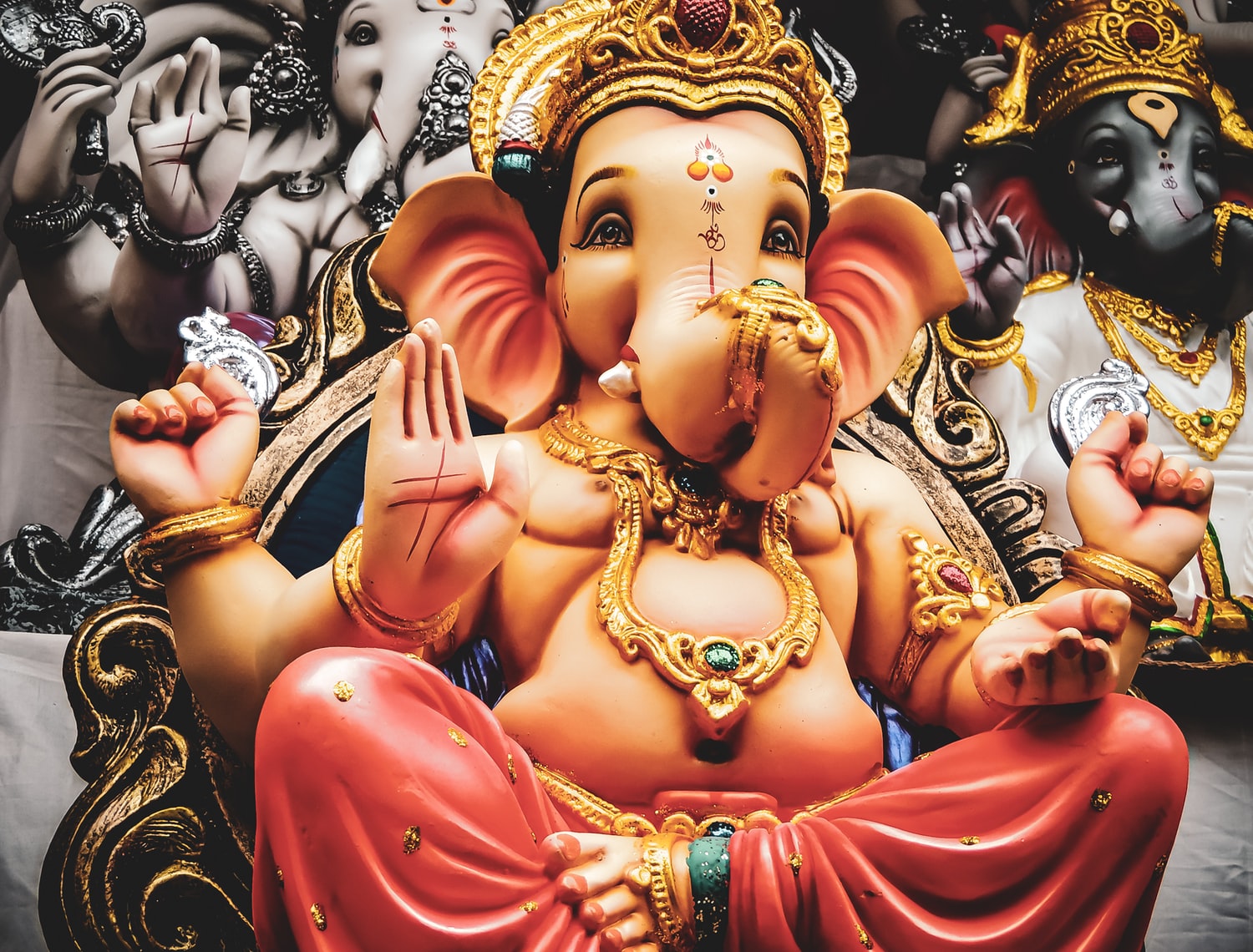
 @PrudenceLouise1