 @Polaris
more from that month
@Polaris
more from that month
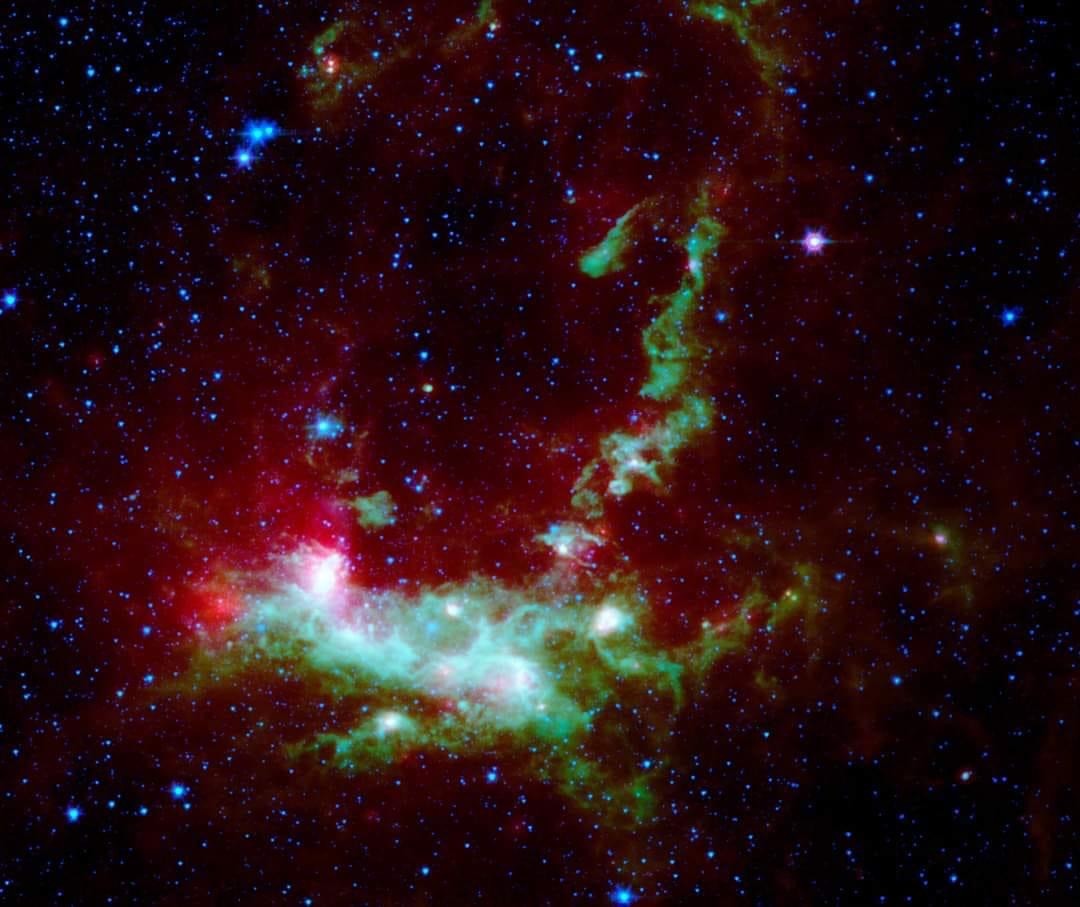
Henize 206 (abbreviated to He 206, and also known as DEM L 221 and LHA 120-N 206) is a star forming region, located at a distance of around 163,000 light years in the constellation of Mensa. It is part of the Large Magellanic Cloud, a small satellite galaxy of the Milky Way. He 206 surrounds a star cluster known as NGC 2018 and it was catalogued for the first time in 1956 by Karl Henize. Star formation is active around an X-ray superbubble that resulted either from a supernova explosion, or from immense stellar winds of massive stars. No super stellar wind has been detected through observations, thus the supernova scenario is more likely. Photometric observations have set an upper limit of 10 million years for the age of the stellar population. Additionally, in the region a shell of neutral hydrogen has been detected. The latter coincides with the X-ray superbubble. Based on the expansion velocity of the hydrogen shell (i.e., 22.5 km/s), its age was estimated at 2.8 million years. Thus, if star formation in the region was triggered by a supernova shockwave, this happened at some point between two and ten million years ago. Image: Composite infrared image of He 206 taken with the Spitzer Space Telescope. The image was created using filters that are centred at 3.6 µm (blue), 4.5 µm (blue, shared channel), 5.8 µm (cyan), 8.0 µm (green), and 24 µm (red). The blue color shows the emission that comes from stars, while cyan and green show emission from gas. Finally, the red color traces emission from dust. Image Credit: Credit: NASA/JPL-Caltech/V. Gorjian(JPL) #Astronomia
No comments yet