 @Nathan6692
more from that month
@Nathan6692
more from that month
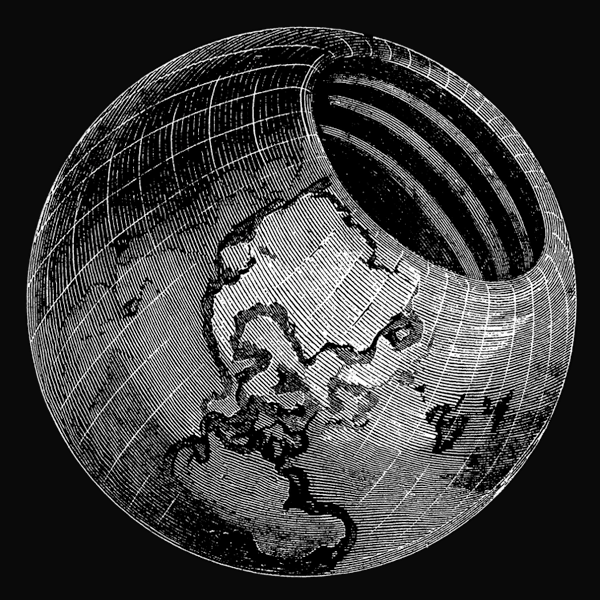
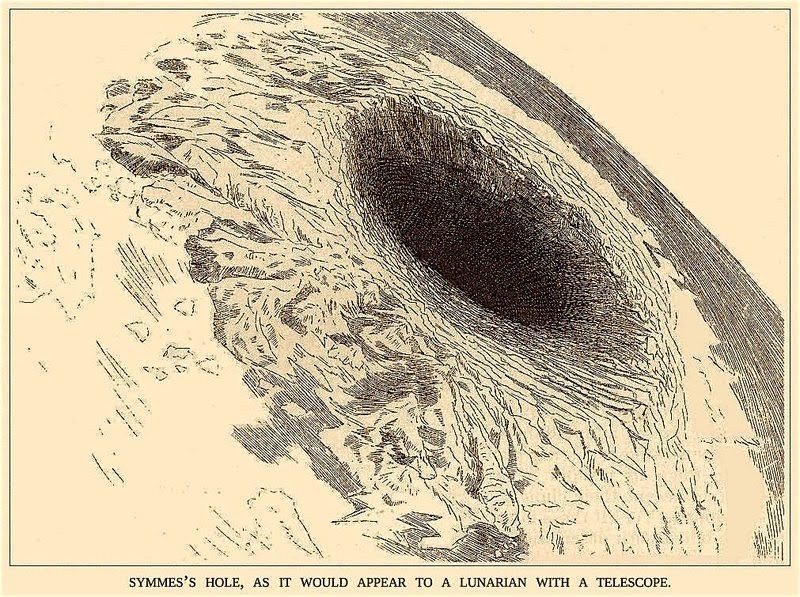
The Scientific Basis for Hollow Earth Possibly the first person to scientifically speculate about a hollow earth was none other than Edmund Halley, of Halley’s Comet fame. Proposed in 1692 as a way of explaining anomalous compass readings, Halley’s theory is that the planet is a series of nested, spherical shells, spinning in different directions, all surrounding a central core. In his estimation, based on readings of the magnetic field and what he knew of the gravitational pull of the sun and the moon on the Earth, this model could account for any inaccuracies in his readings of the magnetic fields of the planet. He also posited that the space between each shell may have had luminous atmospheres capable of supporting life. Halley’s strange idea was expanded upon over the next few centuries, tossing out the messy view of multiple spheres for the much funner vision that the entire interior of the Earth is just one, impossibly large cavern. Generally, this new view of the hollow Earth is accompanied with the theory of a small sun that hangs in the very center, creating a lush, livable environment on the flip side of the Earth’s surface. According to a number of hollow Earth websites, this vision was developed among famous mathematicians and scientists such as Leonhard Euler in the 18th century and Sir John Leslie in the 19th century, although the sources for these accreditations seem to be somewhat nebulous. Regardless of where it originated, the model of a Hollow Earth managed to grow and survive. In 1818, John Cleves Symmes, Jr. published his Circular No. 1, declaring to the world that the Earth is hollow. Symmes, a veteran of the War of 1812 and unsuccessful trader, soon became maybe the most famous and successful proponent of the Hollow Earth theory. His initial vision of the Earth’s interior was like a simplified version of Halley’s multi-layered model, with the exception that Symmes’ version included huge holes at the North and South poles which allowed access to the hidden world inside. These holes, his unique addition to Hollow Earth theory, would even come to be known as “Symmes Holes.” In his very first declaration, Symmes proposed to mount an expedition to the North Pole, where he was sure they could locate one of these apertures, and gain access to the inner Earth. He too believed that the interior of the Earth not only could, but did support life, saying in Circular No. 1, that the inside of the Earth would be “stocked with thrifty vegetables and animals if not men.” Symmes believed that his theory was not science fiction, but science fact, and that it applied not only to the Earth, but too all planetary bodies. To him, the whole universe was hollow. Even in the 19th century, Symmes’ theories were greeted with derision from the public and scientific community, but he would not be silenced. Symmes continued to campaign, giving lectures and publishing letters about the Hollow Earth, always angling for an expedition to the North Pole that would prove his theory. Barrelling right through the skeptics, Symmes was eventually able to convince enough people of the possibility of his Hollow Earth that in 1822, he and his supporters actually got Congress to vote on funding for his expedition. The grant was shot down, but Symmes’ belief in the inner Earth never died. He continued to campaign for the theory until his death in 1849. Even after Symmes’ death his idea continued to thrive amongst believers. Students and admirers of Symmes’ work, and even Symmes’ own son continued to publish materials explaining the increasingly odd theory. One bizarre offshoot of the traditional Hollow Earth theory, put forth by natural healer and eventual cult leader, Cyrus Teed, even inverted the idea, devising a "cellular cosmology" that placed the entire universe inside a shell. According to Teed's thinking, we were actually living on the inside of the Hollow Earth, looking up at the universe, which itself was just an illusion created by a strange solar mechanism. The stars were just reflections of the mechanism's light. Teed's theory managed to gain enough traction that a small cult developed around him, called the Koreshan Unity after Teed renamed himself Koresh. The Koreshans established an extensive colony in Estero, Florida in 1894, but most of the community disbanded after Teed's death in 1908. Both Teed and Symmes still have monuments dedicated to their work and beliefs. The location where the Koreshan community made their home is now protected as the Koreshan State Historic Site, while Ohio's Hollow Earth Monument is dedicated to Symmes' work. Even as unbelievable as the beliefs of Symmes and Teed were, as the Hollow Earth theory grew into the 20th century, it began to take on an even more supernatural air. #info #EverythingsInfo
No comments yet