 @Milan1999
more from that month
@Milan1999
more from that month
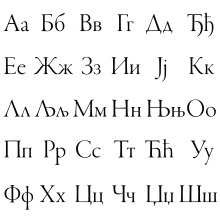
Cyrillic is a script used in several Slavic languages, such as: Belarusian, Bulgarian, Macedonian, Russian, Ruthenian, Serbian and Ukrainian, as well as in a number of other languages in the areas of Eurasia, primarily in the former Soviet Union. The designation of modern Cyrillic according to ISO 15924 is Cyrl 220, and its Old Slavic variants Cyrs 221. Modern Cyrillic alphabets are based on Old Slavonic Cyrillic, [2] [3] which originated in South Slavic areas at a time when many, primarily eastern South Slavic areas, were under the rule of the First Bulgarian Empire. [4] Cyrillic and Glagolitic were formulated either by Cyril and Methodius who brought Christianity to the South Slavs, or by their students. [5] [6] [7] It is the basis of the alphabet used in various languages, former or present, in parts of Southeast Europe and northern Eurasia, and especially in those of Slavic origin, and in non-Slavic languages that are influenced by the Russian language. In 2011, about 252 million people in Eurasia used Cyrillic as the official alphabet in their national languages, with Russia comprising about half of that number. With Bulgaria's accession to the European Union on January 1, 2007, Cyrillic became the third official alphabet of the European Union, after the Latin and Greek alphabets. [8] The Cyrillic alphabet is derived from the Greek uncial, extended by letters from the older Glagolitic alphabet, including some ligatures. These additional letters were added for Old Slavic voices that are not present in Greece. The letter is named after two Byzantine brothers, [9] Cyril and Methodius, who had previously created the Glagolitic alphabet. Modern scholars believe that the Cyrillic alphabet was developed and formalized by the early students of Cyril and Methodius. In the early 18th century, the Cyrillic alphabet used in Russia was significantly reformed by order of Peter the Great, after his return from a diplomatic mission in Western Europe. The new form of the letter became closer to the Latin alphabet, several archaic letters were removed and several letters were personally designed by Peter the Great (such as "I", which was inspired by the Latin letter "R"). Western European typographic culture was also accepted. [10]


No comments yet