 @LawrenceDauchy
more from that month
@LawrenceDauchy
more from that month
Winning the Perplexity Buy-Box: A 5-Step Strategy for Shopify Brands *By Lawrence Dauchy 7th of May*
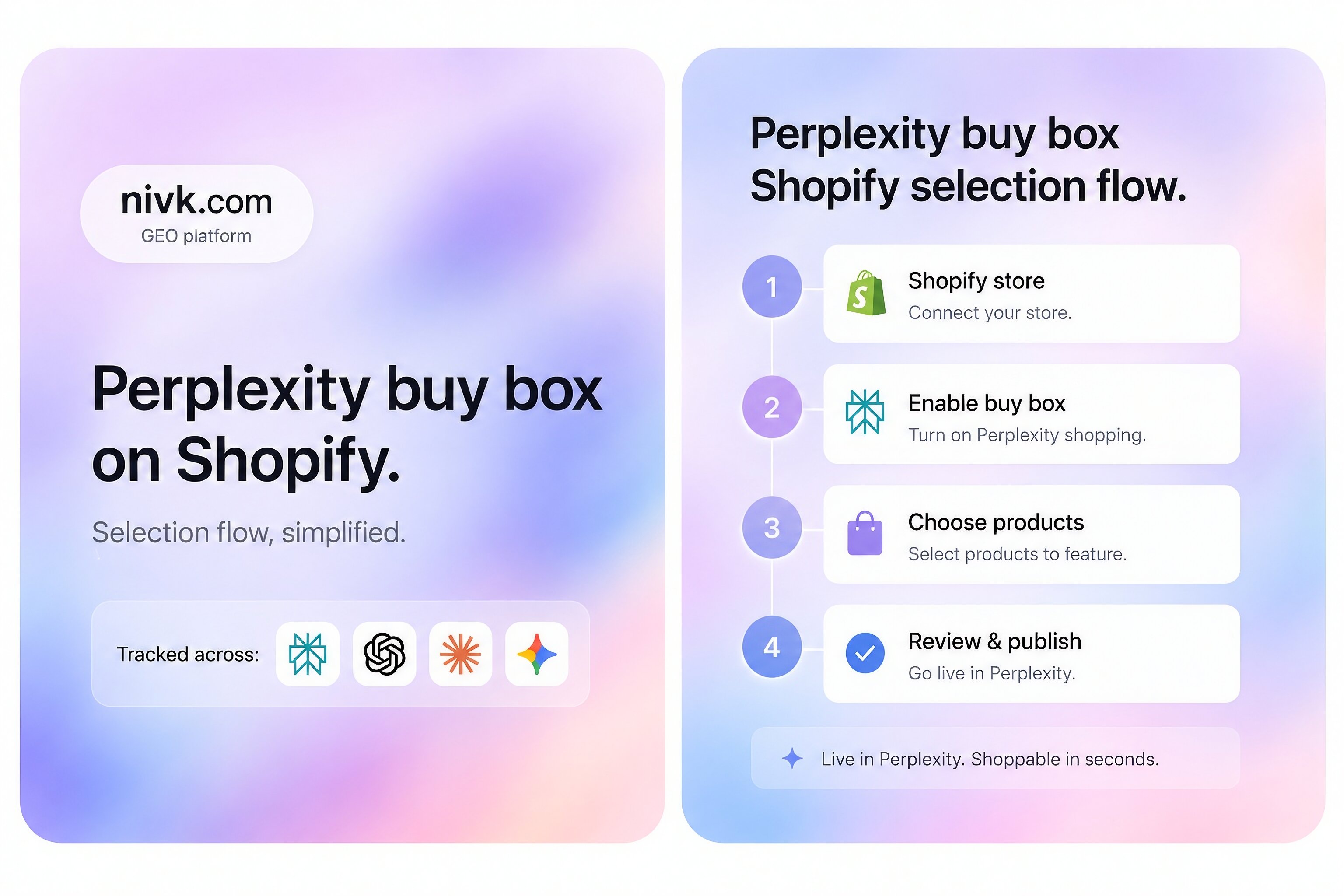
Perplexity does not publicly define a single “Buy-Box” the way marketplaces do. For Shopify brands, the more useful meaning is simpler: It is the moment when Perplexity surfaces your product, explains why it fits the shopper’s request, and makes it easy to buy. That is the real opportunity. So the short answer is this: To improve your chances of showing up in Perplexity Shopping product cards and buying flows, make your products easy to discover, easy to compare, and easy to trust. There is no shortcut. But there is a practical system. **What the Perplexity “Buy-Box” really means** For Shopify brands, the Perplexity “Buy-Box” is best understood as the product selection moment. A shopper asks a buying question. Perplexity responds with recommendations. Some products appear as product cards with things like: pricing images review summaries pros and cons merchant options buying paths That matters because the shopper may never visit a traditional search results page. The platform is trying to answer the shopping question directly. So your store is no longer only competing for a ranked link. It is competing to be the product Perplexity decides is a strong fit for the buyer’s constraints. That is a different job. **How Perplexity decides which products to recommend** Perplexity has explained its shopping experience in terms of product listings, recommendations, research, and buying flows rather than a classic marketplace buy box. The practical takeaway is that product selection appears to depend on things like: relevance to the prompt authority and source quality ratings and reviews availability pricing product specifications how well the product matches the shopper’s constraints That last part is especially important. A shopper rarely asks for a generic item. They ask for something like: best washable wool rug for a small apartment with pets best travel backpack under 30 liters with laptop sleeve best moisturizer for dry sensitive skin under $40 That means Perplexity needs more than a title and a lifestyle image. It needs usable product facts. **Step 1: Make your Shopify products retrievable** The first gate is retrieval. Perplexity cannot recommend a product it cannot reliably find and understand. That means your Shopify setup should make important products easy to discover through the product-data paths that matter. A practical checklist starts inside Shopify: keep important products active and available avoid unnecessary technical barriers use specific product titles fill descriptions with real facts, not only campaign language complete category, product type, vendor, variants, metafields, images, price, and availability make sure connected feeds or merchant integrations are healthy Retrieval work is not glamorous. But it is what prevents systems from guessing whether a product exists, whether it is current, and whether it belongs in the category the shopper asked about. **Step 2: Complete the product data that matters most** The second step is simple: Complete the fields that help Perplexity match products to real buyer constraints. The strongest product data usually answers: what the product is who it is for what makes it different whether it fits the shopper’s limits For most Shopify brands, the priority fields are: product title product category product type brand price and sale price availability variant differences materials, ingredients, size, weight, capacity, or compatibility shipping and return context ratings, reviews, and common review themes product images that clearly show the actual item The rule is simple: Visible content, Shopify product data, structured data, and feed data should all agree. If the page says one thing and the product feed says another, the product becomes harder to trust.
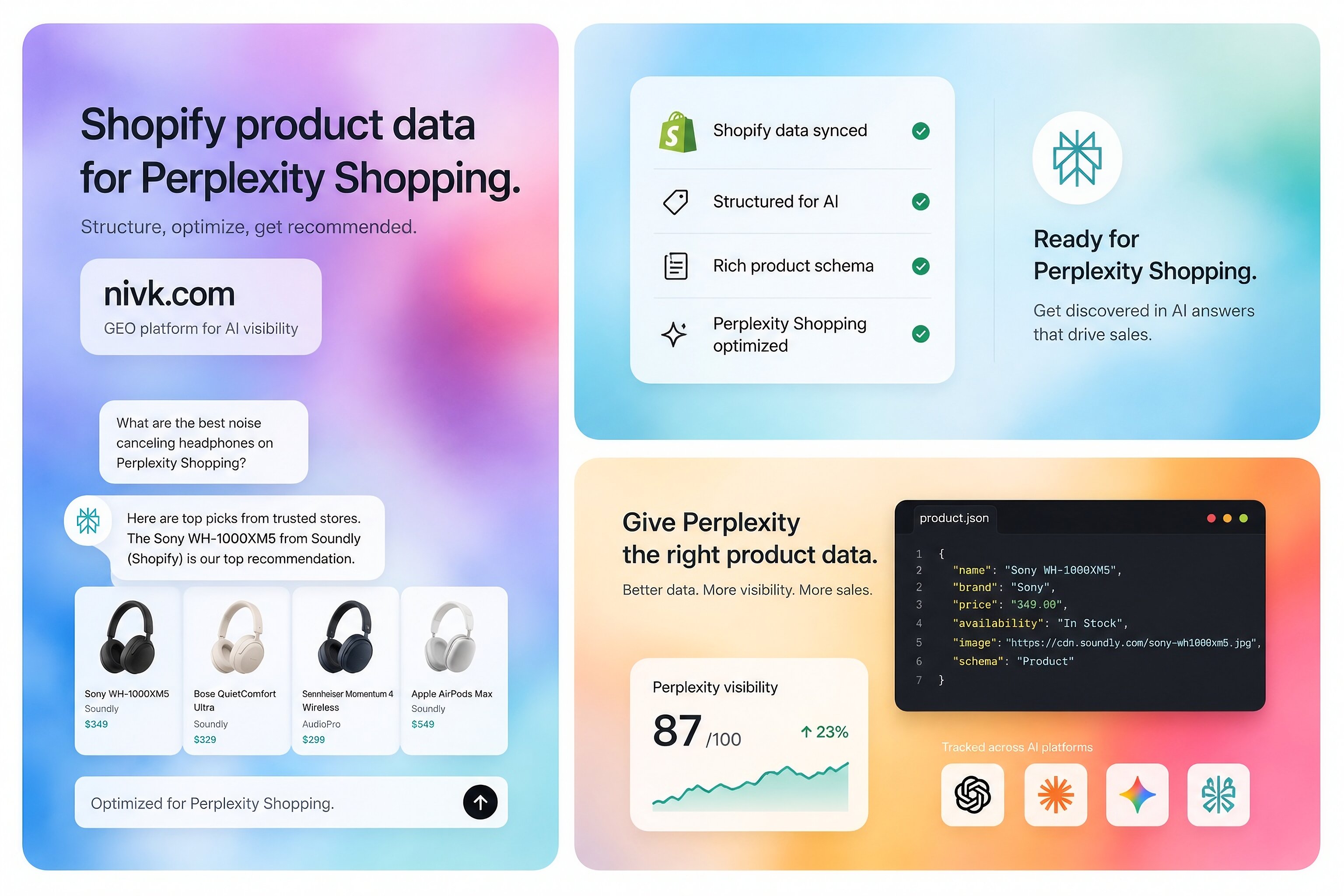
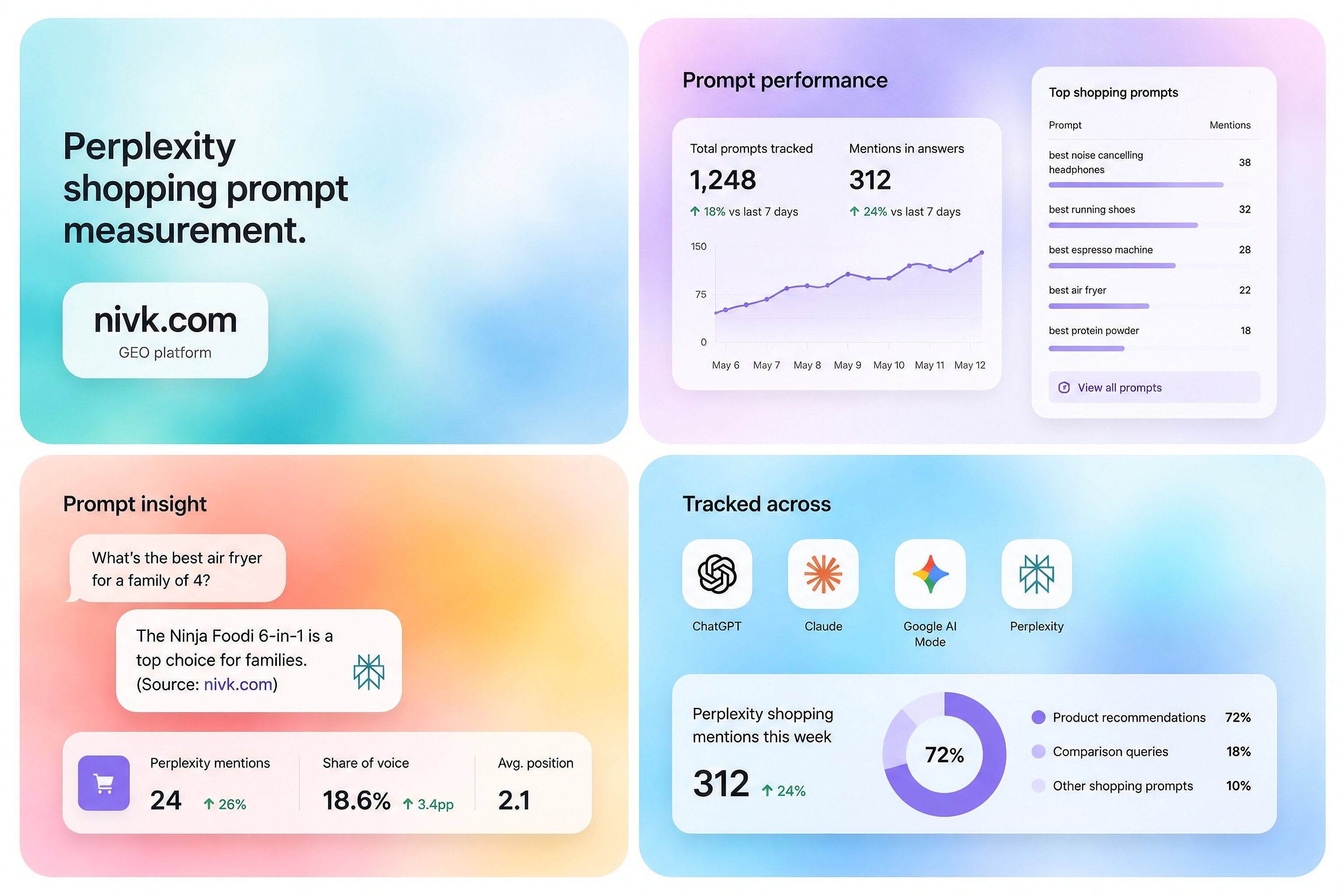
**Step 3: Make products easy to compare** Perplexity is useful because shoppers can ask multi-constraint questions and get summarized recommendations. That means your product page needs to support comparison, not just persuasion. A weak paragraph says: **Designed for everyday comfort, this premium travel backpack brings style and function together.** A stronger paragraph says: **This 28-liter carry-on backpack is designed for two- to four-day trips, fits most 15-inch laptops, opens clamshell-style, and includes a separate shoe pocket. It is best for travelers who want one-bag packing without checked luggage, but it may feel too large for daily commuting.** The second version gives Perplexity usable comparison signals: capacity trip length laptop fit opening style extra features buyer fit limitation That is the kind of product language that helps recommendation systems. For each priority product, the page should answer questions like: Who is this product best for? Who should not buy it? What are the main specifications? What does it solve better than similar products? What are the main tradeoffs? What do reviews praise most often? What do reviews criticize most often? What products is it most often compared against? This is extraction work. The goal is to give Perplexity passages it can reuse without inventing context. **Step 4: Strengthen reviews and source proof** Reviews and outside proof matter because Perplexity is a research-first shopping interface. It does not only list products. It tries to explain why a product fits the query. That means review quality is a real asset. Star ratings help. But review language often helps more. Phrases like these are much more useful than vague praise: runs narrow holds up after 20 washes good for wide feet not warm enough below freezing easy to assemble alone That kind of language helps a product match or fail a real buyer prompt. Third-party proof matters too. Useful outside sources can include: independent review sites niche buying guides publisher roundups creator reviews Reddit or community discussions partner pages expert comparisons marketplace listings with consistent product facts This does not mean every mention is equally valuable. It means products with clearer public evidence are easier to recommend than products only described by their own store. **Step 5: Measure Perplexity visibility with repeatable prompts** Do not judge Perplexity visibility from one manual search. A single answer can be useful for diagnosis, but it is too thin to treat as proof. Build a prompt set around the shopping intents that matter most: category prompts constraint prompts use-case prompts comparison prompts alternative prompts For each prompt, record: date product cards shown cited sources recommended products merchant links review summary language competitor appearances whether your product appeared whether it was mentioned but not carded Then compare the pattern over time. A useful Perplexity visibility report should answer things like: Which prompts trigger product cards? Which products appear most often? Which sources are cited repeatedly? Which competitor products keep showing up instead? Which product facts are missing from your store data? Which review themes are visible or absent? Do not rely only on referral traffic. Perplexity can influence a shopper before a visit happens. A buyer may see the product, remember the brand, search it later, and buy through a different path. So repeated presence is usually a better signal than one-click attribution. **What Shopify brands should watch out for** Watch out for anyone promising guaranteed placement in Perplexity shopping results. No serious operator can guarantee that. Watch out for product data that looks complete to humans but still looks thin to machines. A shopper may infer size from a photo. Perplexity may need the dimensions, weight, material, or compatibility stated directly. Watch out for fake review optimization. Review summaries are only useful when they reflect real customer experience. And watch out for stale pricing or availability. If the product data is wrong, the product becomes harder to trust. The limit is clear: You can improve Perplexity readiness. You cannot force Perplexity to recommend your product for every query.
**Frequently asked questions** **Does Perplexity have an official “Buy-Box”?** Not in the marketplace sense. “Buy-Box” is a useful shorthand for the product-selection and purchase moment, but it is not the platform’s formal terminology. **Do Shopify products automatically appear in Perplexity Shopping?** Not automatically for every query. Product data quality, relevance, availability, reviews, and source trust still matter. **Is Instant Buy available to everyone?** Availability depends on the shopping surface, region, merchant compatibility, and product setup. That is one reason merchants should focus on data quality first. **Can brands pay to appear in Perplexity product recommendations?** Perplexity has described its shopping results as algorithmic rather than something merchants can simply buy their way into. So the stronger path is better product readiness, not assuming paid placement solves it. **What is the fastest way to improve Perplexity Shopping visibility?** Usually a product-data audit. Fix: weak titles vague descriptions incomplete specifications unclear variants stale pricing stale availability weak review themes inconsistent product facts Then rerun the same prompts and compare the results. **Key takeaways** The Perplexity “Buy-Box” is best understood as a product-selection and checkout moment, not a fixed marketplace placement. Shopify brands improve their chances by making products: retrievable complete comparable review-supported measurable across prompts Perplexity-style shopping systems tend to work better when the product has deeper details like availability, reviews, pricing, and specifications. And the practical goal is not to chase a magic placement trick. It is to make your product easier to understand, easier to compare, and easier to trust.
No comments yet