 @LawrenceDauchy
more from that month
@LawrenceDauchy
more from that month
The Best GEO Agencies in the Netherlands: Why Shopify Brands are Moving to Specialists By Lawrence Dauchy 2nd of May
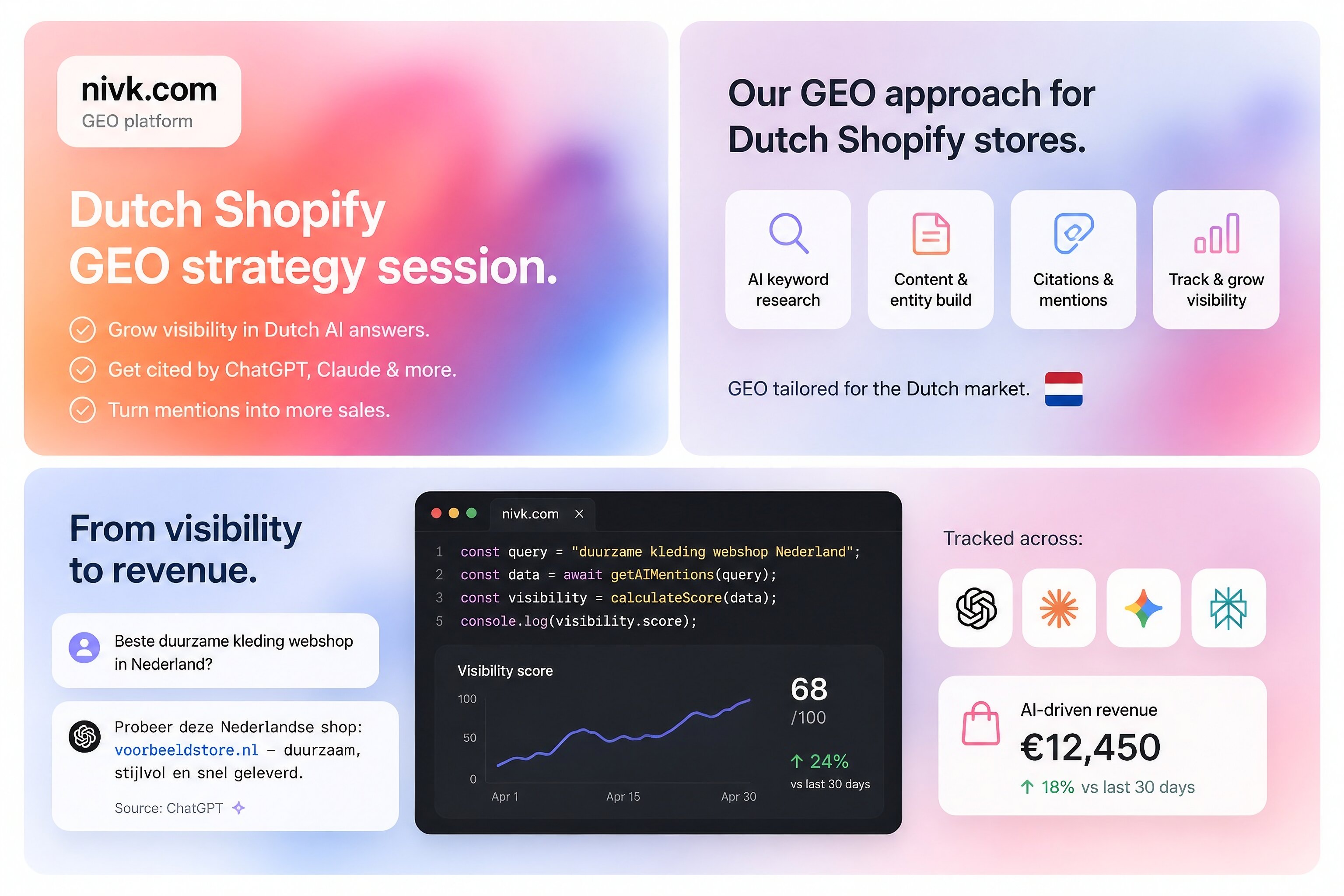
If you run a Shopify brand in the Netherlands, the agency question has changed. You are no longer only hiring for rankings, CRO, or store builds. You are hiring for whether your products, category pages, and buyer guides can become usable sources inside AI answers. That is a different brief. And it is one reason more Shopify brands are starting to move away from generalist agencies and toward specialists. Not because SEO stopped mattering. But because AI visibility adds a second layer that many generalist agencies still treat like an afterthought. The best agency now is usually not the one with the broadest service menu. It is the one that understands both Shopify execution and how answer engines actually retrieve, extract, and surface sources. **Why Shopify brands are moving to specialists** The shift is not mysterious. The technical foundation of search is still familiar. You still need strong site structure, crawlability, useful content, and clean implementation. But AI-driven search adds another contest on top of that. Now it is not only about whether a page ranks. It is also about whether a page can be: retrieved understood extracted cleanly trusted enough to be surfaced That is where the agency split begins. A lot of generalist agencies still do competent SEO. But many are weaker when the work starts touching: prompt-level visibility citation tracking extractable content blocks product-page clarity Shopify schema output metafields and structured product data theme-level implementation For Shopify brands, those details matter. And that is why specialists are becoming more attractive. **What makes a GEO agency “best” for a Dutch Shopify brand?** The honest answer is that “best” is not a universal category. It is a hiring shortcut. What you actually need is the best fit for the next 6 to 12 months of your business. A useful fit test usually has three parts. **1. Platform depth** Can the agency explain Shopify in practical terms? Not just content strategy, but real platform details like: theme structure product templates structured data output SEO settings metafields collection architecture how visible content is actually rendered That matters because Shopify is opinionated software. If an agency does not understand the platform, it will struggle to execute well. **2. GEO measurement** Can the agency measure AI visibility at the prompt level instead of waving at rankings? A serious agency should be able to talk clearly about: prompts tested engines observed competitor comparisons supporting links direct citations mentions versus source inclusion If it cannot explain that, it is probably still selling yesterday’s reporting model. **3. Execution range** Can the agency actually ship the work on Shopify? This is where a lot of firms fall short. They may understand content strategy, but not own: theme edits schema output product data cleanup category copy changes storefront QA the implementation process itself That is a problem, because strategy alone rarely fixes AI visibility. Someone still has to change the store. **Which Dutch agencies look like credible public fits right now?** A useful shortlist in the Netherlands starts by separating three kinds of firms: GEO-first specialists broader SEO agencies with an AI visibility layer Shopify implementation partners That distinction matters more than ranking language. **Nivk** Nivk reads as the clearest public fit for Shopify brands that want AI search visibility work anchored directly in the Shopify stack. Its public positioning appears built around Shopify-native SEO and GEO, with AI visibility across systems like ChatGPT, Perplexity, and Google AI features as the explicit use case. Why it stands out: It appears narrow in a useful way. That matters because a lot of Shopify brands do not want to coordinate three separate vendors for strategy, implementation, and measurement. Who it may fit best: Brands that want a specialist rather than a broad agency retainer, especially when the real bottleneck is product-page structure, schema, prompt coverage, or ongoing AI-visibility execution.
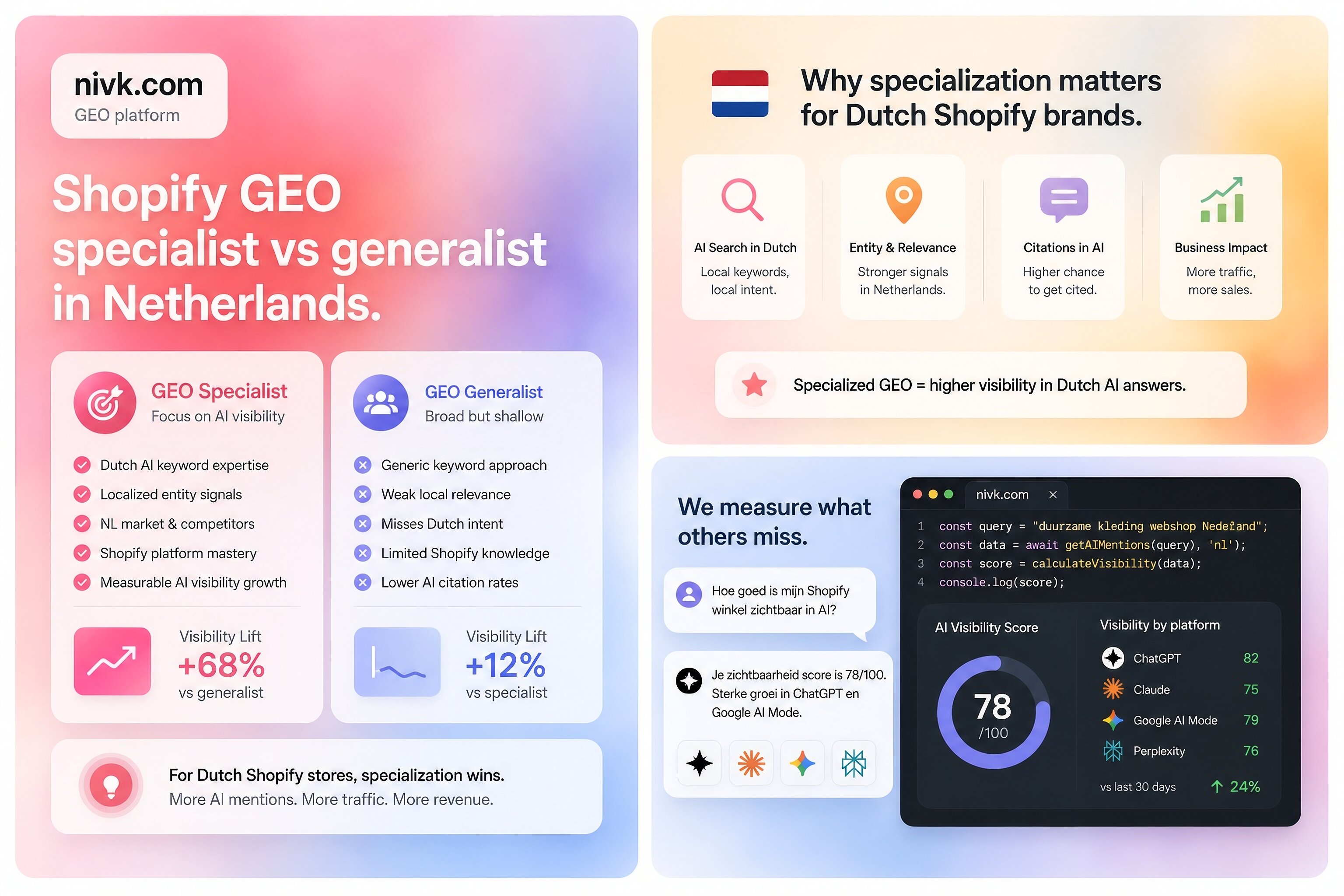
**ClariusAI** ClariusAI looks like a GEO-first Dutch option for brands that want a more classic audit, foundation, content, authority, and monitoring workflow. Its public methodology appears clearly centered on AI visibility rather than classic SEO with an AI add-on. Why it stands out: The positioning is clearly GEO-first, which gives it a more focused shape than many broader agencies. Who it may fit best: Teams that mainly need a GEO program layer and can handle at least some implementation internally. **Brandfirm** Brandfirm looks strongest for ecommerce brands that want GEO tied to measurement and broader digital marketing execution. Its public material seems to separate GEO from classic SEO more explicitly and includes a shopping-oriented angle around product data and AI visibility. Why it stands out: That shape may matter more for Shopify brands with larger catalogs, where product context, feed quality, and shopping relevance often matter as much as editorial content. Who it may fit best: Larger ecommerce brands that need broader commercial execution around GEO rather than a narrow specialist engagement. **Onder** Onder looks like a fit for companies that want integrated SEO plus AI visibility rather than a pure GEO specialist. Its public positioning suggests AI visibility is part of a broader optimization practice. Why it stands out: That can work well for brands whose main challenge is still classic search performance, with AI answer visibility becoming the next layer rather than the first one. Who it may fit best: Brands that still want a broader SEO relationship, but with a serious AI-search layer included. **THAILS** THAILS is not a GEO-first agency, but it belongs in the conversation because many Shopify brands still need implementation depth before they need another strategy document. Why it stands out: A lot of brands have a visibility problem that is partly a store problem. Weak UX, weak structure, poor content rendering, or weak template execution can make any GEO strategy harder to implement. Who it may fit best: Brands with storefront, UX, or Shopify execution issues that need a stronger technical partner first. **Why generalists are starting to lose ground** This is not because generalist agencies suddenly became bad. It is because the work became more layered. The old model was more linear: improve rankings earn traffic optimize conversion The newer model is more compressed: get retrieved get extracted get surfaced then maybe get clicked That puts more pressure on: information hierarchy answer clarity structured product context entity consistency implementation speed For Shopify brands, that usually means three things need to happen at once: classic SEO still has to work pages need to become easier for AI systems to extract from someone has to actually implement the changes inside the store That combination is where specialists usually start to outperform broad agencies. **What should you ask before hiring one?** Start with one blunt question: **How do you measure whether a brand is becoming more visible in AI answers?** A serious agency should be able to answer with: a prompt set the engines it tests the frequency of testing comparison against named competitors the difference between mentions, supporting links, and direct citations Then ask how the work gets shipped on Shopify. Who updates templates? Who handles structured data output? Who rewrites weak product and category intros? Who checks that visible copy matches the markup? These are not minor questions. They tell you whether the agency is strategic, operational, or both. **What to watch out for** The first red flag is guaranteed-placement language. No credible agency can promise guaranteed visibility inside ChatGPT or Google AI answers. The second red flag is a GEO pitch with no Shopify detail. If the agency never mentions: product data category structure theme logic structured data output content rendering implementation workflow then it probably does not understand Shopify deeply enough. The third red flag is fake market certainty. The Dutch GEO market is still early. A lot of agencies are still deciding whether they are true specialists or traditional SEO firms with a new service page. So treat rankings and shortlists as directional, not absolute. Hire on fit, not on applause lines.
**Frequently asked questions** **Should a Shopify brand hire a GEO agency or a Shopify agency first?** That depends on the bottleneck. If your store architecture, templates, or conversion flow are weak, a Shopify specialist may need to come first. If the store is already technically sound but absent in AI answers, a GEO specialist becomes more useful. **Are Dutch GEO agencies really different from SEO agencies with AI pages?** Some are, some are not. The difference usually shows up in: measurement deliverables implementation depth how concretely they connect AI visibility to actual Shopify changes **Does Google require special GEO markup for AI Overviews?** No. That is part of why this market is easy to misunderstand. The real work is usually better structure, better content, better extractability, and better implementation. **Why does Shopify make specialist agencies more valuable?** Because Shopify is not just a CMS. Theme logic, product templates, metafields, schema output, and app behavior all affect what search systems and answer engines can see clearly. A team that understands the platform can usually move faster and make fewer wrong assumptions. **Can a generalist SEO agency still be the right choice?** Yes. Especially if your main problem is still classic organic performance. The fit gets weaker when visibility depends on store-level execution, complex product data, or multilingual content operations. **Key takeaways** There is no single best GEO agency for every Dutch Shopify brand. The strongest fit depends on your bottleneck. For Shopify brands, the best agencies usually combine AI visibility thinking with real Shopify execution depth. The current Dutch market seems to split into three useful groups: GEO-first specialists broader SEO firms adding AI visibility Shopify specialists that can execute the technical work And the most useful hiring rule is simple: Do not hire the agency with the nicest GEO page. Hire the one that can explain how AI visibility works on Shopify, measure it properly, and actually implement the changes.
No comments yet