 @Genieljay
more from that month
@Genieljay
more from that month
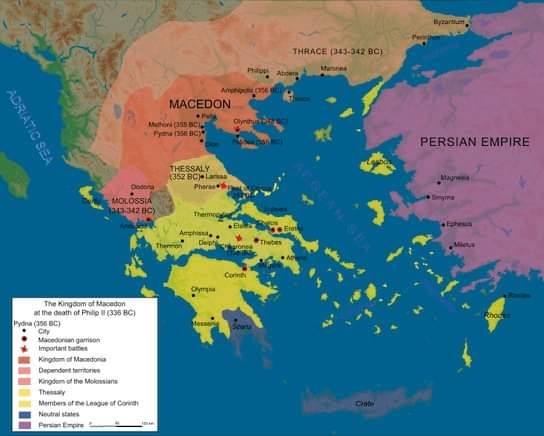
#source deep web archieve Alexander ascended to the throne after his father, Philip II, was assassinated in 332 BC. Whether this was an isolated act of a desperate man out for blood, or a part of a larger conspiracy was not known. Before his death, Philip II had consolidated his rule through a series of diplomatic and political maneuvers that made Macedonia the strongest power in Mainland Greece. He introduced military reforms and professionalized the Kingdom's army into a world-class fighting force. His introduction included the adoption of sarissa (12 - 16 feet pike) and the close coordination of cavalry and infantry, the latter of which was a novelty in Classical Greece. Alexander the Great was only 20 years old when he inherited the kingdom his father had established. Though an untested leader, he was by no means green to military matters. Alexander had already experienced his first battle at the age of 16 when he was entrusted to the command of the left-wing of the army at the Battle of Chaeronea, where he decisively routed both the combined armies of Athenians and Thebans through successful flank attacks. Still, he was a political neophyte who must reassert his authority in order to regain the respect his father had once commanded from neighboring territories. Things were not looking great for Alexander. First, the 10,000-strong advance guard his father had sent as a beachhead to Asia Minor (modern-day Turkey - east of Macedon) was in communication with the Athenian opposition to the south. Second, the cities of Athens and Thebes wanted to quit their 'forced' membership in the League of Corinth - which was an ancient equivalent of NATO composed of Greek city-states. Their common goal was to avenge the Persian Invasion of Greece from a century ago and liberate Greek polities under Persian rule. The League of Corinth was an alliance in all but name. In practice, it was an exercise of Macedonian hegemony since it obligated member states to contribute resources under the central command of Macedon. The northern and western borders of Macedonia were also not secured as many neighboring tribes that inhabit the regions had yet to show any sign of goodwill to the new king. Alexander and his army can be put in jeopardy if their supply and communication lines from Greece were cut off by a hostile force. Not keeping the men well-fed and forcing them to ration will negatively affect their overall performance. What's more, the Macedonian soldiers will lose their impetus to march away from home if the lives of their friends and relatives were in danger. It is vital for Alexander to secure his country's territorial integrity if he will be out of the country for a long period of time. Despite a period of decline, Persia was still the world's largest and most powerful empire. It will take years to bring down an empire of such size. And Alexander cannot afford trouble back home if he wanted to subjugate the empire. Alexander's first order of business was to march south to settle matters with the Thessalians, who had blocked his access to the south. They occupied a narrow pass in a mountainous terrain which nullified the Macedonians' local superiority in number. A direct assault on this occupied pass is a suicide mission. So, Alexander decided to leave a contingent facing the Thessalians, and under cover of darkness, ordered another contingent hidden from their view to find an alternative passage. The next day, the Thessalians were surprised to find Alexander behind them. They surrendered to him completely without a fight. Their cavalrymen were added to their military roster. Next, Alexander marched north towards Thrace to deal with Triballians and Illyrians whose policies towards Macedon were unknown. They encountered a group of Thracians on top of the Balkan mountains. Their army composition was unknown, though it can be assumed they were sufficiently armed to contest the Macedonian arrival. They were probably roughly the same size as the Macedonian army facing them. It should be noted that the Macedonian army also included contingents of Thessalian cavalrymen, Agrianes peltasts, Cretan archers, Greek hoplites, among others. It was a multi-ethnic army but for the sake of simplicity, I'll refer to them as the Macedonian army or Macedonians since they were employed by the Kingdom of Macedon. The Thracians had collected wagons to serve as cover from projectiles. They also planned to push these down once the Macedonians were at the base of the mountain. The Macedonians responded by opening their ranks to provide a safe exit for the wagons. Others had locked their shields together and let the wagons roll over them. Their tactics worked. The Macedonians sustained no injuries. Alexander then ordered his archers to occupy a position to their right and provide covering fire for the Macedonian phalanxes in the center who are ascending the mountain slope. He then led a contingent of Hypaspists and Peltasts to their left-wing. The initial fighting in the center proved too much for the ill-disciplined Thracians. They were simply no match to the phalangites. Soon, they scattered. About 1,500 were killed. The women and children who were left behind were taken prisoners and their things confiscated. Thanks to their familiarity with the topography and their light equipment, most of the armed Thracians fled from Macedonian grasp. Not long after, Alexander went after the Triballians
No comments yet