 @Genieljay
more from that month
@Genieljay
more from that month
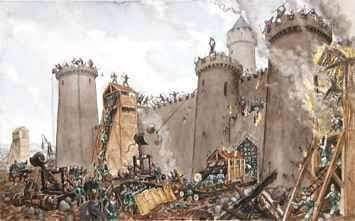
Copy paste ko lang sa group ko sa facebook wala kasi nakalagay na credit I. Ancient Siege Warfare In pre-Hellenistic Era Greece, most polities did not have a standing army during peace time and logistics was still rudimentary. A typical greek army lacked the capability to remain on the field for an extended period. They did not have the tech, the manpower and the resources to undertake siegraft that will characterize the creative brutality of later periods. The best they can do was to conduct an economic blockade, either by land or sea (via warships). They can starve their enemies out and wait for the besieged city to capitulate. Or, they can wait for their armed men to leave the gates and fight them in an open field. The more advanced form of warfare would not appear until the ascent of Macedon II. Risks on Besiegers The besiegers were at risk of starvation if not enough food were procured from nearby communities or received from their supply train. Camping near swamps, drinking contaminated water, and other unsanitary practices may risk outbreak and kill more soldiers than the enemy could ever hope. The sudden arrival of torturous weather and lack of adequate clothing may kill soldiers too III. Ancient Defenses Huge stone walls were rare and the exclusive privileges of the more prosperous cities like Babylon, Tyre, and Persepolis. These cities were usually far from regions with high-intensity conflicts present in disputed borders or rebellious provinces. Even with the growing popularity of catapults and onagers at time of Alexander, breaching thick stone walls before the advent of gun powder remained an incredibly hard job to do. Though difficult to penetrate, breaching walls was doable. Enemy sappers who can dig tunnels underneath these walls can undermine their foundations, leading to collapse. Another way to bypass the defense of the walls is by catapulting incendiary materials to houses and structures within walls. However, this may only be feasible at a certain trajectory. Not all terrains can offer this option to a besieger IV. Fortified Settlements Ancient settlements were often found in a highly defensible location like hills and surrounded by natural barriers like thick woods, mountain ranges, and rivers, which can be difficult for an invading army to enter through. Furthermore, it was not unusual for ancient settlements to be found in areas of great strategic importance. Their lands may be fertile and served as bread baskets for nearby and far-flung provinces. The lands may also be rich in unique minerals ideal for crafting weapons and armors of war. Or, they may be situated along a road with heavy economic traffic. Blocking such road may cripple the economies of communities dependent on it for their sustenance. For most settlements, wooden palisades and trenches offered the most basic protection. Even temporary shelters like army camps might need such defences to deter any surprize attack or slow down enemy assault until reinforcement arrives. In addition, wooden pikes pointing outward might be planted around the outer layer of the walled city to deter battering rams, ladders and siege engines from breaching a vulnerable section. A unit may also anchor themselves next to pikes and caltrops to deter cavalry changes on their flank. If a body of water is situated nearby, the water can be diverted to ditches around the besieged city to provide additional obstacle for an invading army. The flood and the muds surrounding the ditches can keep the siege engines and battering rams stuck and prevent them from coming into direct contact with the walls or gates. The towers along the walls provided excellent protection from enemy missiles and granted defending archers, slingers and artillery teams a better view and farther effective shooting range. Within a certain distance, heavy objects can be dropped to soldiers scaling the wall. Hot water can also poured down on them. V. Breaching Settlements Depending on the level of preparation, it was usually a lost cause when a significant number of invaders had already entered the city. The victorious army, careful not to cause further damage in the city in the hope of heavy plunder, may keep the rest of the city intact. The same thing applies if their objective were to secure the good will and cooperation of the residents within the city and beyond. There were occasions when a stout defense were offered in choke points and blind spots in the streets by what remains of the defending army and hostile population, dragging the entire fight into a war of attrition. Some soldiers, eager to extricate themselves from dangerous close quarter combat, resort to arson to put out any remaining armed resistance VI. The nature of ancient sieges Assaulting fortifications directly can cause heavy casualties to an attacker. Thus, the aggressor might need a theoretical minimum of 2:1 advantage in numbers if they hope for any chance of victory in a head on clash. And even then, this might only be won at a tremendous cost to the attacker. Given the difficulty of sieges and significant drain to manpower and resources for an invading army, diplomatic channels were kept open between opposing armies and emissaries may be sent back and forth to consolidate gains and minimize their war burdens. If there were no sufficient food to keep the army well fed during their stay in the city and after they left, the discipline of the army may break down and force the army to mutiny, desertion, or worse, defection. As you see, a typical siege is hard if played by conventional rules of war. But with opportunity and military talent to bank on a sound plan, victory can be achieved in the most spectacular fashion. Here are a few noteworthy examples of successful indirect approach to sieges: 1. Cyrus the Great's draining of a body of water surrounding an enemy city to infiltrate the sewers 2. Scipio Africanus's forces setting fire to a tent undetected, which engulfed the entire enemy camp quickly 3. The mongol practice of catapulting dead bodies into the city to spread fear and disease among the trapped populace 4. Intercepting a confidential letter from an enemy messenger and pretending to be that messenger to infiltrate enemy base 5. The gifting of trojan horse
No comments yet