 @Genieljay
more from that month
@Genieljay
more from that month
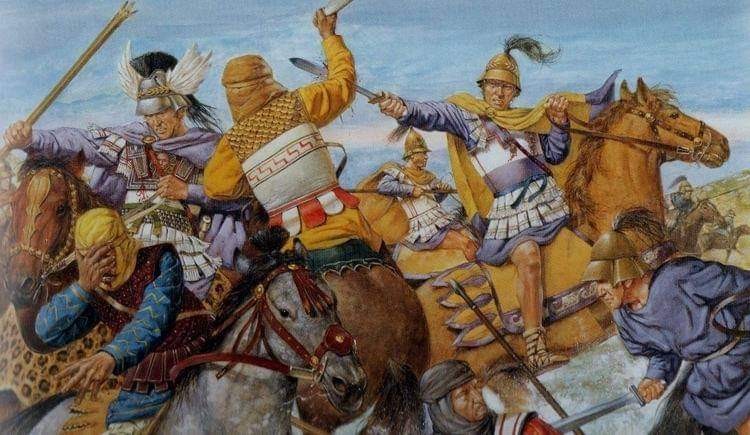
Alam na ito sa karamihan kaya share ko lang. Credit: owner 🤣 Alexander the Great's Persian Campaign. One year after being crowned Macedonian King and elected as the leader of the coalition of Greek city-states against the Persian Empire, Alexander led his army to an overland route from Greece to Asia Minor (Today's Turkey). The Macedonians crossed the Dardanelles Strait with over a hundred ships called 'triremes' and managed to evade the Persian fleet patrolling the seas. His navy was no match to the seasoned Persian sailors, and thus, preferred to avoid them in open engagement. At any time, the Persians can land an invasion force to Greece and take the fight back within the Macedonian turf. This can result in Alexander losing all his gains and will force him back to defend his state. Not wanting to give the Persians the initiative of opening up another front in the war, his army entered deeper and deeper into Persian lands so that they will concentrate all their attention on him. He and his alleged male lover, Hephaestion, briefly visited the tomb of his childhood hero, Achilles, in the ancient site of Troy and some cities along the coast surrendered to the Macedonians as they marched. The Persian nobles, governors, and the Greek mercenary named Mennon of Rhodes had discussed plans to stop the Macedonian advance. The only Greek in the war council offered a scorched-earth strategy to prevent the Macedonians from being adequately supplied. And while this may play into Alexander's plan and draw the ire of an already overburdened population, this is actually a sound plan. The Persian Fleet can block any ships from resupplying the army and will leave the Macedonian forces stranded in the peninsula. By burning farms and villages and depriving any resources in Alexander's path, his army may weaken to the point of surrender. In the end, Mennon's suggestion was turned down. The Persians decided to make a stand on the eastern bank of Granicus River and wait for Alexander's crossing. The two most cited sources on the battle, Arian and Rufus, offered two different versions of the battle. This has been a subject of intense debate among historians, with others offering a revisionist view that combined both elements of the two contrasting accounts. Because most historians preferred Arian's version over Rufus', we will continue with his story instead though with some adjustment from modern historiography. This time Alexander had the numerical advantage against his enemies. Opposing his 37,000-strong multi-ethnic army were 20,000 - 30,000 Persian forces (modern estimates) acquired from across the empire. The Persians were in control of the higher ground. The Macedonian army was composed of 32,000 infantry and 5,000 cavalries, while the Persians had around one-third infantry and two-thirds cavalry. The mainstay of many nationalities under Persian rule was the cavalry as most of their territories were suitable for cavalry warfare. The River Granicus was fordable though its varying depths, strong flow, and steep banks on the Persian side presented a challenge to the phalanx units moving in a compact formation. The Macedonians marched to battle in an echelon-shaped formation. The right-wing taking the most forward position to deliver the first blow, while the left-wing was reclined and will not bear the brunt of the Persian forces. The infantry was placed at the center, while the cavalry was divided between wings. The Persians arrayed themselves in two battle lines, the second line was occupied by the unreliable Greek mercenaries and was placed farther away from the river, while the first line is composed of cavalries. Given the mostly stationary movement and defensive posture of the first line, there is a good reason to believe that foot soldiers might also be interspersed among them. Otherwise, it would not make sense for a line of cavalry to march to their death against a wall of 16-feet pikes. (Horses are smarter than what they are credited for). The harsh river and some infantry support can give the cavalry some edge against a partially disorganized phalanx. One of the easiest ways to cripple morale and turn an organized body of men into a disordered mob is by annihilating senior officers. Both armies intend to cripple the command structure to end the fight quickly. Alexander prepared to meet his Persian counterparts. Alexander's right-wing advanced and tied down a large number of the Persian left wing. During the river crossing, the advancing Macedonians were subjected to hails of arrows and javelins, suffering huge casualties in the process. Once they closed their distance to the Persians opposing them, their longer lances proved superior to Persian javelins in a melee duel. Since they were more experienced and far from being rusty, superior numbers were the only thing going for the Persians at this section of the fighting. Alexander then noticed the exposed Persian center, where most senior officers were gathered. A huge gap appeared after a large host of Persian soldiers engaged the Macedonian right. Alexander then led his most experienced cavalry, the Hetaroi, to the gap, along with other mounted units to challenge the Macedonians in a clash of arms. After some hard fighting between generals of both armies, the Macedonians eventually won but barely survived. Alexander's contingent was surrounded for the majority of the battle. He was within a hair's breadth of dying. During the engagement, Alexander was hit in the head and his helmet was cut into two. It was not a killing blow, so Alexander struck back and killed his opponent with a fatal stab. Unbeknown to Alexander, another assailant was approaching him from an unexpected angle. The timely arrival of Cleitus the Black, one of his closest friends and general, chopped off the assailant's arm before his sword reaches Alexander's neck. The battle could have gone the other way had it not been for the intervention. When most of the senior officers laid dead and the center reeling from the force of the Macedonian cavalry charge, the rest of the Persian wings followed suit. Some units that continued to fight were promptly surrounded and destroyed. The second line remained intact and offered Alexander their terms of surrender, but the Macedonians, surrounding them on all sides, proceed to murder them in cold blood. Alexander proved his point that Greek treachery will not be tolerated. The Persian camp was ripe for the taking. Most of the Persian horse lords managed to escape to safety. The Macedonians were tired from their long journey and had yet to receive ample rest. In contrast to his policy of imposing fear in Mainland Greece, Alexander introduced himself to Persian subjects as a liberator against Persia's oppressive rule, which proved very popular to the locals. Many cities began to flock under his banner. He prevented any unwanted looting by his soldiers to keep the peace with the population and meditated political conflicts in cities he visited to prevent them from becoming more violent. Alexander can keep his army well-fed and well-supplied through the support of his newfound friends. Alexander knew that Macedon was not completely on good terms with some populations in the Balkans, so he also sent back some of the loots and enslaved mercenaries to Mainland Greece to placate them. Meanwhile, Mennon of Rhodes survived and will fight another day in the coastal city of Halicarnassus, the latest stumbling block to Alexander's conquest of Persia. In the future, Mennon will invade several Macedon-controlled islands in the Aegean Sea, form an alliance with Sparta, and try to foster another rebellion in Mainland Greece. Out of some dumb luck, he will die in one of his battles without establishing a beachhead in Alexander's homeland. After his death and his arch rival's further successes, the anti-Macedonian invasion force that he assembled would eventually abandon the campaign and scatter. Alexander was extremely lucky.
No comments yet