An Analysis of Cryptocurrency, Bitcoin, and the Future :

Abstract : Cryptocurrency, an encrypted, peer-to-peer network for facilitating digital barter, is a technology developed eight years ago. Bitcoin, the first and most popular cryptocurrency, is paving the way as a disruptive technology to long standing and unchanged financial payment systems that have been in place for many decades. While cryptocurrencies are not likely to replace traditional fiat currency, they could change the way Internet-connected global markets interact with each other, clearing away barriers surrounding normative national currencies and exchange rates. Technology advances at a rapid rate, and the success of a given technology is almost solely dictated by the market upon which it seeks to improve. Cryptocurrencies may revolutionize digital trade markets by creating a free flowing trading system without fees. A SWOT analysis of Bitcoin is presented, which illuminates some of the recent events and movements that could influence whether Bitcoin contributes to a shift in economic paradigms. Key Words: Cryptocurrency, Bitcoin, Encrypted, Currency, Bitpay, Exchange Rates

1. Introduction : Bitcoin, the world‟s most common and well known cryptocurrency, has been increasing in popularity. It has the same basic structure as it did when created in 2008, but repeat instances of the world market changing has created a new demand for cryptocurrencies much greater than its initial showing. By using a cryptocurrency, users are able to exchange value digitally without third party oversight. Cryptocurrency works on the theory of solving encryption algorithms to create unique hashes that are finite in number. Combined with a network of computers verifying transactions, users are able to exchange hashes as if exchanging physical currency. There is a finite number of bitcoin that will ever be generated, preventing an overabundance and ensuring its rarity. Water, despite its requirement as a life giving material, is generally accepted as being free or of little cost because it is so abundant. If water was rare, it would be more valuable than diamonds. Value exists for bitcoin because its users have trust that if they accept it as payment, they would could use it elsewhere to purchase something they want or need (Kelly, 2014). As long as the users maintain this faith, the valued object can be anything. Bitcoin‟s value exists in its ecosystem much in the same way that wampum, a seashell, was the currency of the land for Native Americans (Kelly, 2014). Bitcoin does not have intrinsic value like gold in that it cannot be used to make physical objects like jewelry that have value. Nevertheless, value continues to exist due to trust and acceptance. Current legal and financial structures are not designed with a technology like this in mind. Financial institutions are built off of much older forms of currency. In some ways, it is comparative to the computing industry. The baseline of computing still relies on transmitting and processing 1‟s and 0‟s, providing only two dimensions of input. Yet all of our current technology uses this technologically archaic system due to adoption, cultivation, and lack of need for newer systems. If cryptocurrencies became the global norm for transactions, long standing systems for trade would need to be completely reformed to deal with this type of competition. For this reason, cryptocurrencies could possibly be the single most disruptive technology to global financial and economic systems.

BitPay, the largest bitcoin processor in the world, has recently seen transaction rate grow 110% in the past 12 months. Transaction increase is an indicator of user acceptance growing. The conditions for Bitcoin‟s widespread adoption could be described as a “fire triangle”. Where fire needs fuel, oxygen, and heat to exist; Bitcoin needs user acceptance, vendor acceptance, and innovation to ignite. Without all three aspects, bitcoin may not truly become a legitimized mainstream currency. Bitcoin is currently experiencing an increase in user acceptance and use, which is driving the other two aspects of the “fire triangle”. Cryptocurrency‟s adoption will be an important subject to watch in the future, as it could be a truly transformative technology that alters the way money is exchanged worldwide. Bitcoin‟s increased adoption has been integrally tied to global market shifts. The current Internet- fueled global market is very much entangled. If one regional market begins to plummet, it can easily drag the others with it. Bitcoin, like the Euro, can freely move across many national borders, creating an environment that promotes global trade, mutual prosperity, and even peace.

2. Strengths : Bitcoin has strength by design to make it a viable currency that has elevated it in status over the years, more notably the fixed limit of bitcoin that will exist. Bitcoin will be mined with diminishing returns every four years until the maximum number of bitcoins are reached: a total of 21 million (King, 2013). This aspect of Bitcoin is important for its value. Due to the limited amount of bitcoins, it will never become inflated from an overabundance of bitcoins. Also, bitcoin and other cryptocurrencies are generally regarded as being protected from inflation originating from national government changes or restrictions (Magro, 2016). This creates a “safe haven” for investors to put their wealth into, as it generally does not lose value based on inflation. Bitcoin is quickly showing its strength as a refuge against inflating national currencies. However, as is the case with most commodities, the price can fluctuate wildly based on many other external factors. The combination of demand for a safe haven option and its price volatility helped Bitcoin to become the best performing currency of 2015 using the US Dollar Index (Desjardins, 2016). This means that Bitcoin was the highest valued currency in the entire world at the end of last year.
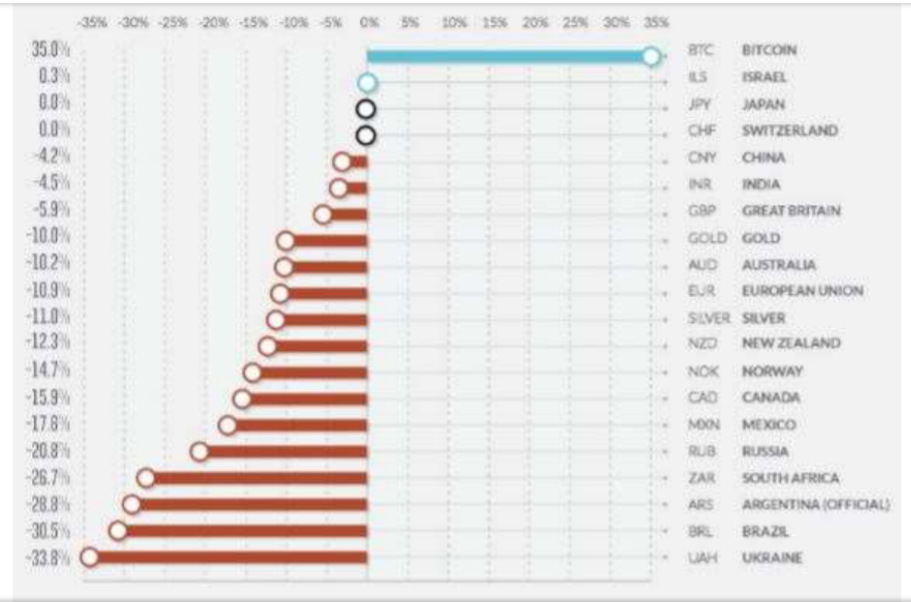
South America has seen a huge increase in bitcoin transactions, increasing 510% from 2014 to 2015 (Bitcoin: A New Global Economy, 2015). Argentina is a hotbed for increased cryptocurrency usage due to its extremely high inflation rate and high population of unbanked citizens (Magro, 2016). In the past, Argentinians would convert their currency into US dollars to preserve their value. However, Argentina has recently put restrictions on how many US dollars its citizens can convert. As a result, both a black market for purchasing USD at a higher price and increased bitcoin adoption has arisen (Magro, 2016). The demand for Argentinians to keep their currency value has made itself very apparent, and cryptocurrencies are prominent legal vehicles to meet that demand.
6 comments
Dear this is not a EXC articles. But still thank you for sharing
Welcome
very informative article
Tnx
wlc
U too..🙋🙋