 @BOTMON
more from that month
@BOTMON
more from that month
Trump Crypto Empire: The Truth About USD1 and $WLFI The emergence of the Trump family in the cryptocurrency arena has captured global attention, blending politics, high finance, and cutting-edge digital assets in an unprecedented way. In 2025, World Liberty Financial (WLF), a firm closely affiliated with the Trumps, launched **USD1**, a U.S. dollar-backed stablecoin, followed by the debut of the **$WLFI governance token** on the Nasdaq stock exchange. These launches positioned the Trump family not just as investors, but as central figures shaping the landscape of digital finance, challenging traditional notions of currency, corporate governance, and market influence. The move sparked immediate media coverage, investor enthusiasm, and controversy, reflecting both the potential and risks inherent in politically connected crypto ventures. At the heart of this story lies the interplay between innovation and scrutiny. While USD1 offered institutional-grade security by being backed with U.S. Treasury securities, $WLFI promised governance rights and financial stakes that drew both retail and institutional investors. However, the concentration of token ownership, market volatility, and ethical questions surrounding conflicts of interest have fueled debates over fairness, transparency, and the regulatory oversight of digital assets linked to prominent political figures. This blog delves into the launch, reception, and implications of $WLFI and USD1, examining the roles of top investors, mass extraction patterns, and the broader ethical and legal considerations shaping the Trump family’s crypto empire.
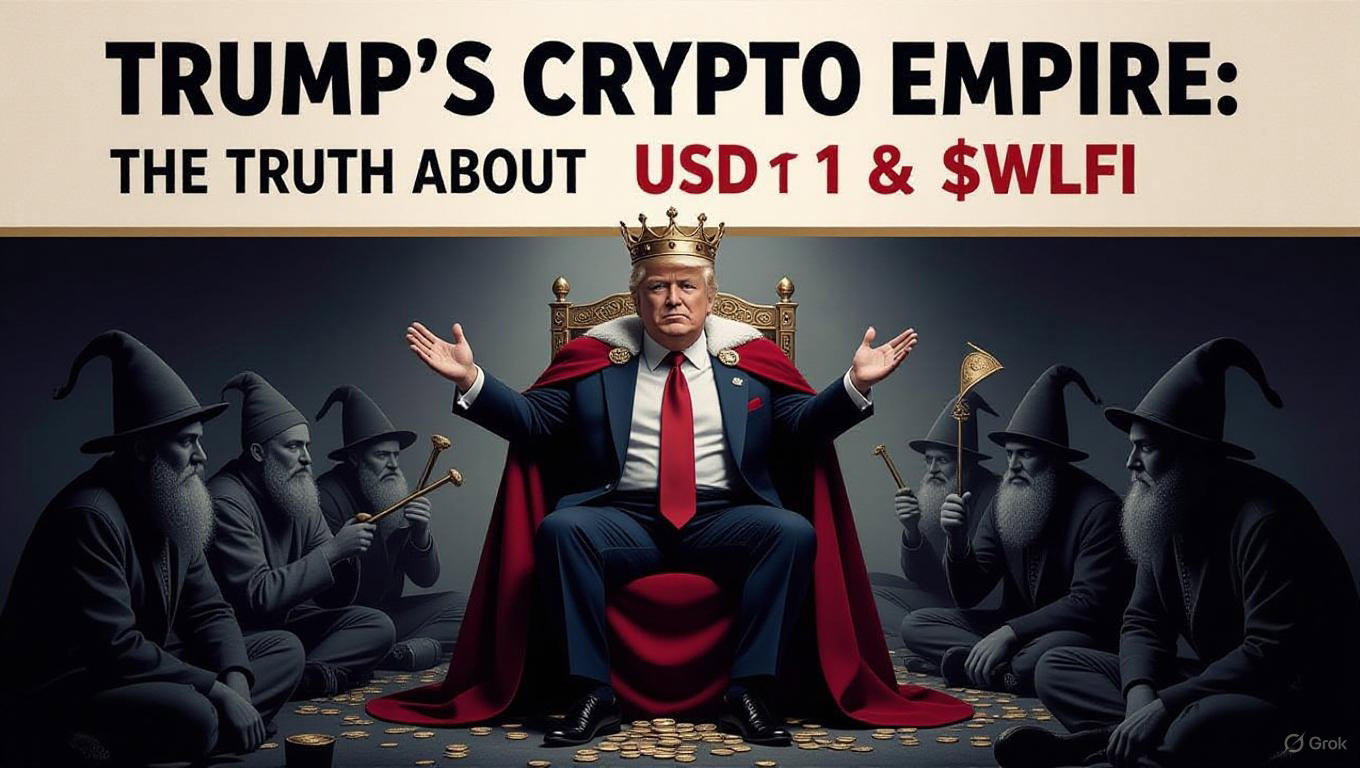
The Launch of $WLFI Token In **August 2025**, World Liberty Financial (WLF) made headlines with the launch of its **$WLFI governance token** on the **Nasdaq stock exchange**, marking a milestone in the intersection of cryptocurrency and traditional finance. Unlike most crypto tokens, which trade exclusively on blockchain-based exchanges, $WLFI’s debut on a major stock exchange signaled a push toward **mainstream legitimacy**, bridging the gap between digital assets and institutional investors. Market Reception and Valuation The token’s debut was met with **significant market enthusiasm**. Investors were drawn to the combination of the Trump family’s high-profile branding and the promise of governance participation in WLF’s expanding ecosystem. At the peak of trading activity, the value of the Trump family’s holdings in $WLFI briefly reached **$6 billion**, underscoring the enormous financial stakes involved. However, the excitement was tempered by **immediate volatility**. Within days, $WLFI experienced sharp fluctuations in price, reflecting several factors common to newly listed crypto assets: **Speculative Trading** – Many early investors were motivated by the potential for rapid short-term gains rather than the long-term utility of the token. **Liquidity Constraints** – Despite Nasdaq listing, $WLFI faced liquidity limitations in certain trading pairs, amplifying price swings. **Regulatory Uncertainty** – Investors reacted cautiously to the evolving U.S. regulatory environment for cryptocurrencies, particularly tokens tied to politically connected figures. This volatility highlights a key tension in the cryptocurrency market: the balance between **high reward potential** and **substantial investment risk**. Top Investors and Mass Extraction While the Trump family maintained majority control of World Liberty Financial (WLF) and its tokens, **several high-profile institutional and private investors** quickly positioned themselves as key stakeholders in USD1 and $WLFI. These investors provided critical liquidity at launch, helping drive the initial market capitalization and facilitating broad adoption across crypto exchanges. Key Investors **Abu Dhabi Investment Group** – One of the earliest and largest institutional backers, this firm invested **$2 billion using USD1** stablecoins. Their participation underscored USD1’s credibility as a globally accepted fiat-backed asset. **Silicon Valley Crypto Ventures** – A venture capital consortium specializing in blockchain startups, they acquired a substantial portion of $WLFI tokens during the initial offering, betting on the Trump brand and governance rights. **Family Offices and High Net-Worth Individuals** – Several prominent family offices from Europe and North America joined the token sale, attracted by governance privileges and the potential for significant capital appreciation. These investors were often **given priority access** to token allocations before retail investors, reflecting the strategic advantage of institutional partnerships in shaping a token’s initial valuation.
Mass Extraction Dynamics The launch of $WLFI and USD1 also brought attention to **mass extraction patterns**, a phenomenon common in tokenized ecosystems where early investors capitalize on market hype. In this case: Early whale investors, including some affiliated with WLF, were able to **profit from initial price surges**, selling portions of their holdings at peak valuations. The Trump family itself, while restricted by **lock-up periods** for $WLFI tokens, strategically released certain allocations to capitalize on high-demand windows, increasing their liquidity without destabilizing the market. Retail investors, drawn by media coverage and the Trump brand, often bought in during price spikes, sometimes resulting in **short-term losses** as the market corrected. Mass extraction in this context highlights a **critical tension**: while WLF created an innovative financial product, early movers—particularly insiders—had disproportionate access to profits compared to general investors. This has led to scrutiny from regulators and calls for greater transparency in token issuance and distribution practices. Implications for Governance and Market Trust The concentration of $WLFI tokens and USD1 stablecoins among top investors presents both **opportunities and risks**: **Opportunities:** Institutional backing provides credibility, liquidity, and potential for long-term ecosystem growth. **Risks:** High concentration of tokens can amplify market volatility, create perceived unfairness, and expose the ecosystem to accusations of insider advantage. For WLF, managing these dynamics is essential to maintaining **investor confidence** and ensuring sustainable adoption of USD1 and $WLFI in both retail and institutional markets. Ethical and Legal Considerations The Trump family’s prominent involvement in **World Liberty Financial (WLF)** and its associated tokens—USD1 and $WLFI—has raised significant **ethical and legal questions**. These concerns are multifaceted, encompassing potential conflicts of interest, regulatory compliance, and broader implications for financial markets. Conflicts of Interest One of the central ethical concerns is the potential for **conflicts of interest**. As high-profile political figures and business owners, the Trump family occupies a position where private business interests and public influence could intersect. Critics argue that this could lead to: **Policy Favoritism:** The family’s engagement in digital assets might influence regulations or enforcement policies in ways that benefit WLF, potentially disadvantaging competitors. **Insider Advantage:** Access to privileged information, particularly regarding regulatory developments or international investment flows, could create uneven playing fields for other market participants. **Brand Leverage:** The Trump name itself carries political and public weight, which may sway investor sentiment and artificially inflate token value, raising questions about fairness in market dynamics. Market Manipulation Concerns The rapid rise in $WLFI and USD1 value has intensified **concerns about market manipulation**. Some analysts and regulators have pointed to: **Price Volatility:** The token’s initial surge in valuation, followed by sharp corrections, mirrors patterns often seen in crypto markets influenced by a small number of high-stake holders. **Concentration of Holdings:** A significant portion of $WLFI is controlled by the Trump family and a small cohort of early investors, which amplifies their ability to impact prices through coordinated sales or strategic market moves. **Media Influence:** Public statements by the Trump family and associated media coverage have the potential to sway retail investor behavior, intentionally or unintentionally affecting market outcomes. These factors underscore the **delicate balance between promotion and market manipulation**, particularly when politically connected individuals are involved. Regulatory Scrutiny The Trump family’s ventures have attracted **increased regulatory attention**, both domestically and internationally: **U.S. Securities and Exchange Commission (SEC):** There is concern that $WLFI may fall under securities regulation, given its sale to retail investors and governance functionality. Compliance with disclosure requirements, anti-fraud regulations, and reporting obligations is critical. **International Oversight:** USD1’s adoption by global investors, such as Abu Dhabi-based firms, has raised questions about cross-border financial compliance, including anti-money laundering (AML) and know-your-customer (KYC) protocols. **Tax and Reporting:** The significant revenues generated by WLF, including token sales, are subject to taxation and financial reporting, increasing legal exposure if reporting standards are not rigorously followed. Broader Ethical Implications Beyond legal compliance, there are **broader ethical implications** tied to wealth concentration and public perception: **Concentration of Wealth:** The Trump family’s large holdings in $WLFI highlight the potential for extreme wealth accumulation within a single family or entity in emerging digital markets. **Investor Vulnerability:** Retail investors, drawn by media coverage and the Trump brand, may be more exposed to financial risk, raising questions about investor protection and responsibility. **Political Influence:** Given the Trump family’s political prominence, the intertwining of public profile and private financial gain raises questions about transparency, governance, and public trust.
Conclusion The launch of USD1 and the $WLFI token represents a significant development in the intersection of politics and cryptocurrency. While the Trump family's ventures have introduced innovative financial products, they have also raised important questions about transparency, governance, and the influence of private interests on public policy. As the cryptocurrency landscape continues to evolve, the legacy of World Liberty Financial will likely serve as a case study in the complexities of digital finance and political engagement.
No comments yet