 @BOMBERuss
more from that month
@BOMBERuss
more from that month
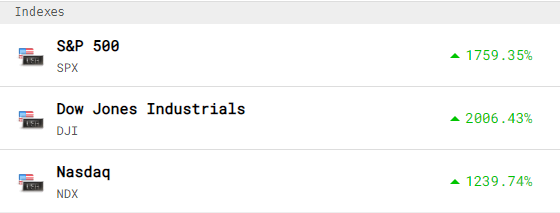
🔥The return on investment in #bitcoin surpassed the indices by 1645%🔥 The growth of bitcoin in recent years has been characterized by a high return on investment (ROI), which over the same period has eclipsed the main stock market indices. Compared to the S&P 500, Dow Jones Industrials and #Nasdaq indices, bitcoin has recorded an average return on investment of 1645% over the past five years, this is the data of the Bitcoin #ROI tool from Finbold. The yield of the digital currency exceeds the yield of the Dow Jones index by 1978%. The profitability of the asset is also 17.4% higher than that of the S&P 500 index, which tracks the dynamics of the shares of the 500 largest US companies. As for Nasdaq, the return on investment of bitcoin surpassed it by 1221%. The Bitcoin ROI tool allows you to compare the return on investment (ROI) of #BTC with traditional assets in percentage terms, emphasizing how much investments in cryptocurrency outperform other financial assets over a certain period of time. The high profitability of bitcoin partially confirms the idea that cryptocurrencies are an ideal means to make high profits in a short period, given that the aforementioned traditional indices have been around for several decades. Over the past five years, both asset classes have undergone huge ups and downs, but bitcoin has managed to stand out from the rest with its growth, which is mainly associated with the entry of institutional investors into the crypto space. The growth trajectory of traditional assets was interrupted by the beginning of the pandemic, which led to a large-scale collapse of the stock market. At the same time, bitcoin suffered from regulatory uncertainty, which resulted in the historic collapse of the digital asset along with the entire cryptocurrency market. Since the beginning of 2021, bitcoin has shown several bull runs in combination with record high prices. At the time of publication, the asset was trading at $ 42,080, which means an increase of more than 3,000% over the past five years. And although bitcoin is increasingly correlated with the traditional financial sector, the main cryptocurrency and indices represent two different asset classes. For example, indexes track commercial companies that manage tangible products and services, while bitcoin is a virtual currency. In the coming years, it will be interesting to monitor how bitcoin behaves in comparison with traditional exchange products, since these two asset classes are increasingly showing correlation. It is also worth highlighting the correlation of bitcoin with shares of US technology companies, which are tracked by the Nasdaq index. The observed correlation makes it possible to perceive bitcoin as a reliable asset-a refuge from rising inflation. The correlation of assets is also increasing along with the tightening of the yield curve of US government bonds in conditions of high inflation. On the other hand, the growing volatility and correlation with traditional assets can reduce the high profitability of bitcoin. It is worth noting that over the past few months, volatility has affected both bitcoin and traditional assets equally. In addition, the digital currency is becoming an option for diversification, as bitcoin supporters expect full integration of the asset into the traditional financial space. Despite the volatility, bitcoin is currently becoming a reliable option for conservative investors, and traditional financial players, such as banks, already offer services with BTC.
No comments yet