 @Alther
more from that month
@Alther
more from that month
The discovery of the world of non-USD Stabecoin: Who is worth watching? In the huge Crypto world, Stabecrim dominates a large name: US dollars. We know USDT, USDC and even DAI, most of which are supported by dollars. But the interesting question is whether Stabelin always has to rely on the USD? And, if not, the non-USD stabechoin players who deserve our attention?
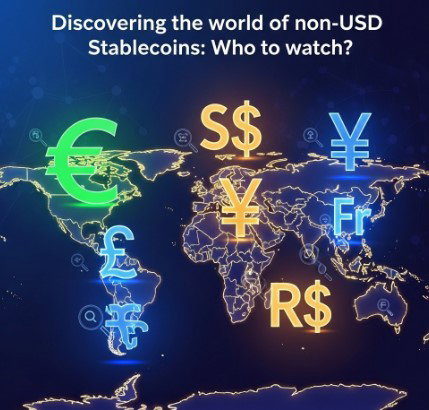
Nowadays, the answer to that question is starting to take size. Many countries and companies are starting launching StableCoins based on local currencies, no longer USD. The goal is simple: reduce the dependence on dollar, strengthen domestic financial systems, pave the way for more economical and locally relevant digital transactions. Let's take a look at some major players. **Euroc-Europe's rapidly growing baby** The Euroc is issued by the circle, the same company that issues USDC. Difference of? The Euroc is fully supported by the Euro and operates on many major blockchain such as atherium, avalanche and solana. Support from major exchanges such as coinbase and integration with DEFI applications such as AAV and Curve make Euroc the most ready and liquid euro stabelin in the world today. It is like the "European version of USDC", with all transparency and regulatory characteristics we expect. **XSGD - Gaurav of Southeast Asia** In Southeast Asia, XSGD is, a Singapore dollar-supported stabecon that is already used for everything from business transactions and grabpe integration to cross transfers. Straitsx, its issuer, work closely with the regulators of Singapore and even provide a direct bridge between the local purse (eg coinhco) and the Defy World. XSGD is also available on uniswap and various international liquidity pools. Of course, XSGD is a successful example of a local stabechoin that is actually being used in real life. **JPYC - In love with web 3, but still needs validity** Japan has JPYC-a Japanese yen-supported stabechoin. Specifically, JPYC is widely used in NFT ecosystem and Japanese Digital Manga community. Many Japanese web 3 startups have made JPYC the primary medium of exchange on their platforms. However, JPYC is still in the "Pre-Regulation" phase, which means that it is not fully recognized as an official stabelcoin. But in terms of innovation and community engagement, JPYC is quite impressive. **GBPT - Pound from Isle of Man** The poundage can be well known yet, but has a strong foundation. Released from the Isle of Man, GBPT has 100% reserves and has passed local regulatory tests. It is already active on Uniswap and Sushiswap, and is starting to be used by UK businesses, which are still comfortable with pound sterling while trying to pay crypto. **BRZ - Winner of Latin America** Brazil has a BRZ, a stabechoin based on the actual Brazilian. Thanks to the unstable local economy, Brazilians are very open to stabechoin - and BRZ has emerged as a local answer to that need. The BRZ is already used for regional remittances (eg, from Brazil to Argentina), and has also been included on uniswap, and has been adopted by local exchanges such as Mercado bitcoins. In this region, BRZ ruins supreme. **xchf - calm but stable Swiss franc** Switzerland has XCHF, a Swiss Frank-based Stabelcoin that cannot be widely discussed, but it provides an important objective: real estate tokrification and property financing. Because Swiss Frank is known for its stability, XCHF is a favorite option for long -term and conservative projects. So, it could be said that the world doesn't need to rely on the ~~dollar~~ itself, because we live in an era where global finance is also beginning to recognize the importance of monetary diversification in the digital realm. Non-USD crypto stablecoins are a tangible expression of the rise of monetary sovereignty worldwide. Euroc proves that Europe can compete. XSGD indicates that Southeast Asia still does not stand. BRZ confirms local needs in Latin America. Meanwhile, JPYC, GBPT, and XCHF shows it how stablecoins can be adapted to local references - from culture and rules to social behavior. Of course, challenges remain. The liquidity of some stabelin is still below the USDT/USDC. Many have not yet been widely integrated into DEFI. And some still require strong legal recognition. But the trend is clear: the world is preparing its own stabelin. If you are active in the web3, a Defi developer, a border-cross business, or simply a fintech enthusiast-now non-USD stabelin is the time to accept stabelin as a strategic option, not just a "small experiment". Because the digital world of the future will not be given a monopoly by the same currency.
No comments yet